
From END Info 46 | March 2026 | Download
Tom Unterrainer
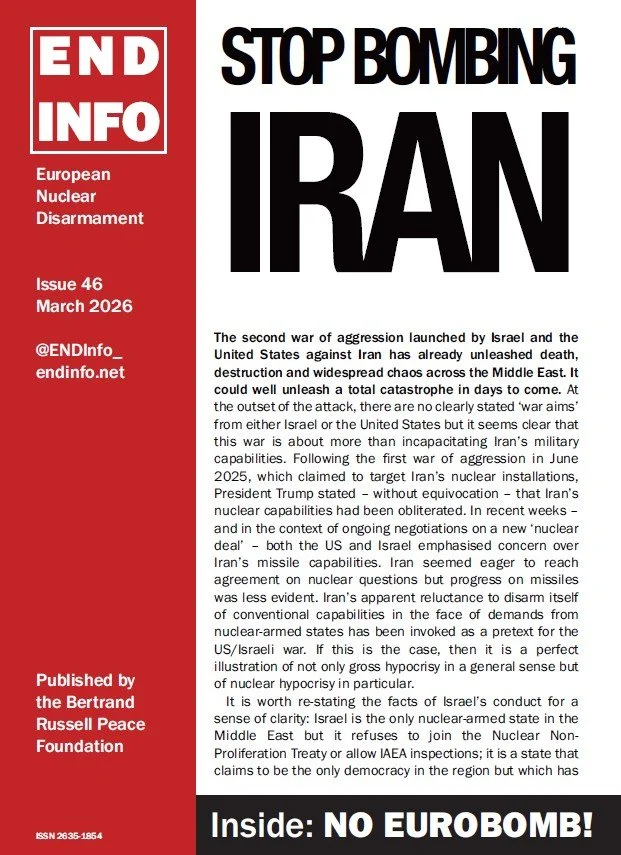
The second war of aggression launched by Israel and the United States against Iran has already unleashed death, destruction and widespread chaos across the Middle East. It could well unleash a total catastrophe in days to come. At the outset of the attack, there were no clearly stated ‘war aims’ from either Israel or the United States but it seems clear that this war is about more than incapacitating Iran’s military capabilities. Following the first war of aggression in June 2025, which claimed to target Iran’s nuclear installations, President Trump stated – without equivocation – that Iran’s nuclear capabilities had been obliterated. In recent weeks – and in the context of ongoing negotiations on a new ‘nuclear deal’ – both the US and Israel emphasised concern over Iran’s missile capabilities. Iran seemed eager to reach agreement on nuclear questions but progress on missiles was less evident. Iran’s apparent reluctance to disarm itself of conventional capabilities in the face of demands from nuclear-armed states has been invoked as a pretext for the US/Israeli war. If this is the case, then it is a perfect illustration of not only gross hypocrisy in a general sense but of nuclear hypocrisy in particular.
It is worth re-stating the facts of Israel’s conduct for a sense of clarity: Israel is the only nuclear-armed state in the Middle East but it refuses to join the Nuclear Non-Proliferation Treaty or allow IAEA inspections; it is a state that claims to be the only democracy in the region but which has been accused of practising “apartheid” by Amnesty International and others; it is a state that has been found in contravention of international law after international law with respect to its occupation of Palestine and treatment of the Palestinian people; it is a state that has prosecuted a wicked and deliberate genocide against the Palestinian people, most clearly in Gaza but in the West Bank also; it is a state who’s Prime Minister is a fugitive from justice: there is an international arrest warrant out on Benjamin Netanyahu, issued by the International Criminal Court.
Israel, like other nuclear-armed states, will claim that its nuclear weapons are a “deterrent”. In fact, Israel – like other nuclear-armed states – uses its weapons to compel other states. Its weapons and alliances with other nuclear-armed states has allowed it to perpetrate massacre after massacre, invasion after invasion, atrocity after atrocity. If Israel did not have nuclear weapons then it would have been compelled to stop its genocide on Palestine.
What of the United States and the second Trump Presidency in particular? Here is a state with the largest, most powerful and apocalyptically deadly military capability ever assembled in the history of humanity. For what purpose is all this power put to use? Most clearly, as in the case of events in Iran, it is deployed in the service of slaughter and destruction with no clearly stated purpose. It is almost as if Trump has ‘gone to war’ simply because ‘it was possible’ to do so. And not only ‘go to war’ but to do so in contravention of an international system of law crafted and ‘normalised’, in large part, in an era of American economic and political dominance in the Western Hemisphere and then more widely after the fall of the Soviet Union. Global tectonic shifts in power are taking place and this reality has undermined American dominance. In the face of such a reality, the United States is undertaking wild, reckless and potentially fatal actions to re-write the ‘rules of the game’ to its own advantage. Treaties are put on the bonfire, conventions are ignored and ‘international law’ is undermined. Hypocrisy after hypocrisy joins the US-inspired parade of death.
The absence of initial, clearly-stated aims has been resolved to a degree. On the afternoon of Friday 6 March Donald Trump took to his social media platforms to demand Iran’s “unconditional surrender”. This demand comes after a full week of savage attacks on Iranian towns and cities and after the illegality of the initial aggression was compounded by the sinking of an Iranian vessel in international waters, the assassination of Iran’s ‘Supreme Leader’ and various atrocities and killings of civilians. Ongoing Iranian ‘defensive measures’ and ‘lashings out’ – some of which were very poorly judged, particularly attacks on states that have, in the recent past, acted as mediators to Iran’s benefit –have turned the US/Israeli war of aggression into regional conflict. This regional conflict has been intensified by Israel’s building assault on Lebanon, with intensive attacks on Beirut.
Trump’s demand for an “unconditional surrender” looks more like preparing an excuse in advance for a deepening and intensification of barbarism than a rational attempt to end the crisis. Iran is not Iraq, where a ground invasion was staged to effect “unconditional surrender”. Iran is not Syria, which was wracked by a prolonged civil war. Iran is a nation of some 90 million people with a long, long history and distinct and particular recent formation. “Unconditional surrender” seems unlikely.
This combination of factors – military belligerence, ‘lawlessness’, reckless action and high stakes – makes for a tinderbox situation. Adding to the mix the fact of Israel’s nuclear-armed status and the presence of nuclear reactors and facilities in the region compounds the stark risks.
Others in NATO should follow the lead of Spanish Prime Minister Pedro Sánchez to demand an end to the war. The relative caution shown by certain US allies – British Prime Minister, Keir Starmer included – should be noted. Maximum political pressure should be exerted to turn caution into direct calls for an end to the war.
Oil
Iran is, of course, a significant oil producing nation with relatively low production costs. A member of OPEC, Iran has abided by restraints on its level of oil production. Yet it remains OPEC’s third largest oil producer, amounting to approximately 4.5% of global oil supplies. Where does this oil go? By 2025, Iran was sending 80% of its oil exports to China. One early target of US bombing was in Kharg Island, where 90% of Iran’s oil exports are processed. Any disruption to or cessation of this oil supply will force China to look elsewhere and it is in a relatively strong position to do so.
The extent to which Iran’s supply of oil to China informed Trump’s strategy is open to question. What is not open to question is the fact that the Trump administration’s foreign policy objectives and priorities identify China as the most significant competitor to the US in the context of the tectonic shifts in world power.
In response to the attacks on Iranian oil facilities, Iran has itself attacked oil installations in the region. Additionally, oil transit through the Straits of Hormuz has been disrupted.
As a consequence of Israeli/US actions, global crude oil prices have surged by over 43%. This surge will have considerable knock-on effects on prices across the board. It is worth noting that the United States is a net exporter of oil.
Unpredictability
It is impossible to predict what will come next. Trump could decide to cease bombing tomorrow. It could be in six months. What is clear is that this is a time of great unpredictability and, as such, significant instability. Each and every new outrage brings more death, further destruction and even sharper risks. UN Secretary General, António Guterres, is right when he repeats the claims of the UN Charter: “there is no viable alternative to the peaceful settlement of international disputes.” The alternatives to such an approach are being demonstrated all-too-clearly in Iran.
Our friends at Pugwash are right to warn against the “normalization of war as an instrument of policy.” In Iran, we see what it means for the abnormal and unacceptable to be put into practice.
Britain’s Trade Union Congress is correct to state that in “these perilous times, the path to peace lies in strengthening diplomacy and safeguarding human rights.” In Iran, we see what happens when diplomacy and rights are discarded in favour of raw, destructive power.
The Spanish Prime Minister is absolutely right to state that “to be naive is thinking that the solution is violence. To be naive is believing that democracies or respect between nations arise from ruins. Or thinking that blind and servile followership is a form of leadership.” This is why those who know better than their actions demonstrate should join Sanchez with clear statements and clear actions.
Bertrand Russell was right in 1916 and his words still ring true when he warned that: “neither side can hope for the absolute and crushing victory ... except at a cost which cannot be seriously contemplated. Sooner or later, negotiation will have to end the war.”
Sooner or later, negotiation will have to end this war because the alternative to this involves options of truly catastrophic proportions. Nuclear weapons are used every day to compel, to threaten and to terrify opponents into submission. When questions of the continuing existence of states and state systems come in to play and when nuclear-armed states are in the mix, the function of nuclear weapons can change: rapidly and dangerously so.
The United States and Israel must stop bombing Iran before the ‘unthinkable’ and ‘impossible’ seem like rational choices for those with nowhere else to turn.