

Tom Unterrainer
From ENDInfo 45 DOWNLOAD HERE
Text of a contribution to London Region CND’s annual conference, January 2026.
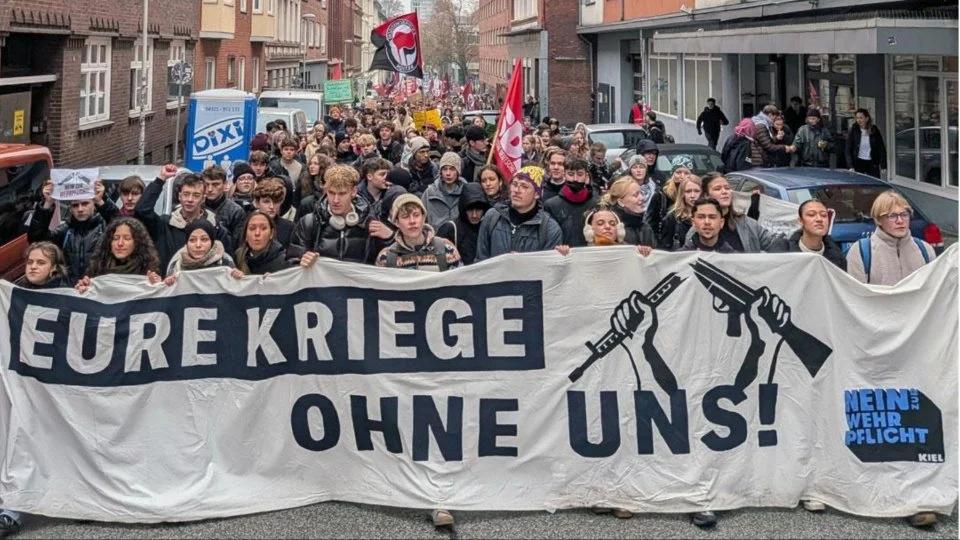
In December last year [2025], tens of thousands – some estimates indicate as many as 55,000 – of German school students staged a nationwide “strike”. Across 90 towns and cities, these young people participated in mass protest actions against government proposals to vary Germany’s much-modified and historically contentious conscription laws. In 2011, conscription was but into abeyance: although the government retained the power to reintroduce it. In late 2025, the German government passed legislation to introduce a questionnaire to be completed by all 18-year-old men – not women: they are excluded from conscription by basic federal law. The questionnaire is designed to determine a ‘willingness’ to be conscripted or to put it more plainly: to kill and be killed. The 55,000 on the streets and very many more gave their answer.
Why open a short discussion of European rearmament with this example? Because something as mundane as issuing a questionnaire and the explicit response to it helps to clarify the nature of some of the moving parts in the maelstrom of noise, deception and confusion swirling around the rearmament issue.
For instance: why is Germany edging towards conscripting 18 year olds when any war they might be sent to die in will be dominated – at best – by high-tech, hyper-sophisticated, already battle-tested death machines or – at worst – the prospect of nuclear war and universal destruction? To what use will a relative handful of inexperienced and untrained near-children be put in a war waged with drones, AI weaponry, missiles and the rest other than as potential victims for drones, AI weaponry, missiles and the rest? What – if not the normalisation of a drive to war and the prospect of war itself – is the purpose this move? What, if not a clumsy attempt to garner societal consent for a drive to war, is the purpose?
The basic fact of the matter is that European rearmament and the remilitarisation of society is about more than dollars, pounds and euros. Money and finance is political, of course, but there is a lot more to political power than money alone. Coercion and consent walk hand-in-hand, which is why the tens of thousands of protesters in Germany and a growing number across Europe are of such importance. They – we – do not consent and we will not be easily coerced.
Yet this war fever is real and the instruments of political power fuelling European rearmament are very real indeed. Take, for instance, the remarkable decision by the European Union institutions to issue 150 billion euros in loans to finance war readiness. Originally named ‘Rearm Europe’ and re-christened Security Action For Europe – SAFE … you see what they did there? – this 150 billion is to be found using a mechanism originally proposed and designed at the close of the 1980s for the purpose of eliminating unemployment, funding social needs and improving life in general across the European Union. At the time, this proposal was roundly – and tragically, in my opinion – rejected by the main powers in the EU. Now the mechanism has been revived, not for the purpose of social good but to facilitate death and destruction.
EU states have been told – as we have been told in the UK – that all the additional arms spending, all this preparation for war, will produce dividends across the economy. It is true – as multiple research studies have indicated – that the ‘multiplier effect’ of military spending – that is, the society-wide economic benefits of spending – is much lower than for spending in other sections of the economy. Which is why the mechanism employed for SAFE is, from this point of view, remarkable.
However, if we assume that they are not sincere about society-wide dividends for military spending and dig a little deeper, we get another – telling – dimension to our story. Take, for instance, Professor Elke Schwarz’s recent research on the role of venture capital in the context of the UK’s National Security Strategy and Strategic Defence Review. Schwarz points out that historically, venture capital was not a major factor in the defence sector. She characterises venture capital as being focussed not on a:
“specific technology, but growth in valuations. And the higher the valuation, the larger the capital gains on the investor’s equity stakes at the point of exit. To be very clear, the business aim for VC companies is not necessarily to invest in a robust British technology innovation base, but rather in the growth potential of the companies that are enrolled into the defence industry environment.”
Schwarz then points out the significant lobbying, political influence and structural tactics of venture capital, that are deployed to secure their interests. Venture capital is now deeply interested in the UK the and European-wide arms industry. The bedrock of venture capital is based in the United States. What we are seeing is a massive state-backed, deliberate and coordinated facilitation of US venture capital in the arms industry: an industry that is increasing high-tech, AI driven and increasingly destructive.
Which brings us back to the brutal politics of the matter. For all the talk of the US as an unreliable ally in the ‘defence of Europe’. For all the question marks raised over NATO. For all the fire and fury from the White House, the reality is that: the US nuclear presence in Europe is expanding, not contracting; US firms are circling European rearmament looking for massive profits; European states – whatever the views of various fractions – are committed to mass rearmament and war-fighting preparedness; in so doing they are engaged in massive state assistance for US venture capital; that far from ensuring the defence or security of Europe, Europe is being offered for plunder and put at more risk. All of which – and much more – points us in one direction: the need to build clear, consistent and honest opposition to European rearmament and the need to redouble our efforts at pointing towards a concept of common security.