Flashpoint Briefing: Kaliningrad
Tom Unterrainer, END Info 50, November 2026 download pdf
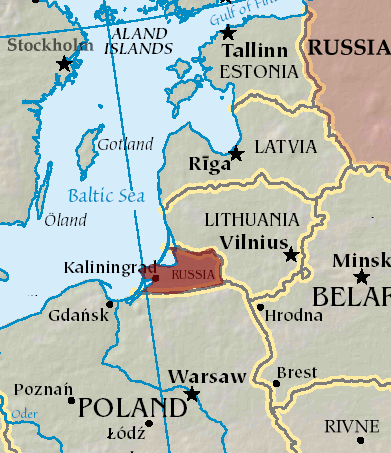
In a diplomatic memo sent on 30 September 2026, Russia warned that it had “information that NATO is preparing an air and naval blockade” of Kaliningrad, the Russian semi-exclave sandwiched between the Baltic Sea, Poland and Lithuania. Russia warned further that it “will be ready to use the entire arsenal of forces and capabilities at its disposal, including nuclear weapons, in order to defend its territory should NATO countries undertake any attempt aimed at isolating the Kaliningrad Region from the rest of the country.” This is not the first time that Russia has issued direct threats of nuclear use in the last few years. END Info 30 (March 2022) carried a series of statements released by the Bertrand Russell Peace Foundation following similar threats in the aftermath of Russia’s invasion of Ukraine. We asked Putin and other leaders of nuclear-armed states to “remember your humanity”, echoing the signal call of Russell-Einstein Manifesto. We further asked: “Who will provide a ladder for Putin to climb down?” (28/02/2022) and: Putin’s “‘deterrence’ flips to ‘escalate to de-escalate’. Where does that end?” (03/03/2022). The call remains unheeded and the questions remain unanswered by those with the power to soften increasingly sharp nuclear risks. In fact, rather than work towards any resolution or de-escalation, offers of negotiation and diplomacy have been ignored. Worse still, European rearmament has accelerated and talk of war is never far from the lips of European NATO leaders.
Kaliningrad
The territory of what is now the Kaliningrad Oblast has, like much of Europe, a long and convoluted history. The city of Königsberg (now Kaliningrad) was famously home to the philosopher Immanuel Kant. He was born in the city, died in the city and reportedly never left it. Yet in old age he had seen enough of the world pass before him to be moved to write a treatise on Perpetual Peace (1795), which Bertrand Russell described as follows:
In this work he advocates a federation of free States, bound together by a covenant forbidding war. Reason, he says, utterly condemns war, which only an international government can prevent ... Since 1933, this treatise has caused Kant to fall into disfavour in his own country. (History of Western Philosophy, 1946)
Kant’s “own country” was, of course, what is now Germany and he wrote in German. These facts indicate some of the tumultuous history involved.
The present status of the territory has its origins in the Potsdam Agreement (1945) between the victorious powers following World War II. The Agreement stated:
CITY OF KOENIGSBERG AND THE ADJACENT AREA
The Conference examined a proposal by the Soviet Government that pending the final determination of territorial questions at the peace settlement, the section of the western frontier of the Union of Soviet Socialist Republics which is adjacent to the Baltic Sea should pass from a point on the eastern shore of the Bay of Danzig to the east, north of Braunsberg-Goldep, to the meeting point of the frontiers of Lithuania, the Polish Republic and East Prussia.
The Conference has agreed in principle to the proposal of the Soviet Government concerning the ultimate transfer to the Soviet Union of the city of Koenigsberg and the area adjacent to it as described above, subject to expert examination of the actual frontier.
U.S. president Harry Truman and British prime minister Clement Attlee supported the proposal of the Conference at the forthcoming peace settlement.
It was not until the Treaty on the Final Settlement with Respect to Germany (1990), commonly known as the ‘Two Plus Four Agreement’ [see page ##], that the matter of borders and territorial control was resolved.
Between 1945 and 1990, Kaliningrad’s status as a semi-exclave of the USSR presented few problems given the border with the Lithuanian Soviet Republic and Poland, a Warsaw Pact member. The collapse of the Soviet Union and dissolution of the Warsaw Pact complicated Kaliningrad’s status. Further complications came with NATO expansion eastwards, in contravention of assurances otherwise. Both Poland and Lithuania eventually joined NATO, the former in 1999 and the latter in 2004. Russia’s invasion of Ukraine and the consequent sanctions have had a significant impact on Kaliningrad, with Lithuania now blocking road and rail transit of key supplies including fuel, construction materials and some technologies. As such, there has been a 50% reduction of land transit of goods and Kaliningrad has become more dependent on shipping for basic supplies, which has put strain on ports and docks.
Military presence
As Kaliningrad is internationally recognised Russian territory, it is hardly surprising that the Russian military is present in the semi-exclave. Its unique geography, clear vulnerabilities and potential strategic location makes a significant military presence even less of a surprise.
Between 1997 and 2010 Kaliningrad was designated as a ‘Special Region’ and ‘Defensive Area’ by the Russian military. This meant that a distinct and dedicated structure and operational posture, where different sections of the military operated under a single command, functioned. In 1999, the forces of the ‘Special Region’ consisted of 850 tanks, more than 500 rocket systems, 93 ships and 6 submarines, 180 aircraft and 25,000 troops. By 2008, two years before the forces were integrated into other parts of the Russian military, it consisted of 30 ships, 3 submarines, multiple missile systems - including ‘defensive’ systems - and two aircraft divisions. By 2010, when Kaliningrad forces were finally integrated, there were 10,500 ground troops stationed across the territory.
Throughout the Cold War, the 1990’s and 2000’s and up to today, the Kaliningrad Oblast has been highly militarised. However, through the 2000’s up to 2014 there was a steady reduction in the deployment of troops and material. The basing of the Baltic Fleet in Kaliningrad has been a constant. Events in Ukraine, including Russia’s annexation of Crimea, along with the interconnected reality of NATO expansion and increased tensions reversed this trend. Now, up to 18,000 troops and nuclear-capable Iskander missile systems are stationed, along with the Russian air forces and the Baltic Fleet.
NATO
NATO’s ‘legacy’ expansion is well-established and well-studied. The more recent expansion of NATO to include Finland and Sweden has again shifted the balance in the Baltic region. Ulrike Franke of the European Council on Foreign Relations welcomed the expansion with the claim that the “Baltic Sea becomes a NATO lake”. Dr Ian Davis of NATO Watch notes that in “May 2026, Lithuania’s foreign minister [Kęstutis Budrys] said that NATO had to show Moscow it was capable of ‘penetrating the small fortress they’ve built in Kaliningrad’ and of razing Russian air defences and missile bases there”.
In June 2026 France, Poland and Lithuania staged a joint-NATO exercise named ‘Gallant Boar’, along the Suwałki Gap along which Poland, Lithuania, Kaliningrad and Belarus share a border. Lithuania’s military described the “key objective” of ‘Gallant Boar’ as improving “capabilities required for the rapid and effective defense of the Suwałki Gap”. Russia interpreted the exercise as a practice run for further isolating Kaliningrad.
On August 18 2026, 25 aircraft from NATO member states undertook an unannounced exercise near Kaliningrad. The ‘DefenceMatters.eu’ website describes the events as a “US-led NATO air exercise close to Russia’s Kaliningrad exclave [which] brought together stealth fighters, surveillance aircraft, tankers and one of the US Air Force’s newest electronic-attack platforms.”
Russia’s 30 September diplomatic memo claimed that “NATO is preparing an air and naval blockade” of Kaliningrad. It certainly looks to be the case that NATO has been practising land and air blockades of Russia’s semi-exclave and with the Baltic Sea re-christened the “NATO lake”, ever escalating tensions - including Lithuania’s steps to remove anti-nuclear clauses from its constitution (see END Info 49) - and little evidence of de-escalatory measures, might Russia have a real cause for concern?
What else has Russia said?
Maria Zakharova, spokeswoman of the Russian Foreign Ministry, was asked about the memo on the evening of 30 September in the following terms:
Is the statement issued by the Russian Embassy in Ireland, which mentioned the possibility of a nuclear strike on NATO countries if they attempt to blockage Kaliningrad, the official position of the Foreign Ministry of Russia? What exactly has provoked this statement in September 2026?
She replied:
The Russophobic hysteria of Western revenge-seeking quarters has come to a head. Several hot heads are consistently pushing Europe towards a potential conflict and preparing it for an escalation of tensions. Ordinary Europeans are being scared with apocalyptic scenarios and “hybrid threats” allegedly coming from Russia.
They have embarked on a path of total militarisation. They are building up their armed forces, and defence spending in the NATO countries that border on Russia have reached an unprecedented level. The bloc is expanding its military infrastructure, rapidly building military enterprises and integrating civil innovations and dual technologies into their defences. Europe has quickly launched drone production facilities. Alliance members hold aggressive military exercises in direct proximity of our borders ...
As President Vladimir Putin has said, our country does not threaten and doesn’t intend to threaten European countries. However, there should be no doubt whatsoever that Russia has the necessary capabilities for preventing any aggression and inflicting defeat on any aggressor. If Europe attacks Russia, it will be a completely different sort of war – a very short war.
A further question was put to Maria Zakharova on 16 October, following the Warsaw Security Forum:
In a recent interview with the Italian newspaper La Repubblica, Chair of the NATO Military Committee Admiral Giuseppe Cavo Dragone said that the North Atlantic Alliance had no plans to blockade Kaliningrad. “I want to be absolutely clear: NATO is not preparing any blockade of Kaliningrad. This is a threat built around a scenario that does not exist,” he emphasised. How would you comment on this?
The reply:
Yes, such a statement was indeed made. Let us assume, difficult as it may be to believe, that the Admiral is being sincere this time. If so, what plans are actually being drawn up? For example, on October 12, at the annual Warsaw Security Forum, one of the central events was a keynote address by NATO Supreme Allied Commander Europe General Alexus Grynkewich, entitled Theory of Victory: How Do We Achieve Military Success Against Russia in Deterrence and Defence?
A senior NATO general chose Warsaw, the capital of a country currently pursuing militarisation at a breakneck pace, to present his proposals, the analytical merits of which we shall leave you to judge. It is worth noting that Poland harbours ambitions to turn its Wojsko Polskie into perhaps the most powerful military in Europe, and specific scenarios for its deployment are already being drawn up.
For instance, the General Staff of the Polish Armed Forces has developed operational plans for launching pre-emptive precision strikes against the Kaliningrad Region, should a “war with Russia become inevitable”. Just consider this: nothing has happened yet, but the Polish hussars are already charging ahead in formation.
Specifically, the plan envisages the destruction of all military infrastructure, primarily Iskander and S-400 missile systems, as well as ammunition depots, fuel terminals and command posts. The operation would involve US-made HIMARS and Polish Homar-K missile systems with a range of up to 300 kilometres, F-16 fighter jets armed with precision-guided missiles with a range of up to 1,000 kilometres, loitering munitions and combat UAVs.
At the same time, Polish coastal anti-ship missile systems and NATO aircraft would be used to impose a naval blockade on the Kaliningrad Region. The aim would be to prevent Baltic Fleet vessels from leaving their bases and to cut off the region’s supply routes. In parallel, a ground offensive in the Suwałki Gap is envisaged, involving the 16th and 18th Mechanised Divisions and the 1st Infantry Division of the Polish Armed Forces.
Is this not essentially Operation Barbarossa 2.0? However, the “strategists” in Warsaw and elsewhere would do well to remember what President of Russia Vladimir Putin and Foreign Minister Sergey Lavrov have repeatedly stated: any treacherous armed attack against the Kaliningrad Region will be met with a literally incinerating response, using every means at Russia’s disposal. The war will be very short.
Neither statement contains a withdrawal of nuclear threats. Each ends with warnings of a “very short” war, should that point ever be reached. Both statements contain factual accounts of European rearmament, NATO exercises and the public airing of plans for an attack on Russian territory.
Flashpoint
NATO asserts that it does not plan to blockade Kaliningrad, yet over the summer months it staged two exercises with a focus on Kaliningrad. Further, NATO acknowledges that Kaliningrad is a key strategic territory and that:
If Russia were to attack a Baltic member state ... NATO plans would naturally involve cutting off and neutralising the Russian assets stationed in Kaliningrad to protect alliance territory
NATO Watch
Further still, open rhetoric and planning from senior NATO figures seems designed to put Russia on notice.
In response to Russian nuclear threats, NATO Secretary-General Mark Rutte remarked: “Putin knows that he can never win against NATO, so I don’t take this that seriously.”
Nuclear threats, provocative activity around Russian territory, reckless rhetoric and full-scale rearmament are very serious matters indeed. If NATO insists on carrying on regardless and with complete disregard for what actually constitutes European security, then the already-acute nuclear risks will continue to sharpen. As we asked in 2023, “where does that end?”
Even without further deliberate escalation, there exists a tremendous risk of precipitous escalation by accident or miscalculation. Any such accident or miscalculation could all-too-easily result in a “very short”, very deadly and most certainly catastrophic war. Where is the “ladder” for NATO and Russia to “climb down”? How can the potential Kaliningrad flashpoint - along with the myriad flashpoints that litter Europe and beyond - be settled?
A serious approach to questions of European security - a new European security architecture - is an essential step. Such arrangements have been outlined in successive appeals for ‘common security’, nuclear-free zones, renewed and sincere diplomatic efforts over decades. More recently, the Russian government has itself made proposals. China has done the same, with an eye to a global settlement.
For this essential step to be realised, a first step must be taken. The leaders of nuclear-armed states must remember their humanity “and forget the rest”. We need serious efforts to make this first step a reality.