

Tom Unterrainer | Tom Unterrainer | From ENDInfo 49, August 2026 | DOWNLOAD PDF
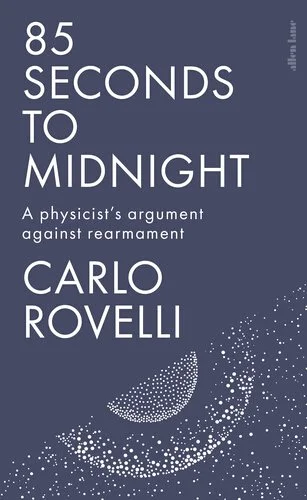
Carlo Rovelli, 85 Seconds to Midnight – A physicist’s argument against rearmament, 2026
Carlo Rovelli’s latest book, 85 Seconds to Midnight, is an urgent, compelling and authoritative warning to humanity in the context of rearmament and sharpening nuclear risks. Echoing the Bulletin of the Atomic Scientists and their ‘Doomsday Clock’, he warns that the “destination point of current policy” is “nuclear war.” This is not a small claim and for those indifferent to or ignorant of nuclear risks, it is controversial. For nuclear disarmers, Rovelli’s intervention is wholly welcome and continues an important tradition: that of scientists taking responsibility and using their platform to warn the world of real dangers ahead.
In a series of short, chronologically ordered, chapters Rovelli charts a history of the nuclear age characterised by “misunderstanding and errors”. This history is punctuated by unexpected and exceptional moments where more “rational” choices point towards alternative policies. Some of the points Rovelli emphasises in his history warrant further exploration and scrutiny but his argument that humanity “has only one real enemy: our own irrationality”, carries great force.
That a good dose of this “irrationality” emerged from eminent representatives of that most rational of disciplines, physics, is important for Rovelli given his status as one of the most eminent practitioners and greatest popularisers of theoretical physics today. 85 Seconds to Midnight stands proudly in the tradition of the Russell-Einstein Manifesto (1955), the work of the Pugwash Movement which grew out of it and a host of other such efforts.
In a letter to Einstein in February 1955, Bertrand Russell – who played a key role in the formation of the Campaign for Nuclear Disarmament and served as its first, and only, President – wrote:
In common with every other thinking person, I am profoundly disquieted by the armaments race in nuclear weapons. You have on various occasions given expression to feelings and opinions with which I am in close agreement. I think that eminent men of science ought to do something dramatic to bring home to the public and Governments the disasters that may occur.
Einstein wrote back five days later:
I agree with every word of you letter … Something must be done in this matter, something that will make an impression on the general public as well as on political leaders.
These two Nobel Laureates – Russell for Literature, Einstein for Physics – corresponded over the following months and agreed the text of the manifesto that bore their name. Einstein’s final letter to Russell, dated 11 April 1955, was also his final public act: he died eight days later at the age of 76. Russell lived for another 15 – very active – years, where, amongst other things, he was imprisoned for his anti-nuclear activities and pioneered opposition to America’s genocidal war in Vietnam. His final public act was in solidarity with the Palestinian people.
Why recount this history in the context of Rovelli’s book? Firstly, because Rovelli touches on it himself in a chapter titled ‘Voices of Reason’. Secondly, because the clear and unequivocal words of the 1955 Manifesto – “All, equally, are in peril … We have to learn to think in a new way …” – are reflected in Rovelli’s own prose. Like many of the greatest physicists – those practitioners of complex thought and masters of complex mathematical systems – Rovelli is a master at asking simple and arresting questions: “Why is this crucial with respect to today’s situation?”, “What if we stopped?”, and my favourite:
Does it seem reasonable to you that humankind, made up of people that are sometimes reasonable, like you, dear reader, and me, accepts such a level of risk?
Likewise, he has the skill and authority to render the complex and unthinkable – the risk of nuclear annihilation and its causes – in a straightforward and horribly thinkable fashion. Moreover, because this short book is more of a Manifesto for 2026 than a detailed analysis Rovelli calls on us to act:
Those who know how to write, please write; those who know how organize, please organize; those who know how to convince, please convince; and those who have to make the decisions, please think about the long term, for the good of all.