
Tom Unterrainer | END Info 48 | Download PDF
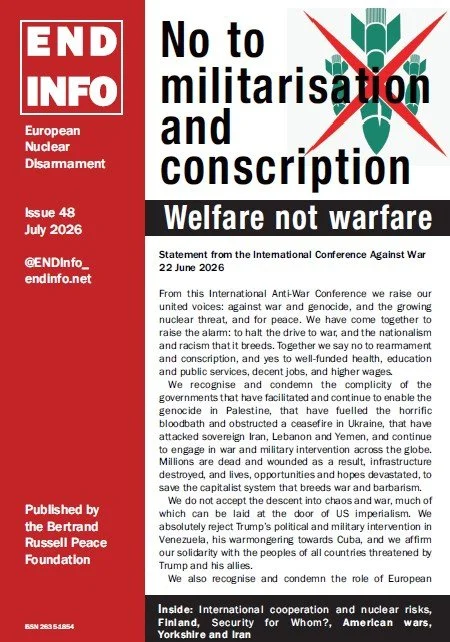
The International Conference Against War, held in London on 20 June 2026, brought together thousands of people (including large delegations from France, Germany, Spain and Italy) in opposition to an escalating drive to rearmament and an increase in war-mongering rhetoric across Europe. The conference was a significant step forward in increasing international cooperation, laying the ground for united action and opening up a space for planning and dialogue. The anti-war and peace movements need many more such opportunities, not least because those coordinating the war-drive are themselves operating across borders and because the risks posed by such a war-drive know no national boundaries.
This is particularly true with respect to ever-sharpening nuclear risks. The risk of nuclear detonation by accident or design is not an incidental or secondary feature: it presents a deadly potential reality that is made more likely by the current drive to war, increased military spending and a more aggressive military posture.
Such a perspective was commonly accepted by peace and anti-war movements in the 1980s. The European Nuclear Disarmament (END) initiative took it very seriously indeed and combined a series of open, lively and participatory conventions with serious attention to nuclear risks, growing militarism and a focussed political demand for a European nuclear-weapon-free zone. Such a zone was never realised, but developments such as the Intermediate-range nuclear Forces Treaty (INF – sabotaged during the first Trump administration) worked to significantly reduce nuclear tensions and risks.
The scope for any such positive development as the INF Treaty looks slim, not least because the dominant military power in the Western alliance – the USA – is set on a project of upending, undermining and destroying the network of treaties, agreements and protocols that comprised the ‘world order’. As we have argued, this is being done in order to assert US interests within the tectonic shifts in global power (see Spokesman 141). Nevertheless, a key lesson from END in the 1980s is that even if success looks difficult or unlikely, the creative impulses unleashed by transnational campaigns can produce positive results.
What sort of rearmament?
Each and every nuclear-armed state is engaged in developing, expanding, and enhancing nuclear capabilities. This is not a very recent development. In fact, the unleashing of this drive to nuclear rearmament can be traced to the time of the first Trump administration.
The reality of this nuclear rearmament has now been joined by a public, unapologetic and rampant conventional rearmament drive across European states.
We are told that such a rearmament drive is essential to ensure ‘European security’. The given context for the drive is an acute threat from Russia, most obviously demonstrated by the invasion of Ukraine. The fact that Russia, after all-too-many years of grinding and murderous onslaught, has failed to overwhelm Ukraine seems not to have had an impact on assessments of the ‘Russian threat’. Meanwhile, Ukraine is now in a position to strike deep into Russian territory: most notably with military drone technology.
One ‘lesson’ of Russia’s war in Ukraine and, more recently, from the US/Israel war of aggression against Iran, is that broadly ‘conventional’ means of war-fighting – ‘tanks and guns’ – are being replaced by new technologies. For example, Britain’s ‘Defence Investment Plan’ (DIP) includes the announcement that the Royal Navy will not now be furnished with replacement frigates. Instead, a ship designed to transport and deploy marine battle drones will take their place. Within the DIP, the largest single budget line is for nuclear weaponry and broadly ‘conventional’ arms are in some instances to be replaced by drones and new technologies (with a large dose of ‘AI’, no doubt).
A combination of outsized nuclear spending and the implied over-reliance on nuclear weapons for ‘security’ [sic], together with new, ‘unconventional’ military technologies risks a dangerous combination. The introduction of such technologies into the business of war makes war-fighting more ‘viable’ and therefore more likely, removes human ‘safeguards’ and ratchets-up possibilities for drastic escalation: the ‘threshold’ for nuclear use is potentially lowered.
This prospect is all-the-more terrifying in the context of increased rhetoric, open talk of war and utterly diminished diplomatic initiatives.
What sort of military alliances?
NATO is, in all fundamental respects, a nuclear alliance. When this fact is noted and when nuclear developments are measured against claims that the alliance is in mortal danger, we see that NATO is in rather better health than some would claim.
Not only has the United States recently replaced nuclear bombs stationed in Europe under ‘sharing’ arrangements with new bombs with enhanced capabilities (‘steerability’ and ‘dialability’ for instance), but the UK will now join ‘sharing’ arrangements. In addition, we know that US nuclear weapons are stationed at RAF Lakenheath under direct USAF command.
Finland, a recent NATO member with an enormous border with Russia, has now ditched anti-nuclear weapons laws (see END Info 47). Lithuania, a longer-standing NATO member which borders Russia, plans to amend its constitution to remove prohibition on nuclear weapons.
France has announced plans to ‘compliment’ existing US/NATO nuclear sharing arrangements with French/NATO nuclear deployments across Europe. Following this announcement, US officials have “signalled openness” to increasing further the number of states with US nuclear bombs.
ICAN’s assessment of nuclear weapons spending in 2025 shows a 22% increase in spending by the US ($69.2 billion), a 17% increase by the UK ($12.6 billion) and an 8% increase by France ($7.7 billion) from the previous year. The UK now outspends Russia and together, the three ‘nuclear powers’ in NATO spent $89.5 billion on such weapons in 2025. In the same year, Russia spent $9.5 billion and China, $13.5 billion.
What sort of war?
NATO leaders claim that the alliance and its member states “must be ready for war with Russia by 2030”. Leave aside whether or not Russia wants war with NATO and ask “what sort of war do they mean”? NATO member states and prominent advocates for rearmament within them are quick to invoke the necessity of war readiness but rarely do they explain what such a war would entail.
Take, for example, a recent article in the Mirror newspaper published from London. The headline proclaims: “Charing Cross tube station becomes fake wartime HQ to prepare for Europe’s fight against Putin” (22 May 2026). The headline suggests that a tube station in central London would be a suitable base from which to command an all-out war with Russia. Too many will have read the headline, thought of the ‘Blitz spirit’ and been thankful that someone was working to ‘protect them’.
Others will have seen the headline and thought, “there’s no way Charing Cross station would survive a nuclear strike!” They’d be right to think so. However, the news management around rearmament and the drive to war avoids directly addressing this fact and reading below the headline, we see that in this ‘war game’, Charing Cross station stood in for NATO operations Estonia.
Some might be relieved to think that NATO is only contemplating war in Estonia, rather than central London. Any such relief would be unwarranted, not only because of the envisaged slaughter of Estonians but because a war between nuclear-armed NATO and nuclear-armed Russia would not be confined to one state and would most likely escalate quickly to nuclear use.
The war being ‘talked up’ and prepared for will be a nuclear war and as such, international cooperation against war will be much-diminished if nuclear reality, nuclear risks and nuclear disarmament are not central considerations.