
From END Info 47 | April 2026 DOWNLOAD PDF
Tom Unterrainer
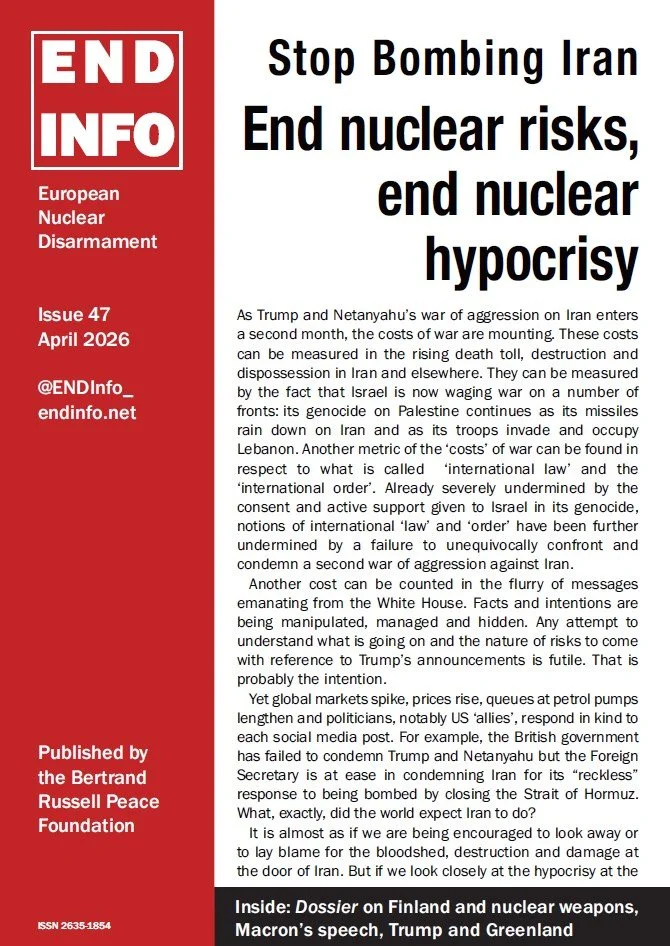
As Trump and Netanyahu’s war of aggression on Iran enters a second month, the costs of war are mounting. These costs can be measured in the rising death toll, destruction and dispossession in Iran and elsewhere. They can be measured by the fact that Israel is now waging war on a number of fronts: its genocide on Palestine continues as its missiles rain down on Iran and as its troops invade and occupy Lebanon. Another metric of the ‘costs’ of war can be found in respect to what is called ‘international law’ and the ‘international order’. Already severely undermined by the consent and active support given to Israel in its genocide, notions of international ‘law’ and ‘order’ have been further undermined by a failure to unequivocally confront and condemn a second war of aggression against Iran.
Another cost can be counted in the flurry of messages emanating from the White House. Facts and intentions are being manipulated, managed and hidden. Any attempt to understand what is going on and the nature of risks to come with reference to Trump’s announcements is futile. That is probably the intention.
Yet global markets spike, prices rise, queues at petrol pumps lengthen and politicians, notably US ‘allies’, respond in kind to each social media post. For example, the British government has failed to condemn Trump and Netanyahu but the Foreign Secretary is at ease in condemning Iran for its “reckless” response to being bombed by closing the Strait of Hormuz. What, exactly, did the world expect Iran to do?
It is almost as if we are being encouraged to look away or to lay blame for the bloodshed, destruction and damage at the door of Iran. But if we look closely at the hypocrisy at the centre of Trump and Netanyahu’s war, the relative quietude of their “allies” and start to examine what has happened and what could happen next, then we see the truly horrific potential of an already dangerous and deathly situation.
It could seem alarmist to emphasise nuclear risks, but it is not. The context for what is happening in Iran and the region is framed by the fact of an ongoing genocide carried out by a nuclear-armed state. The very idea of a live-streamed genocide that the great powers of the world have either consented to, actively supported or done nothing to halt might have seemed far-fetched in the not-too-distant past. It is now a reality and it is compounded by the fact that the belligerent party in the genocide is now waging a war of aggression. The boundaries of what is and is not ‘imaginable’ must therefore shift.
The fact that some commentaries and official statements claim that Trump and Netanyahu’s war of aggression is justified as an attempt to forestall Iran’s unproven aspirations to develop nuclear weapons is another key element. Yes, this is a blatant nuclear hypocrisy in its own right but going along with it legitimises the fact that the US and Israel are themselves nuclear powers. The hypocrisy is compounded by the simple fact that everyone knows that Israel is a nuclear power but refuses to not only acknowledge the fact but also to allow International Atomic Energy Agency (IAEA) inspections or join any of the international treaties relating to nuclear weapons. Is it any wonder that the number of voices suggesting that ‘Iran would never have been attacked if it actually had nuclear weapons’ is growing? This whole narrative and such speculations not only risk further nuclear proliferation but normalise the prospect of the use of nuclear weapons. Where will this end?
Further, the lessons of recent US actions provides a more solid indication of actual US policy than an analysis of Trump’s statements ever could. For example, when the US assembled an enormous naval presence off the coast of Venezuela it was thought that this was simply a show of force. What happened next is a recorded fact. Similarly, as military deployments increased in the region around Iran it was thought that this was an attempt to leverage Iran in negotiations. The fact is that Iran has consistently sought negotiations and despite considerable concessions being made by them, Israel and the US launched a war of aggression.
The point here is to suggest that for all the talk of ‘striking a deal’, when the US deploys forces in very large numbers and indicates intent then the recent record warns us to expect the worst. This makes the deployment of thousands of US marines and airborne troops a meaningful further risk: a risk that they might actually be used inside Iran and a risk that will result from the likely blood-bath.
Further still, the World Health Organisation has spoken openly of being “vigilant” about nuclear threats. Whilst it is part of the WHO’s job to remain “vigilant” it is not usual for their spokespeople to be outspoken. So when Hanan Balkhy, a WHO Regional Director, told Politico that: “The worst-case scenario is a nuclear incident, and that's something that worries us the most” and that “[a]s much as we prepare, there's nothing that can prevent the harm that will come … the region's way — and globally if this eventually happens — and the consequences are going to last for decades”, we should take note.
Lastly, the IAEA has confirmed that the site of the Bushehr nuclear reactor has come under direct attack. No radiation leaks have been reported. However, when the avoidance of an absolute nuclear disaster seems to be more a matter of luck than judgement we are in a very dangerous place indeed.
All of this nuclear hypocrisy must end. The severe nuclear risks must end. The US and Israel must stop bombing Iran.