Comments on China’s GSI in relation to nuclear issues

From END Info 38

Tom Unterrainer

The is an expanded version of a contribution to a recent panel on the GSI Concept Paper organised by the Society for Anglo-Chinese Understanding (SACU). A recording of the panel can be viewed here.

I want to focus on nuclear weapons questions as they relate to the Global Security Initiative but in so doing, it would be wrong to conceive of nuclear risks as entirely separate from the general security issues that the GSI seeks to address. I’d go further and say that eliminating the existential risks posed by the prospect of nuclear use is a central aspect of any coherent approach to security.

Priority 3 of the concept paper addresses nuclear questions and opens with a reaffirmation of the 2022 joint statement of five nuclear-armed states, China included. This statement was, of course, a reaffirmation of a similar statement by Reagan and Gorbachev in the 1980s: “a nuclear war cannot be won and must never be fought”.

Since the January 2022 statement, rather than a reduction in nuclear risks the world is faced with the most acute set of such risks since the opening of the atomic age.

As evidence, we need look no further than the decision of the Atomic Scientists to set the hands of their ‘Doomsday Clock’ to ’90 seconds to Midnight’. This cautionary metaphor – signalling the perils we all face resulting from the combined dangers nuclear war, climate catastrophe and technological threats – has never been as close to ‘Midnight’ as it is now. The Atomic Scientists were clear about the contribution of nuclear threats, arising from the terrible events in Ukraine, to their decision.

It goes without saying that if the proposals contained in China’s GSI were to become the norm through which states and groups of states interacted on the global stage, then we would expect to see a drastic ‘winding back’ of the minute and second hands of the ‘Doomsday Clock’.

But, of course, such proposals as those contained in the GSI are not a ‘new departure’ for China. If you trace the public statements of leading spokespeople from the time of China’s emergence as an atomic and nuclear power in the 1960’s, through to the 1980s – when the concept of ‘Common Security’ was promoted by progressive forces in Europe – through to the wording of the GSI, a certain continuity of thought and concern is overt.

For example, China’s test of an atomic bomb on 16 October 1964 was not accompanied by jubilant, boastful or threatening public statements. Rather, official statements and the communique issued by Premier Chou En-Lai struck a note of regret.

China’s initial statement reported: “The Chinese Government has consistently advocated the complete prohibition and thorough destruction of nuclear weapons. If this had been achieved, China need not have developed nuclear weapons. But our proposal was met with stubborn resistance…” The statement further made clear that: “The Chinese Government hereby solemnly declares that China will never at any time or under any circumstances be the first to use nuclear weapons”, a statement of a ‘No First Use’ policy which remains central to China’s nuclear posture to this day. Worthy of note is the fact that the US and UK, for instance, repudiate a ‘No First Use’ commitment. This statement also proposed:

“That a summit conference of all the countries of the world be convened to discuss the question of the complete prohibition and thorough destruction of nuclear weapons, and that as the first step, the summit conference should reach agreement to the effect that the nuclear powers and those countries which may soon become nuclear powers undertake not to use nuclear weapons, neither to use them against non-nuclear countries and nuclear-free zones nor against each other.”

Chou En-Lai’s communique to world leaders, sent on the 17 October 1964, reiterated this proposal and explained that – to quote – “China’s mastering of nuclear weapons is entirely for defence and for protecting the Chinese people from … nuclear threat.”

It could be argued that Chou En-Lai’s attempt to rationalise China’s attainment of nuclear weapons capability is similar to rationalisations employed by every state that has achieved nuclear weapon capabilities. This argument is not completely false, in my view, but China’s continued arguments for nuclear abolition and proposed mechanisms to achieve this – before and after 1964 – are a matter of record.

It is also a matter of record that China had been repeatedly threatened with nuclear attack, first by Truman in 1950, then by Einsenhower in 1953 and again-and-again throughout the 1950s. The UK National Archives report that the British Government considered issuing the threat of nuclear attack against China in 1961. As the record also shows these nuclear threats came not only from the West, but also from the Soviet Union during the nadir in relations with China.

It is probably true to say that of all the threats issued by nuclear-armed states, more have been issued against China than any other nation.

China has made repeated efforts to advance proposals for and potential roads towards nuclear disarmament, from before and up to 1964, through to the 1982 UN Special Session on Disarmament right through until today. In the intervening six decades, China’s internal development has been staggering and the dynamics of global relations and global power have shifted to a similarly staggering extent.

All of which makes the consistency in approach to nuclear risks worthy of note.

But as interesting and instructive as the historical record is, we live in the here-and-now where nuclear risks are abundant. Priority 3 of the GSI concept paper – together with the general framework proposed in the document – offers a number of straightforward measures that could drastically reduce these risks.

The GSI calls for a strengthened “dialogue and cooperation between nuclear-weapon states to reduce the risks of nuclear war”. Today, in place of such dialogue and cooperation, we have the trading of nuclear threats and an apparent breakdown in dialogue. Ending these threats and commencing proper discussion is vital.

It further calls for safeguarding of the “international nuclear non-proliferation regime based on the” Non-proliferation Treaty. All the main nuclear powers are signed up to the NPT and all of them have work to do to ensure compliance with it.

Importantly, the GSI proposes active “support [for] the efforts of countries in relevant regions to establish nuclear-weapon-free zones”. Such active support would not only mirror mechanisms included in previous approaches to ‘Common Security’ but would activate proper consideration of those countries which have ratified the Treaty on the Prohibition of Nuclear Weapons – 68 of them so far, from Antigua and Barbuda to Vietnam – each of which have established nuclear-weapon-free zones on their territory.

A nuclear war cannot be won and must never be fought. China’s call for a system of “international cooperation on nuclear security” and a “fair, collaborative and mutually beneficial international security system” would be an important step forward. The question remains: how soon can progress be made on this call? This question is pressing, as the following two examples illustrate.

US/NATO Strategy

The United States and the nuclear-armed alliance within which it plays the dominant role (NATO) have a clear orientation to China. This orientation is demonstrated by the record of US involvement in the region that pre-dates Obama’s ‘tilt to Asia’ by some decades.

The immediate features of US strategy can be seen in such things as a series of diplomatic visits to Taiwan, billions of dollars of military ‘aid’ to that same country and repeated bellicose statements from US officials.

These features signal a much deeper and more worrying strategic intent. Why worrying? Because when taken as a whole the increased spending, enhanced military presence and increase talk of China as a ‘systemic threat’ strongly suggest a strategy that leads to war.

The record on NATO’s shifting and developing stance on China largely tracks that of the US. It is notable that the various disruptions to US/NATO functioning evident under the Trump presidency did not fundamentally disrupt this tracking. If anything, NATO more firmly displays ‘Trumpist’ policies now than it did when he was in office. If disaster is to be averted then policies and approaches very much like those contained in the GSI must be adopted.

As global nuclear tensions increase, China - along with all other nuclear-armed states - is increasing its nuclear capabilities. As we have seen China first developed nuclear weapon capabilities in an atmosphere of nuclear threat and as it did so, it expanded existing efforts at nuclear diplomacy. China is not responsible for the current nuclear tensions and is functioning at a time of enhanced rhetoric and military activity directed against it. Yet compare and constrast the coverage of China’s expanding nuclear capabilities to the almost complete lack of coverage given to the deployment of new, enhanced US nuclear capabilities in Europe.

In the place of efforts to strip pacifist clauses from Japan’s constitution; the AUKUS alliance; tens of billions on further militarizing China’s periphery; and repeated accusations the US and NATO must recognise what growing numbers of states in the Global South recognise: security is indivisible.

Belarus

Why did Belarus remove nuclear-weapon-free status from its constitution following a referendum? Why has President Lukashenko made repeated warnings that Russian nuclear weapons could return to Belarus? Why is Russia now set to deploy nuclear weapons in Belarus once again?

As documented in END Info 37 [Editorial comments], these developments did not happen by magic. Nor did they happen because Lukashenko and Putin are singularly unpleasant people. The developents unfolded over a number of years as a direct consequence of repeated threats to move US nuclear bombs into Poland and as a feature of longstanding US strategy in Eurasia. Rather than adopt an approach to ‘security’ in Europe focused on reducing tensions and threats, with a clear understanding that security is indivisible, the US and NATO have developed an approach to ‘security’ in Europe that multiplies risks. Had an approach like that outlined in the GSI been adopted, things would be very different indeed.

Conclusions

China’s Global Security Initiative should be carefully considered and discussed. Even a brief survey of world events indicates the pressing need for a different set of security arrangements from those currently pursued by the US and NATO allies.

Nuclear tensions and nuclear risks are more sharply posed than ever. If humanity is to survive these tensions and risks then new thinking and new approaches are required. The alternative is too horrible to contemplate.

Proffering Chinese Wisdom: China’s Global Security Initiative Paper

From END Info 38

Dr Jenny Clegg

This text was presented as a contribution to a recent panel on the GSI Concept Paper organised by the Society for Anglo-Chinese Understanding (SACU). A recording of the panel is available to view here.

At a critical moment for the world, with the war in Ukraine threatening to spiral out of control, China’s leader, Xi Jinping, took a dramatic step forward with the announcement of the 12-point proposal on the political settlement of the Ukraine crisis [see The Spokesman 154: Eurasia in the World]. Just three days earlier, China released a concept paper on its Global Security Initiative that provided clarification on the rationale behind the 12-point proposal. Almost entirely escaping the superficial attention of the Western media, it sets out to explain the aim of the GSI to seek to ‘eliminate the root cause of wars and improve global security governance’.

There has been much angst-ridden speculation in the West in recent years over China’s emergence as a more powerful global actor. What then does this concept paper tell us about China’s intentions as a world leader? In such uncertain times, what solutions are put forward or is this just another self-serving agenda as with any other power?

Is this China making an opportunistic grab for power as it sees the West’s leadership apparently failing? Is the aim to counter NATO, which last year set out its own Strategic Concept identifying China as a security challenge, subverting the rules-based international order? Or does the document merely regurgitate the usual foreign policy rhetoric – a case of old wine in new bottles as one Western commentator put it?

The GSI: background and principles

The GSI was first introduced at a forum for Asian dialogue in 2022 and is best understood as part of a series of initiatives along with the Global Development Initiative put forward at the UN Summit in 2021 to advance the right to development; and the Global Civilisation Initiative launched in March 2023 just after the GSI concept paper, advocating mutual learning. These three proposals frame Xi Jinping’s aim to bring ‘Chinese wisdom’ to the world negotiating table.

In the wider world, thinking on security has broadened out to cover not just matters of war and peace, but also issues of economic security, climate change, pandemics and human rights. At first sight, China’s document appears as a quick skate over a broad list of concerns citing also numbers of organisations and initiatives mostly associated with China itself. This makes the document look decidedly Sinocentric. However, it needs a deeper dive to understand its holistic approach.

The theme is co-operation: starting with principles offered as a basis for re-centring the UN and increasing its role. These are principles drawn from history.

Surprisingly, the first three elements of China’s concept of common, comprehensive, cooperative, and sustainable security are drawn directly from the original conceptions of the Organisation for Security and Cooperation in Europe (OSCE) which from 1975, in opposition to NATO’s Cold War division and the spiralling nuclear arms race, sought to create a new security order for Europe, inclusive of the USSR.

The OSCE concept of common or indivisible security – the idea that the security of one country should not come at the expense of another – is incorporated here into the GSI vision, and indeed into the 12-point proposal on the Ukraine crisis, as an alternative to the Cold War notion of security through military ‘deterrence’ or bloc confrontation.

Here in the paper is also the Reagan-Gorbachev principle which ended the nuclear arms race in 1985 with the words: a nuclear war cannot be won and must never be fought.

At the same time, China’s conception integrates the five principles of peaceful coexistence – principles of respect for sovereignty and territorial integrity, mutual non-aggression, non-interference, equality, and mutual benefit – which have served as the basis of China’s foreign policy over the decades. Agreed first by Mao and Nehru in 1954, these paved the way for the Bandung Conference in 1955 where African and Asian states, newly emerging from colonial rule and under pressure from the Cold War, sought to protect their independence and avoid war through collective non-alignment.

For China also the UN Charter, as the concept paper states, ‘embodies the deep reflection by the people around the world on the bitter lessons of two world wars’.

Drawing as it does from historical experiences of the wider world, the concept paper is far from Sinocentric.

Meanwhile the fourth element of the concept – ‘sustainable security’ – incorporates China’s long-standing conception of the dialectic between peace and development: peace is essential for development, but development also contributes to resolving conflicts ‘eliminating the breeding ground for insecurity’.

Security as a process

Moving on to the actors, the nation-states, there is another dialectic here between major powers and regional formations.

Clearly good relations between major powers are a necessity for world peace, not least in reducing the risk of nuclear war. The concept paper looks to the major powers to set an example in complying with the UN Charter and, when conflicts occur, their role should be to ’support consultation on an equal footing’, facilitate peace talks, and to ‘encourage conflicting parties to build trust, settle disputes and promote security through dialogue’.

China is often criticised as having a hierarchical world view which privileges big powers; however, it seems quite obvious that major powers have more responsibilities in preserving peace.

At the same time, the paper gives considerable space to enumerating regional contexts each with their own specificities regarding security: ASEAN with its distinctive approach of consensus-building amongst politically diverse members; the Latin America-Caribbean zone of peace; African countries and the need to strengthen their ability to safeguard peace independently; the need for Middle Eastern states to construct a new security framework with the international community taking practical steps towards a two state solution to the Palestinian question; the security of the Pacific Island states in relation to the threat from climate change.

Regions then can be seen to have their own focal points of security cooperation, with major powers respecting their contexts, stepping in with support where necessary to facilitate these processes.

The absence here of any mention of the EU, US or Japan suggests China is looking to the Global South for momentum. Security-building then can be envisaged as a process, not only from the top-down with responsible actions taken by major powers but also from the bottom-up, region by region, bringing regional organisation into the multipolar balance alongside the major powers.

The point here is to grasp the dialectic between the international and the regional. So, for example, in the case of the Saudi-Iran rapprochement, China was able to offer a platform free from outside interference for the final stages of a process begun by regional actors themselves. In the case of Russia and the Ukraine, what major powers can do in terms of nuclear arms control could have a bearing on resolving the dispute.

The Security Agenda

On the contents of cooperation, the paper ranges widely from digital and information security to terrorism; from biosecurity to outer space. By finding complementary points of cooperation, countries can form closer partnerships as the building blocks of a peaceful and secure world order.

The recent Xi- Macron agreement ran to some 50 points; similarly, the Xi-Lula agreement. The ill-judged stance of the US and UK governments to deal with China – to confront, compete and cooperate – only concedes cooperation on climate change, ruling most of the GSI list off-limits.

So to answer the question: ‘does China act to further its own self-interest?’, the answer is yes. But from China’s view, creating a safer world is not about selflessness and generosity: if one’s interest is invested in a deal, one is more likely to keep to it. That is surely what common security is about. The challenge is to find those points of mutual interest to build peaceful cooperation.

Cultural relativism and universalism

China’s approach also looks to eliminate ‘the root causes of conflict’. So, for example the root cause of the Sudan fighting surely lies in desertification and land shortage. For China, NATO expansion lies at the root of the Ukraine crisis. Whilst international law is seen as underpinning the UN system, with morality and justice also taken as fundamental, China’s pragmatic search to get to the bottom of a dispute seeks to break through rebarbative cycles of blame and accusation. For Ukraine, this may be the hardest thing: people understandably want retribution.

From the Western perspective the law is absolute, but for China, how the universal is applied varies from context to context according to local conditions. At the same time, Western law-making is designed to uphold private property and individual rights, while China also lends weight to public property and collective rights. How are such disputes and differences over the law to be resolved? Is China to be cast as rule-breaker? The Global Civilisation Initiative with its approach of mutual learning might otherwise enable ways to be found of managing differences.

Conclusion

The paper then demonstrates China’s method or wisdom: a holistic approach focusing on the dialectics of global security, seeking out the interconnections and key links of the processes; the importance of summarising the lessons of history; and contextualising the universal in the particular, the international within the regional.

There are no concrete solutions to be found here: China is just beginning to learn how to be a global power – it is early days.

The point is first to understand what security is. For China then it is not simply a matter of treaties and international laws requiring compliance but a historical process, working through the interactions between the international and the regional, the piece-by-piece of bilateral cooperative partnerships, the hard work of development over the long term.

China’s GSI initiative represents an essentially state centric view – missing is the role of international mass movements for peace and against war. These were to prove a powerful force indeed, uniting in opposition to the nuclear arms race in the 1980s and then in opposition to the Iraq war in 2003. Today the pursuit of human security has become more fragmented into single issue campaigns, also covering poverty as well as human rights and of course climate change. Now some of us in the peace movement are talking about the need to rethink security, more holistically re-applying the common security approach.

Questions remain: how can peace movements mobilise behind positive state initiatives and how are we to make people-to-people relations more effective in promoting the mission of international peace?

Dr. Jenny Clegg, vice-president of the Society for Anglo-Chinese Understanding (SACU), CND National Council member

Knife sharpening at the NATO summit

From END Info 38. Translated from vrede

Ludo De Brabander

The NATO meeting in Vilnius on 11-12 July initially announced itself as a regular transitional summit between that in Madrid (June 2022), where a major New Strategic Concept was adopted, and a yet-to-be-scheduled anniversary summit in 2024 to mark the 75th anniversary of the military alliance. The new geopolitical reality resulting from the ongoing war in Ukraine is changing the nature of the summit. It is expected that Vilnius will provide a major boost to European militarization.

Not so long ago things were rumbling in NATO’s internal kitchen. US President Trump called the military alliance “obsolete”. According to French President Macron, NATO was even “brain dead”. The Russian invasion of Ukraine, however, propelled NATO into a seldom-seen display of unity. In the words of the same President Macron , “the war provided the electric shock needed to give NATO greater strategic clarity”. The military alliance also boasts growing popularity, at least according to recent polling commissioned by NATO. In 2022, an average of 72% of all respondents supported their country’s membership in NATO, up 10% from 2020. The number of respondents who think their country’s military spending should increase (as requested by NATO) has risen from 28% to 40% over the same period .

It is undeniable that Moscow’s war policy – which NATO invariably calls “unprovoked”, but which cannot really be dissociated from Russia’s frustration with NATO’s enlargement policy – strengthened the military alliance. The centre-left government of formerly neutral Finland – which shares a long border with Russia – applied for membership (in 2022) and was granted membership in record time. Sweden is also expected to join soon.

NATO has succeeded in showing a united front over military support to Ukraine and the sanctions policy against Russia, even though there are different views within the organization about the nature of arms transfers to Ukraine and possible future membership of that country to NATO.

It also seems that most NATO member states will still meet the promised 2% target for military expenditure (2% of Gross Domestic Product, GDP) within a few years. This target was agreed at the NATO summit in Wales in 2014, but at that time until more recently it was unthinkable in several member states that military budgets would increase substantially, given the abysmal state of government budgets following the COVID crisis.

A number of important decisions will be taken in Vilnius that will further encourage the militarization of Europe.

Ukraine

At the NATO summit in Bucharest (2008), the administration of US President George Bush pushed for NATO membership for Ukraine and Georgia. That was against the will of countries such as Germany and France. The then French Prime Minister explained that this would upset the balance of power in Europe. The compromise then consisted of the fact that Ukraine could in principle become a member, but that the associated procedure (the ‘membership action plan’) was not started. Russia saw this as endangering the presence – based on an agreement with Ukraine (Kharkiv Pact) – of its Black Sea fleet on the strategic Crimean peninsula. The issue was also very sensitive among Russian nationalists who see Kyiv as the cradle of Russian civilization. Moreover, if Ukraine were to join NATO, Russia would suddenly have to share a long border with the Western military alliance.

Six years later, shortly after the ‘Euromaidan’ change of power in Kiev – which was unfavourable to Russia – Moscow chose to annex Crimea. This caused suspicion among the Eastern European NATO member states, which united shortly after this annexation in the Bucharest-9. They are striving for the rapid integration of Ukraine into NATO. In Vilnius they will insist that there is a timeline for this and that corresponding concrete steps are agreed. Several powerful allies, the US, France and Germany, however, are on the brakes.

Washington wants to continue to give priority in the short term to the structural expansion of military support to Ukraine. The issue of Ukrainian membership should be put on hold for now as part of a future agreement to end the war. Most countries agree that Ukraine cannot join while it is still at war with Russia, in order to prevent Article 5 of the NATO treaty from coming into effect. That article obliges the other member states to take military action if one of the NATO members is attacked, which would entangle the entire NATO in a war with Russia.

At a meeting in Oslo of NATO foreign ministers in early June 2023, the plan was put on the table to upgrade the existing NATO-Ukraine committee to a new NATO-Ukraine Council with accompanying security guarantees and substantial funding. The Ukrainian army must also be further converted to NATO standards.

In addition, a consensus will also be sought in Vilnius on the expected outcome of the war. Ukraine and a number of NATO member states see it as the ultimate goal that Russian troops should be driven out of the entire territory. Other NATO member states think this is a vain hope. A common approach must be agreed in Vilnius, including what Ukraine’s best possible negotiating position should be.

Swedish membership

Finland and Sweden were accepted as candidate members at the NATO summit in Madrid in 2022. One country caused difficulties: Turkey. Ankara demanded that both Scandinavian countries end their alleged support for “terrorist” Kurdish movements, extradite their members and end the arms embargo they maintain against Turkey. The presence of political opponents in Sweden, in particular, was a thorn in Turkey’s side.

The three countries involved signed a three-page trilateral agreement that reduced the Kurdish question to a “terrorist problem”. Finland soon got the green light from Ankara. Although Sweden has since tightened its anti-terror legislation and NATO Secretary General Stoltenberg emphasized that Stockholm has fulfilled its commitments in the agreement, Turkey continues to be uncooperative. Ankara seems to want to get as much out of the closet as possible. The US is eager to welcome Sweden as its 32nd member by the summit in Vilnius and appears to be working behind the scenes on a deal that would include the Turkish purchase of 40 new F-16 fighter jets – a purchase that has so far been blocked by the US Congress. In mid-April, shortly after Turkey approved Finland’s NATO accession, Washington paved the way for the upgrade of F16 aircraft already in Turkish possession.

Rising military expenditure and reinforcement of NATO’s eastern flank

In 2014, NATO leaders decided that each member state should aim to spend 2% of GDP on military spending within ten years. For the time being, only 7 Member States meet this standard. A number of other countries are expected to join the list this year and next.

Wherever NATO Secretary General Stoltenberg goes, he not only insists on this obligation, but also insists that it will be agreed in Vilnius that the 2% standard is not a ceiling, but a minimum target. While NATO member states collectively account for more than half ($1,052 billion in 2022) of global military spending – or spending 13 times more than Russia ($86 billion in 2022) which already spends more than 4% of with its GDP (partly a result of the war against Ukraine) – Stoltenberg believes that is too little to meet the threats of a world “that has become much more dangerous”.

Financing Ukraine’s war effort against Russia requires significant budgets and military investments. The necessary resources must also be found to further strengthen NATO’s Eastern European flank. At the NATO summit in Warsaw (2016), it was decided to move to an ‘Enhanced Forward Presence’ by deploying four multinational combat battalions in Poland and the Baltic States. Four more were added after the Russian invasion of Ukraine (in Bulgaria, Hungary, Romania, Slovakia). At the NATO summit in Madrid (2022) it was agreed to raise the battalions to the level of a brigade. A brigade usually consists of several battalions and is more widely equipped.

In Vilnius discussion will probably focus on the implementation of this decision, in particular which country contributes which and how many troops. In Madrid it was also decided to significantly increase the manpower of the ‘Rapid Response Force’ from 40,000 to 300,000 troops. These are troops that can be deployed in the short term. This measure has yet to be put into practice, which will require enormous additional budgets and commitments from the Member States.

The Swedish Peace Research Institute (SIPRI) recently stated in a report on global military spending that in 2022 Western and Central Europe spent the most since the end of the Cold War on their military devices. It is expected – based on promises and public statements – that tens of billions more will be added in the coming years.

Nuclear weapons

In Vilnius it will undoubtedly also be about ‘nuclear deterrence’. The laboriously built nuclear disarmament regime that came into being at the end of the Cold War and shortly afterwards has been almost completely phased out in recent years. In 2002, the US renounced the Anti-Ballistic Missile (ABM) Treaty, which imposed limits on the construction of a missile shield in order not to break the nuclear balance. From 2007 onwards, the US deployed a missile shield in Poland and Romania at NATO level, which is gradually being expanded with a system from the sea. In 2019, President Trump also ended the Intermediate-range Nuclear Forces (INF) Treaty, which banned the production of long-range missiles, after accusing Russia of violating it. In reality, the US President thought that China should also be included in such a treaty to ban short and medium-range missiles.

With the Russian invasion of Ukraine, the threat of nuclear war in Europe has suddenly become very real. The Kremlin broke a nuclear taboo by repeatedly threatening to use nuclear weapons. In February 2023, Moscow also announced its withdrawal from New Start, the last bilateral nuclear treaty with the US that limits the number of strategic nuclear weapons deployed. At the end of May 2023, Russia also signed an agreement with Belarus for the deployment of tactical nuclear weapons on Belarusian territory. According to Russia, this is a response to the growing threat from NATO on its borders. Russia also legitimizes this development by referring to the presence of US nuclear weapons in European host countries that have been there for 60 years.

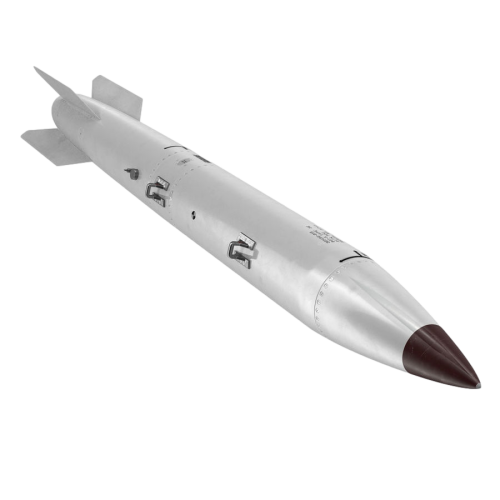
In the margins of the NATO summit in Vilnius, NATO’s Nuclear Planning Group will meet to discuss NATO’s nuclear threats and capabilities. This happens at a time when the US is fully engaged in deploying new high-tech tactical nuclear weapons (B61-12) in European host countries (including Belgium) within the framework of NATO’s nuclear division of tasks. They are there to replace old types of B61 nuclear bombs.

Poland has already announced that it wants to become more closely involved in NATO’s nuclear policy and to indicate in covert terms that it is prepared, if necessary, to deploy nuclear weapons on its territory. Hardliners of military think tanks are arguing in favour of cancelling the NATO-Russia Founding Act (1997) in advance, which contains agreements on military-political and diplomatic relations and in which the parties have entered into a number of commitments, such as the NATO promise not to deploy nuclear weapons in new Member States, ie. in Eastern Europe. The question is whether and to what extent the door will be opened in Vilnius to a strengthening or expansion of NATO’s nuclear arsenal in Europe.

China

In Vilnius, NATO’s global ambitions, especially in Asia, will be extended. A meeting is planned with partners from the Indo-Pacific region: Australia, New Zealand, Japan and South Korea. The four countries mentioned were invited to the NATO summit in Madrid for the first time in 2022.

The new Strategic Concept approved there talks about “systemic challenges” that would emanate from China. In the previous Strategic Concept of Lisbon (2010) there was no mention of China. According to NATO, there is a “systemic competition” with China that challenges “our interests, security and values”. NATO is particularly concerned about the rapprochement between China and Russia that threatens to “undermine the rules-based international order” in light of numerous illegal military interventions (such as against Iraq in 2003), CIA coups and the excesses of the global ‘War On Terror’ (Guantanamo). This makes for a rather hypocritical passage in NATO’s Strategic Concept.

China is also accused of controlling technological and industrial strategic positions and using a “wide array of political, economic and military tools to expand its global footprint and project power.” The pot blames the kettle.

In April, the NATO Secretary General emphasized the importance of partnership with the four countries involved in the Indo-Pacific region. He left no doubt that NATO’s security role is global: “In a more dangerous and unpredictable world, it is even clearer that security is not regional, but global,” said Stoltenberg . The Madrid Strategic Concept already made it very clear that the Indo-Pacific region is important to NATO, “since developments in that region may have a direct impact on Euro-Atlantic security.”

The military buildup by the US and its allies in the Asian region threatens to add fuel to existing tensions. For example, China has reacted with great dismay to US diplomatic and military actions in Taiwan. Last year, the US approved the sale of $1.1 billion in arms to the island. The arms shipments are part of a military purchase list that Taiwan provided to the US in 2019 worth $17 billion. At the end of last year, the US decided on a financial package worth $12 billion (half in donations, half in loans) to finance Taiwanese arms purchases in the US. It is an often used technique to subsidize one’s own military industry.

Most countries, including the US and all other NATO member states, do not maintain formal diplomatic relations with Taiwan under the ‘One China Policy’. Chinese claims to the island are usually recognized, but also not officially recognized. For decades, there has been a consensus between China and the US to maintain the status quo and ambiguity about Taiwan. With the growing arms deliveries and diplomatic visits from the US to Taiwan, this seems to be changing.

In attempting to curtail and contain ‘overly ambitious’ superpowers such as China, NATO’s global ambitions will also undermine the role of the United Nations, which, according to the Charter, is the priority organisation for maintaining peace and security in the world. The Vilnius summit will underscore the global ‘glory days’ of NATO member states, that increasingly seem to want to take the law into their own hands.

We need some European ‘peace noise’

From END Info 38

Guido van Leemput, The Netherlands

Guido van Leemput delivered the following speech at CND’s most recent demonstration at the Lakenheath airbase (20 May 2023). Guido has organised protests at the Volkel base in the Netherlands where US nuclear bombs are stationed under NATO ‘nuclear sharing’ arrangements.

In my younger years there was serious political and military tension in Europe; a Cold War with an Iron Curtain right across Germany. In addition, there were many Western troops in West Germany. Every young man was conscripted. One of them was me. Partly under pressure from the European civilian population – the peace movement – the Cold War came to an end without the dreaded nuclear war.

Now, some forty years later, the situation is much worse. There is a major war going on in eastern Europe, involving all European countries. We hear the swearing of soldiers, the rumble of cannons, the roar of missiles, the threat of nuclear power plants as a dirty bomb, the crying of children, mothers, fathers.

We hear the sadness and noise of war.

Russia has attacked Ukraine and all other countries are supplying weapons to Ukraine. An end is not in sight. There are many layers to this war and escalation is the engine of exacerbating the war and its effects. It is necessary that this war ends as soon as possible.

At the same time as the bloody war in Ukraine, a new Cold War has begun. With the erection of a new iron curtain on the border of NATO members from Finland in the north to Romania in the south. We have a new arms-race. Russia has been threatening to use nuclear weapons for fifteen months now.

In addition, there are plans to place more nuclear weapons in Europe. Russia wants to place tactical nuclear weapons on Belarusian MIG bombers in Belarus and the US is working on the placement of new nuclear weapons in Western Europe. In Germany, in Belgium, in Italy, in Türkiye, the US is planning new nuclear weapons of all the same type. Even in your country, the Americans would like to place new nuclear weapons. In fact, they want that to happen here in Lakenheath

A few words on nuclear sharing with Belarus. The background to the placement in Belarus is the constriction of that country to Russia. It is about the silent battle that is going on for the Kaliningrad exclave, which must be supplied by rail from Belarus through the Suwalki Gap, as it is called in NATO-language. That was a problem last year when Lithuania declared the EU boycott against Russia to also apply to Kaliningrad.

That Lithuanian boycott was withdrawn under pressure from the EU, but it proves the vulnerability of the forward Kaliningrad post to Russia. I fear that tensions over Kaliningrad will rise in the coming years. They are all afraid of each other and that fear is mounting.

Modernization of nuclear weapons in Western Europe was actually planned even before the conquest of Crimea, with the introduction of the F-35. All this is an armament spiral that interferes with, and influences others and it is mirrored in the behaviour of other states.

After the cancellation of numerous treaties, such as the Intermediate-range Nuclear Forces treaty, this is very worrying. As in the 1980s, it is the wish of the vast majority of the European population that the number of nuclear weapons be reduced. There is therefore every reason to work on a strong international peace movement.

I will tell you a bit about the situation in The Netherlands. Until the 1990s, the Netherlands had six different nuclear weapon tasks and at least four different nuclear weapons storage sites. After the Cold War, five nuclear weapon tasks ended, but one remains. That is the Air Force nuclear weapon task of the F-16. The F16 has since been replaced by the F-35.

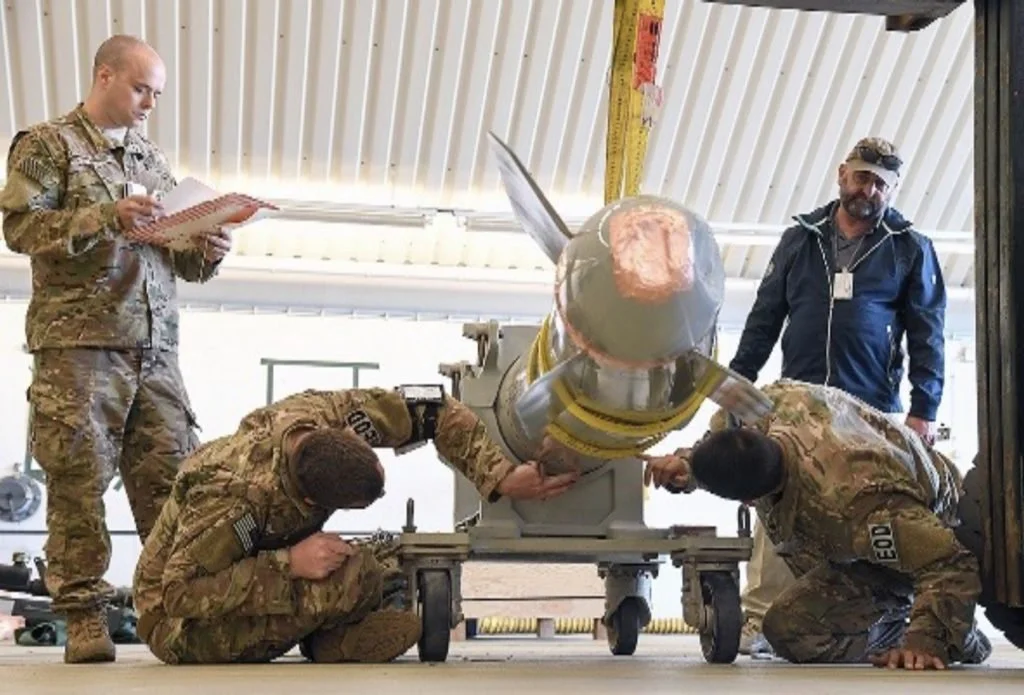
At the moment there are probably still twenty American nuclear bombs at Volkel Airforce Base in the North Brabant province. They are of the type B-61 and they are so-called free-fall bombs. The United States will soon exchange these bombs for new nuclear bombs, the B61-12. This bomb has new technical capabilities. The main difference is that the bombs get a new tailpiece. This allows the B61-12 to aim at a target approximately three times more accurately than its predecessor the B61. This makes the B61-12 the first controlled free-fall bomb in the US nuclear arsenal. In addition, compared to the B61, this new bomb has the ability to drill into the earth before it is detonated.

The B-61-12 lowers the threshold of use, because the bombs could be used against smaller targets with more precision. This suggests that the damage and humanitarian suffering can be limited. This is very worrying: they are still nuclear bombs, which would cause many civilian casualties and long-term damage to human health and the environment. Then there is the risk of stupid accidents. However, the nuclear bombs do increase the risk of nuclear incidents. And that was before the age of artificial intelligence. The misuse of artificial intelligence is an additional reason to dismantle nuclear weapons.

Earlier this year there was a report that a nuclear weapon accident had happened at Volkel. A photo had surfaced of a damaged B-61-11 nuclear bomb with ‘patches’ over the nose. The Federation of American Scientists determined that the photo was taken at Volkel. The Dutch government denied everything and asked the Americans what had happened. The Americans reported that it was an exercise, and nothing was said about Volkel. Nothing wrong. Calm down folks.

There have been sustained peace actions over the last 60 years in Volkel and in major Dutch cities against nuclear weapons. Since the 1960s. The actions varied from small and radical and massive. There were bicycle tours, vigils, civilian inspections to check exactly where the nuclear weapons were, there were large demonstrations and small ones. There were petitions, pressure groups and parliamentary questions. At the parliamentary level, there was even a motion passed against nuclear weapons.

There are two paths to the same goal. First, the UN Convention on the Prohibition of Nuclear Weapons (TPNW). That treaty entered into force in January 2021. We advocate that our governments help strengthen this treaty. Second, Peace Actions. An example: from August 4 to 10, during the commemoration of the atomic bombings of Hiroshima and Nagasaki, a peace camp will be held at the base in Volkel. The peace camp of 4 August in Volkel focuses not only on nuclear disarmament, but also on the connection between the army and climate destruction. The F-35 and F-16 fighters at Volkel emit more than 10 tons of carbon dioxide per flight hour, while they practice how to bomb the world in the next war with new, even 'better' nuclear bombs. Opinion polls show time and time again that the majority of the Dutch population does not want US nuclear weapons stationed.

We must get rid of the permanent threat of nuclear war. Europe cannot be safe without nuclear disarmament. It is necessary to work towards a nuclear-weapon-free Europe via the steps mentioned. It's about time. Let's start immediately.

In the light of the bloody European history, of the bloody war in Ukraine and under the conditions of a new nuclear arms race, it is urgent to have more action, bigger actions, internationally coordinated peace actions against the madness of war and the madness of nuclear destruction.

It is necessary to speak out about the modernization of nuclear weapons. That is why a lot of attention is needed, a lot of noise too, not just noise in parliaments, noise in newspapers, but also with pressure from the peace movement.

A European peace noise!!

$82,900,000,000 per year, $157,664 per minute...

From END Info 38

Editorial Comments, Tom Unterrainer

The International Campaign to Abolish Nuclear Weapons (ICAN) report Wasted: 2022 Global Nuclear Weapons Spending, was recently published. This report details the obscene and deadly dimensions of global spending on nuclear weapons in 2022. The headline figures are as follows:

USA: $43.7 bn per year, $83,143 per min

China: $11.7 bn per year, $22,219 per min

Russia: $9.6 bn per year, $18,228 per min

UK: $6.8 bn per year, $12,975 per min

France: $5.6 bn per year, $10,603 per min

India: $2.7 bn per year, $5,181 per min

Israel: $1.2 bn per year, $2,226 per min

Pakistan: $1 bn per year, $1,967 per min

DPRK: $589 million, $1,221 per min

As can be seen from these estimates, the total expenditure on nuclear weapons by the US exceeds that of all other states (China, Russia, UK, france, India, Israel, Pakistan and the DRPK) combined. What does this indicate?

It is understood that all nuclear-armed states are in the process of enhancing, renewing or expanding their abilities to unleash megadeath. It is widely recognised that in addition to the amounts spent on nuclear weapons, additional billions of dollars are spent on new ‘conventional’ weapon systems and a process of rapid militarisation. Taken together and understood in the context of shifting global events and power - Ukraine being the starkest example - there are clear indications that an arms-race is underway.

The US is the dominant power within the nuclear-armed NATO alliance. All NATO Member States, with the exception of France, are members of the ‘Nuclear Planning Group’. France considers its nuclear-weapon systems to be wholly ‘independent’. In Britain, the government claims that it controls an ‘independent nuclear deterrent’, but it is clear that in both technological and command-and-control terms, the British system is reliant on the US [see The Spokesman 153: Bairns not Bombs for John Ainslie’s analysis].

Whatever France claims for its nuclear-weapons-system, as a NATO member it shares and helps to shape the nuclear-alliances’ posture which, as recent strategy documents have made clear, is primarily directed against China and Russia. As such, it makes some sense to view the spending of the US, UK and France as one, especially when contrasting totals.

NATO states spent a total of $56,100,000,000 on nuclear weapons in 2022. This is approximately 4.7 times the amount spent by China and approximately 5.8 times the amount spent by Russia. Russia and China are not in a nuclear alliance or any other kind of military alliance but if their nuclear spending is bundled together then NATO spending outstrips it 2.6 times. Does such a comparison justify the amounts spent by China and Russia? Obviously not. Every dollar spent on nuclear weapons is a dollar spent on the potential destruction of humanity. But comparing total NATO spending on nuclear weapons with the amounts spent by those states identified as primary adversaries offers more than a rudimentary statistical comparator. It implies a state of affairs best described by the term ‘overkill’; it contextualises the increased nuclear spending of non-NATO states and it indicates that what is left of the non-proliferation and nuclear arms control regime is under severe strain. This is a deeply worrying situation.

‘Nuclear overkill’ describes a situation where a nuclear-armed state has more than enough nuclear weaponry to completely destroy an ‘adversary’. It is the case that the US and Russia hold such an ‘overkill’ capacity in that they are not only capable of wiping each other off the map but have sufficient capacity to end all life on this planet. Much of this capacity was embedded in their nuclear systems during the last Cold War. Despite these established capacities, the US spent $43.7 bn in 2022 and Russia spent less than a quarter of that. What is all this money being spent on? How much of it is spent to maintain existing nuclear weapons and how much is spent on developing new nuclear weapons and associated systems?

Nuclear weapon abolitionists will not be the only people looking at these figures. Ideas that pass themselves off as ‘nuclear deterrence strategy’ imply that it would be ‘logical’ for those who spend one quarter of the amount that the US spends on nuclear weapons to attempt to close the gap. If parity of spending proves impossible, then spending as much as possible above and beyond the obscene amounts already spent ‘makes sense’. The absence of a stable and fully operational disarmament, non-proliferation and arms control regime makes such a course of action all the more likely.

Of course, it is worth remembering that the scrapping of the Anti-Ballistic Missile Treaty and the Non-Proliferation Treaty were instigated by George Bush Jnr and Donald J Trump, US Presidents. Let us also remember that Joe Biden, US President, has done nothing to revive these or similar treaties.

Non-nuclear armed states, especially those viewed as adversaries by the US, may look at this list of spending and conclude that they, too, should become nuclear powers. Isn’t this the ‘logic’ and implication of such obscene spending and the mythology that nuclear weapons are the “ultimate guarantor of security”.

Where does this end? At worst, ‘overkill’ and the arms race it drives could result in the total destruction of humanity: megadeath and planetary destruction. At best, if this continues, then each of the nuclear states will be left sitting on enormous stockpiles of world-ending devices that will not and can not feed the hungry, house the homeless, cure the sick, educate our children or do anything else of use.

This waste must stop.

Biden's Nuclear Posture Review

From END Info 37

Tom Unterrainer

Key Points

● Biden’s NPR is a renouncement of most of the pledges made during his Presidential campaign in relation to nuclear weapons.

● Biden’s NPR demonstrates a significant degree of continuity with Trump’s NPR, which was met with widespread condemnation. Biden’s NPR has avoided similar condemnation to date.

● The continuity operates at two levels:

(1) declaratory policy and equipment;

(2) geopolitics.

● Specifically, Biden’s NPR:

(1) Maintains US declaratory policy with minor changes in language;

(2) Rubber-stamps a multi-billion-dollar modernisation of the US nuclear arsenal;

(3) Green-lights the development of Trump’s proposed W76-2 ‘low yield’ nuclear warhead, despite Biden previously describing it as a “Bad idea”;

(4) Cancels Trump’s plan for a nuclear-armed sea-launched cruise missile;

(5) Asserts the need for arms control but fails to outline a programme to advance the progress of such controls;

(6) Re-asserts that Russia and China are the main targets of any potential US nuclear use;

(7) Offers a dangerous picture of the role of US nuclear weapons at a time of acute nuclear risk.

● Biden’s NPR should be understood as dangerous and intimately connected to the sharp nuclear risks faced by humanity. We should pay particular attention to Biden’s NPR and US nuclear policy in general given the close nuclear alliance between the U.S. and UK and the membership of both in the nuclear-armed alliance, NATO, and with respect to the AUKUS agreement.

Context

A ‘Nuclear Posture Review’ is a process undertaken by the United States to determine the role of nuclear weapons in what the government and military term a ‘security strategy’. The process results in the release of a document, also referred to as the ‘Nuclear Posture Review’ [NPR], outlining the position. The first NPR was approved by President Bill Clinton and published in September 1994. A further four such processes have been undertaken and the outcomes published (not always in full, eg. 2002: Bush) since this date (2002: Bush, 2010: Obama, 2018: Trump, 2022: Biden).

NPR’s emerged in the ‘post-Cold War’ world when it might have been expected that the role of nuclear weapons would steadily diminish. This was not the case. Each and every NPR since 1994 has demonstrated the central role of nuclear weapons in U.S. strategy: from the alleged ‘deterrence’ function of such weapons to direct threats of use, including in response to non-nuclear attacks.

Background to Biden’s NPR

In 1990, then-U.S. Senator Biden claimed that the “military rationale for ‘first use’ [of nuclear weapons] has disappeared.” This was an early indication that he might be prepared to take a different approach to nuclear questions than the established norm. Thirty years later, candidate Biden wrote in Foreign Affairs “that the sole purpose of the U.S. nuclear arsenal should be deterring and, if necessary, retaliating against a nuclear attack. As president, I will work to put that belief into practice” [March 2020].

In the intervening three decades Biden served variously on the Senate Foreign Relations Committee and as Vice President of the United States under President Obama. During his time in the Senate, Biden voted for war in Iraq (1991), the former Yugoslavia (including the 1999 NATO bombing of Serbia), Afghanistan (2001) and Iraq (2002).

Obama

As Vice President, Biden supported President Obama’s early claim to be committed to a “world without nuclear weapons” [Prague Speech, April 2009] and subsequent declarations of alleged progress towards a “world without nuclear weapons” [Nuclear Security Summit, Washington, March/April 2016]. The 2010 NPR, released a year after Obama received the Nobel Peace Prize and two days before the US and Russia signed New START, promised significant reductions in nuclear weaponry and ruled out nuclear responses to non-nuclear attacks. At the same time, Russia warned of the risks associated with deploying ‘missile defence’ in Europe and the likely consequences of such systems [the US ‘Aegis Ashore’ system is now deployed in Poland and Romania]. Obama’s NPR recognised that China’s nuclear arsenal is much smaller than those of the US and Russia but criticised China for a “lack of transparency” that raised questions about overall “strategic intentions”. From 2009 onwards the Obama administration pursued a ‘pivot to East Asia’ [see 2012 policy] and away from the Middle East in the aftermath of the 2008 financial crisis where China’s intervention demonstrated its emergence as a world power and the failure of ‘nation building’ efforts in the aftermath of the illegal invasion of Iraq.

Obama’s welcome words about nuclear disarmament, the achievements represented by New START and the JCPOA and restraint on the development of new nuclear weaponry notwithstanding, the reality of Obama’s NPR was that it continued to assert a primary role for nuclear weapons in the US geostrategic outlook. It did nothing to fundamentally shift perspectives or introduce checks and restraints, as Trump’s 2018 NPR amply demonstrated.

Trump

Kate Hudson, CND General Secretary, wrote of Trump’s NPR at the time:

“the lid is being taken off the restraints on both new-build and nuclear weapons use. The most significant element of the review is commitment to a whole new generation of nuclear weapons, with the emphasis on low-yield, often described as ‘usable’. It should be pointed out here that the bombs used at Hiroshima and Nagasaki are technically low-yield in today’s parlance, so we are not talking about something small. The excuse underpinning this approach is supposedly that there are no real options between conventional weapons and all-out nuclear war, and that there should be more rungs on the ‘escalatory ladder’ … the increase in stated circumstances in which nuclear weapons could be used is a cause for significant concern. This includes against a group that ‘supports or enables terrorist efforts to obtain or employ nuclear devices’, as well as against ‘significant non-nuclear strategic attacks,’ including attacks on ‘civilian population or infrastructure’.”

If Obama’s NPR was a ‘disappointment’ for many sympathetic observers, then Trump’s NPR was acutely alarming for everyone concerned about the future of humanity. Trump’s overall nuclear posture was not confined to the terms set out in the 2018 Review but encompassed the steady and deliberate undermining and destruction of a whole series of treaties and agreements that fundamentally destabilised the ‘nuclear order’. Trump’s withdrawal from the INF Treaty, JCPOA (‘Iran Deal’) and Open Skies Treaty constituted a ‘Bonfire of Treaties’.

How to explain this disastrous approach? In the 2018 NPR the United States made the following ‘commitment’ to ‘Strengthening Deterrence in Europe’:

“The United States will make available its strategic nuclear forces, and commit nuclear weapons forward deployed to Europe, to the defense of NATO. These forces provide an essential political and military link between Europe and North America and are the supreme guarantee of Alliance security. Combined with the independent strategic nuclear forces of the United Kingdom and France, as well as Allied burden sharing arrangements, NATO’s overall nuclear deterrence forces are essential to the Alliance’s deterrence and defense posture now and in the future.”

The bulk of ‘analysis’ in Trump’s Nuclear Posture Review was given over to highlighting the ‘risks’ posed by Russia in particular and the growing ‘risks’ associated with China’s rise as a global power. The commitment to maintaining the ‘availability’ of US strategic nuclear forces as the “supreme guarantee of Alliance [NATO] security” – above and beyond the nuclear capabilities of Europe’s two declared nuclear powers – emphasised once more the degree to which the US continued to dominate the European defence and security agenda via its status as ‘superpower’.

The text of the Nuclear Posture Review, Trump’s highhanded conduct at the 2018 Brussels NATO summit and his unilateral withdrawal from the INF Treaty are rendered comprehendible by simple acknowledgement that the U.S. had enjoyed the status of an unrivalled hegemonic power – sole superpower status – since the collapse of the Soviet Union. Trump took reckless measures to shore up the U.S. position in response to the emergence of rival centres of global power. U.S. strategy aimed at destabilising global norms in an attempt to re-write the “rules” in their own favour. As the global situation develops from a unipolar to a multipolar order, as the risks of nuclear confrontation grow and in the absence of countervailing political will – governmental or otherwise – the U.S. has continued to assert itself in this manner. This means that NATO as an organisation and individual NATO member states continue to be subjects of U.S. dominance. In the context of a substantially expanded and expanding NATO, which pushed to the borders of Russia after the collapse of the Soviet Union against previously stated intentions of the organisation, the dominance of the U.S. within NATO structures pointed European states and their armed forces towards an increasingly confrontational posture.

If there was a clear ‘rupture’ between the Obama and Trump NPR in terms of the development of particular categories of weapon, the declared terms under which such weapons would be used and the overall language employed to talk about nuclear issues, there is some detectable ‘continuity’ in terms of ‘geopolitical’ approach. Such continuity is more obvious when Biden’s NPR is considered.

Biden’s posture pre-NPR

Biden as Presidential candidate and in the first few months of his Presidency put some effort into differentiating himself from Trump on nuclear questions. For example, during the 2020 campaign Biden sharply criticised Trump’s initiative for the W76-2 lower-yield nuclear warhead. He called it a “bad idea” and warned that it would make the US “more inclined” to use nuclear weapons.

Biden followed up on his March 2020 pledge on “sole purpose” use of nuclear weapons [ie. confirming that they would only ever be used in retaliation for a nuclear attack on the U.S. itself] by appointing a number of arms control specialists – people known to be sympathetic to such an approach – to the official body responsible for drafting a new NPR.

Even if any new NPR would, by default, continue to promote the centrality of nuclear weapons in the overall U.S. strategy, a commitment to scrapping the W76-2 and precise clarity on use threshold – “sole purpose” or “no first use” – would have been major events.

Outside the precise configuration of a new NPR, Biden had scope to undo some of the damage inflicted upon the ‘nuclear order’ by Trump’s “Bonfire of Treaties”. In the early months of his Presidency, he could have attempted to resurrect the INF and re-join the JCPOA process. There were reasons for optimism but none of this came to pass.

Not only did Biden make no efforts related to the INF and JCPOA – neither of which would have required Congressional approval ie. efforts could have been made by Presidential initiative alone – but Leonor Tomero, who Biden had appointed to oversee the NPR process, was sacked by the Department of Defense. According to a report in Politico (September 2021) Tomero was:

“a leading voice for nuclear restraint on Capitol Hill and in the think tank community, who was appointed to oversee the Nuclear Posture Review that will set the administration’s atomic weapons policy and strategy.

But officials with more traditional views on nuclear weapons, who promote a status quo agenda to include modernizing the land, sea and airborne legs of America’s nuclear arsenal, did not take kindly to Tomero’s progressive ideology, according to 11 current and former defense officials, as well as others with insight into the debate.

One current U.S. official who works on nuclear issues, when asked about Tomero, said he considers some of her positions dangerous in the face of Russian and Chinese nuclear advancements.”

In early 2021 the U.S. and Russia agreed to begin work on extending the life of the New START Treaty. Announcing the agreed extension, the US State Department commented that “President Biden pledged to keep the American people safe from nuclear threats by restoring US leadership on arms control and non-proliferation”. These words, from Secretary of State Anthony Blinken, make it sound like New START functions to only limit Russian nuclear weapons and that such US weapons are somehow a threat to no one. Around the time of the announcement, Elisabeth Eaves asked ‘Why is America getting a new $100 billion nuclear weapon?’ in the pages of the Bulletin of the Atomic Scientists. She went on:

“America is building a new weapon of mass destruction, a nuclear missile the length of a bowling lane. It will be able to travel some 6,000 miles, carrying a warhead more than 20 times more powerful than the atomic bomb dropped on Hiroshima. It will be able to kill hundreds of thousands of people in a single shot. The US Air Force plans to order more than 600 of them.” (8 February, 2021)

Why, indeed? What or who was to be the target of such new missiles? Where were they to be stationed? …

The immediate consequences of the shift demonstrated by Tomero’s removal and similar developments can be detected in the U.S. refusal to engage with requests from Russia and more widely towards the end of 2021 for negotiations and diplomacy aimed at reducing nuclear tensions. The consequences can also be detected in the repeated insistence of Biden officials that previously bipartite treaties such as the INF should be modified to encompass China.

Examined from a distance and in light of subsequent developments, 2021 can be seen as a year in which nuclear and related tensions were slowly but surely ratcheted up: a year where opportunities for diplomacy were rejected, a year where brinkmanship determined all.

Biden’s NPR

After much delay – the result of internal strife within the US establishment and more significantly, perhaps, the awful events in Ukraine – Biden’s NPR was finally published on 27 October 2022. It was released to the US Congress in March 2022 and received lengthy deliberation. The publication of the NPR followed the release of the U.S. National Security Strategy [NSS] on 12 October 2022. These two publications are significantly interrelated. President Biden writes in the NSS that:

“We have … reinvigorated America’s unmatched network of alliances and partnerships to uphold and strengthen the principles and institutions that have enabled so much stability, prosperity, and growth for the last 75 years …

The United States will continue to prioritize leading the international response to … transnational challenges, together with our partners, even as we face down concerted efforts to remake the ways in which nations relate to one another.

In the contest for the future of our world, my Administration is clear-eyed about the scope and seriousness of this challenge. The People’s Republic of China harbors the intention and, increasingly, the capacity to reshape the international order in favor of one that tilts the global playing field to its benefit …

This is a 360-degree strategy grounded in the world as it is today, laying out the future we seek, and providing a roadmap for how we will achieve it …”

This statement alone registers the degree of geopolitical continuity between the outlook of the Trump and Biden administrations. Of course, this continuity stretches back to the Obama administration and before. Why? For the obvious reason that U.S. strategy maintains the necessity of overwhelming global influence and dictates that all measures must be taken to maintain such influence.

In the light of Iraq and subsequent U.S. policy – never mind the horrors of U.S. policy from the detonation of Atomic bombs over Hiroshima and Nagasaki, the murderous persecution of war against Korea, the war crimes inflicted on the people of Vietnam, to countless instances of military intervention across the world – it can be hard to stomach all these lies about the US as ‘defender of democracy’. Yet this is what you have to stomach if you read such documentation!

The NPR documents the basics of how the U.S. seeks to ‘defend democracy’ and the ‘rules based global order’ by threatening and preparing for nuclear megadeath. In this respect, Biden’s NPR maintains continuity with all previous such documents. According to its authors, Biden’s NPR:

“reaffirms a continuing commitment to a safe, secure, and effective nuclear deterrent [sic] and strong and flexible extended deterrence [sic]. Strategic deterrence [sic] remains a top priority mission for the … [DoD] and the Nation. For the foreseeable future, nuclear weapons will continue to provide unique deterrence [sic] effects that no other element of U.S. military power can replace. To deter [sic] aggression and preserve our security in the current security environment, we will maintain nuclear forces that are responsive to the threats we face.”

Shortly before this statement – which opens the 2022 NPR – was released, Biden told the world that:

“I don’t think there’s any such thing as an ability to easily use a tactical nuclear weapon and not end up with Armageddon.”

As Daryl G. Kimball points out in Arms Control Today (December 2022):

“Nevertheless, [Biden’s] NPR, released two weeks after his ‘Armageddon’ remark, leaves open exactly that possibility.”

Biden’s NPR can be judged under three main headings: (1) declaratory policy, (2) equipment and upgrades and (3) geopolitical posture.

(1) declaratory policy:

Biden’s NPR is a sharp repudiation of every message and signal sent out during the Presidential election campaign and subsequently. There has been no shift to a “sole purpose” or “no first use” stance, rather there has been a return to Obama-era language. Hans Kristensen and Matt Korda from the Federation of American Scientists (27 October 2022) write:

“The NPR reiterates the language from the 2010 NPR that the ‘fundamental role’ of U.S. nuclear weapons is to ‘deter nuclear attacks’ and only in ‘extreme circumstances.’ The strategy seeks to ‘maintain a very high bar for nuclear employment’ and, if employment of nuclear weapons is necessary, ‘seek to end conflict at the lowest level of damage possible on the best achievable terms for the United States and its Allies and partners.

Deterring ‘strategic’ attacks is a different formulation than the ‘deterrence of nuclear and non-nuclear attack’ language in the 2018 NPR [Trump], but the new NPR makes it clear that ‘strategic’ also accounts for existing and emerging non-nuclear attacks.”

So rather than clarify the terms on which the U.S. would consider using nuclear weapons, Biden’s NPR plays around with language. His NPR claims that a:

“thorough review of options [was conducted] for nuclear declaratory policy, including both no-first-use and sole purpose policies, and concluded those approaches would result in an unacceptable level of risk.”

Do the authors of Biden’s NPR – or Biden himself – think the world would be a more or less safe place if China, which maintains a ‘no-first-use’ posture, switched to an opaque posture? Biden’s NPR does not seek to explain why it would be risky to adopt a clear policy and it does not seek to explain why others should abandon such a policy. In fact, the type of policy embodied in Biden’s NPR – and replicated by the British, for example – carry enormous risk because they amount to a ‘first use’ policy.

(2) equipment and upgrades:

In reaffirming commitment to modernising the NC3 system – ‘Nuclear Command, Control and Communications’ – Biden’s NPR is effectively continuing with the same nuclear modernisation programme as the Obama and Trump administrations. Obama, Trump and now Biden committed the U.S. to vast expenditure in an effort to ensure U.S. nuclear dominance: the technical capability to launch a nuclear attack at any time and against any target, enhanced by a highly flexible and integrated monitoring, targeting and communications system alongside extensive nuclear arsenals. Registering this continuity illuminates decisions within Biden’s NPR.

Biden’s decision to discontinue manufacturing the proposed ‘sea-launched cruise nuclear missile’ [SLCM-N] despite sharp opposition in Congress and elsewhere and the decision to retire the B83-1 nuclear bombs appear as positive developments. However, the new missile and B83-1 have only been cancelled due to the overwhelmingly negative decision to go ahead with Trump’s “bad idea” [Biden’s words], the W76-2 “low-yield” warhead and other measures. Here’s how Kristensen and Korda describe things:

“In justifying the cancelation of the SLCM-N, the NPR spells out the existing and future capabilities that adequately enable regional deterrence of Russia and China. This includes the W76-2 …, the globally-deployed strategic bombers, air-launched cruise missiles, and dual-capable fighter aircraft such as the F-35A equipped with the new B61-12 nuclear bomb.”

Kristensen and Korba further describe the expanding nuclear boot-print in Europe:

“The [NPR] also notes that ‘[t]he United States will work with Allies concerned to ensure that the transition to modern DCA [dual-capable aircraft] and the B61-12 bomb is executed efficiently and with minimal disruption to readiness.’ The release of the NPR coincides with the surprise revelation that the United States has sped up the deployment of the B61-12 in Europe. Previously scheduled for spring 2023, the first B61-12 gravity bombs will now be delivered in December 2022, likely due to Russia’s invasion of Ukraine and Putin’s nuclear belligerency. Given that the Biden administration has previously taken care to emphasize that its modernization program and nuclear exercises are scheduled years in advance and are not responses to Russia’s actions, it is odd that the administration would choose to rush the new bombs into Europe at this time.” [emphasis added]

‘Odd’? The ‘oddness’ can be rendered comprehendible if the geopolitical dimensions of current events – and the central role of nuclear weapons and nuclear threats in geopolitics – are taken into account.

(3) geopolitical posture:

If Biden’s NPR ‘falls short’ of the promises he made during the presidential campaign, this should come as no surprise. From a refusal to resurrect the INF Treaty and JCPOA, the development of AUKUS, refusal to engage with comprehensive nuclear talks with Russia beyond extending New START [now undermined by Russia’s suspension of cooperation], pressure on Japan to ditch pacifist aspects of its Constitution, the deployment of nuclear-capable aircraft to Europe, news of the return of U.S. nuclear weapons to Britain, winning European states to massive expenditure (‘Trumpian’) on the nuclear-armed alliance [NATO], ongoing opposition to the TPNW etc etc … it is clear that he is as committed to nuclear weapons as all other U.S. Presidents have been. Not only that, but it is clear from the NPR that nuclear weapons and U.S. nuclear weapon policy are at the heart of Biden’s posture – continuous from previous administrations – with regards to Europe and Asia.

Conclusions

Biden’s NPR is best viewed as a continuation of previous nuclear postures and even where some degree of ‘rupture’ is in evidence, such ‘rupture’ simply reinforces existing overall postures.

Of particular note is Biden’s decision to repudiate his previous stance and to advance the development of ‘low-yield’ nuclear warheads. With this decision, Biden has signalled that the U.S. considers nuclear weapons to be ‘practical’, war fighting devices.

At a time of heightened nuclear risk, Biden has decided to contribute to a vast increase in nuclear tensions. Refusing to clarify use policy and deploying/developing ‘useable’ nuclear weapons systems demonstrates a posture just as reckless and potentially deadly as that assumed by Trump.

Biden’s NPR makes explicit the fact that Russia and China are the intended targets of any nuclear use. Such plain facts coincide with and illustrate the potentially deadly implications of U.S. policy in Europe and South-East Asia.
Depleted Uranium: Deadly, Dangerous and Indiscriminate

Britain’s announcement that it will deploy Depleted Uranium (DU) weapons to Ukraine is a dangerous escalation that will do nothing to aid the people of that country. Rather, the opposite could be the case.

There have been a large number of studies detailing the very dangerous health and environmental impacts of the military use of DU, yet Great Britain - along with other states which possess and use DU - refuse to openly acknowledge the risks. One particularly unpleasant example of this was reported in the British press in 1999, following the use of DU in Kosovo (see Felicity Arbuthnot, ‘Depleted Uranium Warning Only Issued to MoD Staff’, Sunday Herald, August 1 1999). British MoD personnel were warned to stay away from areas where DU had been used unless they were wearing full radiological protective clothing. The same warning was not given to returning Kosovans who wanted nothing more than to go home. Why the difference in attitude?

The International Atomic Energy Agency (IAEA) website refers to two studies (M A Mcdiarmid et al, Environ. Res. A 82 168-180 (2000) and G J Macfarlane et al, The Lancet 356 17-21 (2000)) on the impact of DU on service personnel. Specifically, these studies relate to soldiers who had fragments of DU embedded in their bodies. This is a curious state of affairs given the enormous number of individual studies, evidence and reports detailing the risks associated with inhaling or ingesting DU dust and contaminants. Why are the only studies cited related to chunks or splinters of DU embedded within the bodies of soldiers?

The US Agency for Toxic Substances and Disease Registry, a department of the Center for Disease Control, explains the chemically toxic effects on kidneys and lungs resulting from the inhalation of DU, the fact that DU can enter the water system and food chain and that it can travel large distances. The US is concerned about DU ‘at home’ but not on battlefields on the other side of an ocean.

There must be an immediate moratorium on the deployment and use of DU weapons until a full, long-term and independent epidemiological study on the locations where DU has been used is completed. The UN General Assembly is right to demand - as it did in 2007 - for greater transparency of the use and clean-up of DU weapons. It is worth noting that the UK, US, France and Israel voted against this Resolution.

It is sometimes suggested that DU is a ‘nuclear weapon’ in the same bracket as fission and fusion devices. Although DU is a ‘nuclear material’, there is no nuclear fission or fusion when these weapons are used. Rather, when fired DU burns at over 3000 degrees centigrade and becomes a ‘ceramic uranium aerosol’ that has special properties on impact - ie. it does not deform in the same way as other materials, meaning it can puncture heavy armour. However, DU produces microscopic fragments which are radioactive and chemically toxic that are distributed over the area surrounding impact and which can spread far and wide. It is these particles that produce long-term health and environmental effects.

The use or potential use of such weapons in Ukraine should alarm the people of that country, who have surely suffered enough as a result of this war. DU poses significant health and other concerns and could do further damage to an already damaged country.

Bomb damage

According to a new report by Hans Kristensen of the Federation of American Scientists (‘Was There a U.S. Nuclear Weapons Accident At a Dutch Air Base?’, 03/04/23, fas.org/blogs/security/2023/ 04/volkel-nuclear-weapon-accident), evidence has come to light that suggests an accident involving a B61 nuclear bomb took place at the Volkel Air Base in the Netherlands. The Pentagon strenuously denies the idea. Kristensen writes:

A photo in a Los Alamos Laboratory ... student briefing from 2022 shows four people inspecting what appears to be a damaged B61 nuclear bomb ... If the image is indeed from a nuclear weapons accident, it would constitute the first publicly known case of a recent nuclear weapons accident at an airbase in Europe.

Volkel is one of several bases across Europe that house US nuclear bombs under ‘nuclear sharing’ arrangements. Other bases are stationed in Belgium, Italy, Germany and Turkey. Under ‘nuclear sharing’ arrangements these bombs are not only stored in non-US territory but in ‘peace time’ they are guarded by US forces. The US trains ‘participating country’ airforce personnel to drop these nuclear bombs and in the event of nuclear war, ‘participating country’ aircraft will be loaded with the bombs.

The actual arrangements and command systems involved in nuclear sharing are at best opaque and at worst completely baffling. One example of this is highlighted by Kristensen who writes:

Most people would describe a nuclear bomb getting bent as an ‘accident’, but U.S. Air Force terminology would likely catagorize it as a Bent Spear ‘incident’, which is defined as “evident damage to a nuclear weapon or nuclear component that requires major rework, replacement or examination or re-certification by the Department of Energy”. The U.S. Air Force reserves “accident” for events that involve the destruction or loss of a weapon.

However you choose to describe the damage done to this B61 bomb, there are a number of questions that require urgent examination. For instance: how many ‘incidents’ or ‘accidents’ have there been at nuclear sharing bases over the past decade? Are these frequent events or very rare indeed? How did this damage occur? Was it due to technical or human error? How often are there instances of technical or human error at nuclear sharing bases? Was there any damage to the nuclear warhead on this B61? How frequently are nuclear warheads damaged at nuclear sharing facilities? What are the potential consequences of such damage? What arrangements are in place to deal with any such consequences? How often are these arrangements activated?....

The list of question could go on and on but no matter how many questions are asked and no matter how often such questions are asked, the US and NATO countries involved in nuclear sharing are unlikely to answer. There is a veil of secrecy over the whole enterprise, which makes the prospect of the continuation and possible expansion of US nuclear weapon storage in Europe very troubling indeed.

The US is currently deploying a new range of B61-12 nuclear bombs to Europe. It looks possible that such bombs will also be deployed to the UK. The anti-nuclear movement is building opposition to these and related developments.

Finland joins NATO, Sweden waits for permission: lessons of a nuclear alliance

From END Info 37

Tom Unterrainer

On Tuesday 4 April, 2023, Finland officially joined the nuclear-armed NATO alliance. In so doing, Finland formally repudiated decades of independence and non-alignment. The formal proceedings accompanying Finland’s accession to NATO gave no sense of the drastic turn of events:

NATO Secretary General Jens Stoltenberg

Secretary Blinken, Minister Haavisto, it is a pleasure to welcome you both here today, because this is an historic day. Soon we will be welcoming Finland as the 31st member of our Alliance, and we will raise the Finnish flag outside of this building. But before we do that, there are some formalities that we have to ensure are done in the right and proper way, so Secretary Blinken please hold the floor.

US Secretary of State Anthony Blinken

Well, Secretary General, Mr. Minister, I am delighted to report that - just a few moments ago - that Turkiye deposited with me, on behalf of the United States, Turkiye’s ratification of the instrument of acceding to the protocol for Finland’s accession to NATO. And with the receipt and submission of that protocol, I can say that the protocol is now in force.

NATO Secretary General Jens Stoltenberg

Thank you so much. This is great news, Secretary Blinken. And with that, I can actually then hand over to you, Minister Haavisto, the formal invitation on behalf of all Allies, for the Republic of Finland to accede to the North Atlantic Treaty. So, please.

Finnish Minister of Foreign Affairs Pekka Haavisto

Thank you.

NATO Secretary General Jens Stoltenberg

And then at the same time I also invite you to deposit your documents of accession to the US Government, here represented by Secretary Blinken.

Finnish Minister of Foreign Affairs Pekka Haavisto

Thank you, Mr. Secretary General, thank you Secretary Blinken. Now that I’ve got this invitation, it is my great pleasure to deposit with the Secretary of State of the United States of America Finland’s instrument of accession to the North Atlantic Treaty. Please, Secretary Blinken.

US Secretary of State Anthony Blinken

Thank you very much. Well, with receipt of this instrument of accession, we can now declare that Finland is the 31st member of the North Atlantic Treaty.

NATO Secretary General Jens Stoltenberg

Congratulations!

Finnish Minister of Foreign Affairs Pekka Haavisto

And since we are now a member of NATO we have a very important task, and the task is actually to give to you for the deposit also our ratification for Swedish membership. This is our first act as member state.

US Secretary of State Anthony Blinken

I am delighted, delighted to receive this on behalf of Finland. Thank you.

Finnish Minister of Foreign Affairs Pekka Haavisto

Thank you.

NATO Secretary General Jens Stoltenberg

And then we welcome Finland to the Alliance, and we also appreciate that you have agreed also to invite Sweden. So, this ends this moment and then we will continue outside the building in just a moment. So, thank you so much.

The ceremony over, NATO’s land border with Russia doubled in an instant. It will not have escaped the notice of Russia, the primary target of the vast majority of US nuclear weapons and the target of US bombs stationed in Europe under NATO ‘nuclear sharing’ arrangements, that it was US Secretary of State Anthony Blinken who declared “Finland as the 31st member” of NATO. NATO Secretary General Stoltenberg was on hand to offer his congratulations. All of which makes clear two things: the central - determining - role of the United States in NATO and the very real dangers presented by Finland’s accession to the nuclear-armed alliance.

Such a move would be escalatory at the ‘best of times’. All must know that these are not the ‘best of times’. Nuclear tensions are at their greatest in decades, war rages in Europe. NATO is not just expanding its geographic boot-print in Europe but is extending it across the globe, with a particular focus against China. This is what Finland has rejected independence and non-alignment for: to go to war for the United States and its priorities. What are these priorities? Certainly not peace and security in Europe. The priority is to bolster and if possible enhance US power in the face of emerging alternative powers.

What of Sweden? Why did this country not join at the same time as Finland? After all, they too rejected independence and a wonderful record of seeking peace, disarmament and diplomacy to declare themselves for the nuclear-armed, US dominated alliance. Finland’s first act as a NATO member was to “deposit also our ratification for Swedish membership.”

On March 22 2023, the Swedish parliament voted 269-37 to approve accession to NATO. As of the end of March 2023, both Turkiye and Hungary have declined to ratify Sweden’s membership. Sweden is being made to wait to be allowed to join NATO, which presents itself as the defender of ‘democracy’ and an ‘international rules based order’ by two countries with, at best, tenuous claims to ‘democracy’ and ‘rules’ of any kind. This makes them a natural fit for NATO and as an ally of the United States but it does not make for a good fit for Sweden, which has a much better record on such questions. So whilst the Hungarian President continues with racist and anti-democratic methods at home and the Turkish President continues his war against the Kurds (to name just one ‘issue’), it is Sweden that is excluded from the nuclear-armed alliance.

Of course, the original members of NATO included fascist Portugal and ‘colonial’ Britain and France which continued to perpetuate outrages across their colonies.

So much for ‘democracy’ and ‘rules’. But who can speak of such things in the context of an organisation committed to the prospect of global nuclear annihilation, megadeath and genocide? Finland has sadly joined the club of hypocrites.

Time for Europe’s nuclear-weapon-free zone

From END Info 37

Editorial comments, Tom Unterrainer

More nuclear brinkmanship

The 2022 Belarussian constitutional referendum, conducted three days after Russia’s invasion of Ukraine (27 February 2022), resulted in the renouncement of nuclear-free status. The referendum was met with wide-spread internal opposition and the day of the referendum itself was marked by anti-war protests across the country. The elimination of nuclear-free status was only one of several measures intended to solidify President Lukashenko’s power.

If the timing of the referendum was mere coincidence, its outcome – along with Lukashenko’s support for Russia’s invasion – is of major significance. Take, for instance, these comments from Lukashenko on the day of the referendum:

“If you (the West) transfer nuclear weapons to Poland or Lithuania, to our borders, then I will turn to Putin to return the nuclear weapons that I gave away without any conditions”.

Did Lukashenko pluck the idea that the US might station nuclear weapons in Poland out of thin air? Or were such prospects on the table? You need look no further than the Twitter feed of the US Ambassador to Poland in 2020 to see that Lukashenko’s statement was not without foundation. It is worth noting that although the US Ambassador at the time, Georgette Mosbacher, has been replaced with Mark Brzezinski the Tweet raising this suggestion remains in the public domain.

The context in which such messages were sent was a growing opposition to the presence of US nuclear bombs in Germany and the refraction of this opposition through the Social Democratic Party. As we reported in END Info 15 (May 2020), Rolf Mützenich – SPD leader in Bundestag – publicly criticised the stationing of US bombs in the country:

“Nuclear weapons on German territory do not heighten our security, just the opposite ... The time has come for Germany to rule out a future stationing.”

The suggestion that US nuclear bombs could or should be move eastwards to a state bordering Belarus (and Ukraine) was a direct response to this mood in Germany at the time.

Despite the change in the Belarussian constitution and Lakashenko’s warning at the time of the change, US nuclear weapons have not arrived in Poland or Lithuania and Belarus remains free from Russian nuclear weapons. This does not mean that the matter is settled.

On 31 March 2023, Lukashenko took to the airwaves to deliver an hour-long speech to the nation. Among his comments was the following:

“Putin and I will decide and introduce here, if necessary, strategic weapons, and they must understand this, the scoundrels abroad, who today are trying to blow us up from inside and outside ... We will stop at nothing to protect our countries, our state and their peoples.”

These comments were reported in the press as a direct indication that Russian nuclear weapons would be stationed in Belarus. In an October 2022 interview with the Gazeta Polska weekly, Polish President Andrzej Duda is reported as saying:

“There is always a potential opportunity to participate in the nuclear sharing programme ... We have spoken with American leaders about whether the United States is considering such a possibility. The issue is open ... this would not be a nuclear weapon under the control of Poland. Participation in nuclear sharing does not imply having your own nuclear weapon”.

Duda’s comments were made in a new context, one where there is now no political will and a much-diminished mood in society to remove US bombs from Germany.

What appears to be happening with these repeated, reckless and frankly terrifying threats to proliferate nuclear weapons is connected to what Zbigniew Brzezinski (father of the current US Ambassador to Poland) termed the ‘Critical Core of Europe’s Security’ (see map) and the proximity of Belarus and Russia to this ‘Core’. As Ken Coates noted in his Foreword to the new edition of Bertrand Russell’s Common Sense and Nuclear Warfare:

“America’s diplomatic efforts are not disinterested, and follow the perceived interests of the American Government. This interest has been bluntly stated, in 1997, in respect of Ukraine, by Zbigniew Brzezinski in his blueprint for American Policy, The Grand Chessboard. It sees American power as dependent on the establishment and maintenance of hegemony over Ukraine, which is defined as part of the critical core or ‘geopolitical pivot’ of ‘American primacy’. (2001)

Such an analysis does not let Russia ‘off the hook’ with respect to its criminal actions in Ukraine. Nor does is excuse each and every aspect of Lukashenko’s conduct. But it does illustrate the fact that the US has long recognised the strategic centrality of control over Ukraine. It also highlights the degree to which the stationing of US nuclear weapons in Europe and the conduct of the nuclear-armed NATO play a central role in furthering US strategic aims. Lastly, it helps to give context to the brutal and dangerous realities of nuclear brinkmanship on the European continent and the degree to which such nuclear brinkmanship translates into US efforts to extend influence into ‘Eurasia’.

Each and every step – verbal, constitutional or actual – towards the ‘eastward’ or ‘westward’ deployment of nuclear weapons escalates the already significant nuclear tensions and nuclear risks faced by humanity.

In place of such escalation, Europe needs a nuclear-weapon-free zone.

Nuclear-weapon-free zones

The 2016 Peace Research Institute Frankfurt (PRIF) working paper, A Nuclear Weapon-Free-Zone in Europe: Concepts-Problems-Chances, outlines a number of such objectives: 1. Security objectives in the narrow sense, 2. Political-symbolic objectives and 3. Adapting defence policies to the political situation in Europe. More detail is given within each of the three objectives, as outlined below:

1. Security objectives in the narrow sense

Confidence-building in the regional neighbourhood: “All states in the region are loyal parties to the NPT, and for many of them, membership goes beyond compliance and involves active promotion of the spirit and letter of that treaty.” Acting upon Action Point 9 of the 2010 NPT Review Conference would build and reinforce trust amongst regional signatories to the NPT, and would signal to neighbours – Russia in particular – that no threat is posed.

Irreversibility and Stability: The creation of the NWFZ in Europe would be the result of a legally binding, verifiable and therefore “hard to revoke” arrangement.

Immunizing the region against the consequences of a nuclear confrontation: “one objective of any NWFZ has always been to protect the region concerned against becoming a nuclear battleground”.

2. Political-symbolic objectives

Strengthening the non-proliferation regime: Developing a NWFZ in Europe would mean signatories to the NPT acting on the 2010 Review Conference Action Plan. Such an act could only reinforce existing arms control and disarmament regimes.

Fostering nuclear disarmament: “Sub-strategic nuclear weapons are today one of the most nagging issues for nuclear disarmament … A NWFZ in Europe would intend to, eventually, cover an area in which NATO’s sub-strategic nuclear weapons are presently sited and to stimulate adequate reciprocal concessions by Russia concerning her capabilities in the same weapons category”.

Helping delegitimize nuclear weapons/provoking debate: As the PRIF study points out, the legitimacy of nuclear weapons as an issue of debate has never been “dormant”. There have, however, been identifiable periods when debate and discussion adopted a much higher pitch than usual. The stark threats posed to the continuation of the INF should be an opportunity for the debate to gain traction and the proposal for a NWFZ in Europe can only boost such debates.

3. Adapting defence policies to the political situation in Europe

“One of the most frequently heard observations by non-Europeans is the disconnect between the nuclear constellation and the political situation in Europe. The relation between the West and Russia is not without disputes and occasional tensions … but the idea of a war against each other sounds still far-fetched.”

Developments since the PRIF study was published now make it much easier to imagine war, even nuclear war, breaking out between “the West and Russia”. Further, the general political situation in Europe has deteriorated markedly in the years since the PRIF study, much ‘adaptation’ of defence policies is already underway. The development of plans for the NWFZ in Europe would add something definitively more positive to the current debate and could unleash an all-too-necessary political counter-dynamic to the current direction of travel.

An important aspect of any proposal for a NWFZ in Europe is that it would, in fact, benefit from being part of a international system of such zones. In his indispensable study, Security without Nuclear Deterrence, Commander Robert Green notes:

“Every year since 1996 the UN General Assembly has adopted a resolution introduced by Brazil calling upon the states parties and signatories to the regional NWFZ treaties ‘to promote the nuclear weapon free status of the Southern Hemisphere and adjacent areas’, and to explore and promote further cooperation among themselves.”

The first conference of states already participating in NWFZs took place in Mexico in April 2005. The declaration adopted by the conference reaffirmed a commitment to the “consolidation, strengthening and expansion of NWFZs, the prevention of nuclear proliferation and the achievement of a nuclear weapons free world.” So not only do signatories to the NPT share a commitment to establish NWFZs, but existing such zones are committed to their expansion.

This leaves the rather important question of ‘who’, or ‘what’, will have the capacity to drive forward the call for the NWFZ in Europe. European peace movements can and must answer this question. A united European peace movement, dedicated to nuclear abolition and NWFZ’s, is needed now more than ever.

Nuclear dangers

Thinking globally, acting locally

From END Info 36 DOWNLOAD

Tom Unterrainer

The 22 January 2023 marked the second anniversary of the coming in to force of the Treaty on the Prohibition of Nuclear Weapons.

To date, 68 nations have ratified the Treaty and work to increase that number continues. This work stretches from the offices of diplomats and international politicians to the streets of Yorkshire cities, towns and villages where CND members promote the idea of nuclear ban communities. The Treaty itself has significance beyond the prohibition of nuclearism in those states that have ratified.

It is remarkable - and telling of the role played by nuclear weapons - that it took more than three quarters of a century after the atomic bombings of Hiroshima and Nagasaki for a United Nations treaty to codify prohibition into international law. Every time an additional nation rejects nuclearism and ratifies the TPNW, the world takes another step towards nuclear abolition.

For me, and many others, the TPNW has a significance beyond the incremental steps. The whole process of drafting, coordinating, winning support and signatures for and ratifications of the TPNW was a process of geopolitical significance: it was a full-frontal rejection of the dominant idea that the retention and development of nuclear weapons is a prerequisite for global security.

Driving this full-frontal rejection were nations that have been and continue to be exploited, diminished and oppressed in the name of nuclearism and the global order which is characterised by it: the nations where the United States, Britain and France and others tested their nuclear weapons; the nations where the basic materials of the nuclear warhead were extracted; the nations which have experienced intergenerational damage and which carry the legacies – in the earth, in their bodies – of the nuclear age. It is noteworthy that Japan, the only nation where atomic weapons were detonated on a civilian population, opposed the TPNW.

As Richard Falk put it: “The enormous fly in this healing ointment” - the TPNW – “arises from the refusal of any of the nine nuclear weapons states to join in the TPNW process". Not only did the nuclear armed states refuse to join the process, so did members of the NATO nuclear alliance. They were joined by countries like Japan, which maintain close relations with the United States.

These states did not simply refuse to join in with the TPNW and ignore it: a coordinated and determined effort has been made to stop nations from ratifying and to systematically undermine the legal status of the Treaty.

For instance, the presence of member and soon-to-be members of the nuclear-armed NATO alliance at the First Meeting of State Parties (1MSP) of the TPNW raises a number of questions. First amongst these is: what were they doing there?

Was this a sign, as some hoped, that NATO member states were finally ready to positively engage with the project of nuclear abolition? No.

NATO and NATO-aligned states took the opportunity of their observer status and the speaking rights afforded to them to either challenge the TPNW itself or to promote fallacies around nuclear weapons.

Norway’s statement to 1MSP is explicit:

Norway is attending this conference as an observer. This is not a step towards signing nor ratifying the TPNW, which would be incompatible with our NATO obligations. Norway stands fully behind NATO’s nuclear posture.

The Netherlands struck a similar note:

.…this is not the first time we have participated in the TPNW discussions. We would like to remind delegations of our participation in the 2017 negotiations leading up to this Treaty, including offering concrete suggestions to make the TPNW a more broadly acceptable and credible disarmament treaty - not only to us but also possibly to other NATO Allies – which were unfortunately rejected.

Here, The Netherland’s not only objects to the TPNW but points out that it has been objecting since 2017! They have been ‘persistently objecting’ to the TPNW from the very start. The first prize for clarity, enveloped in a cloud of dire hypocrisy, is awarded to Germany, which stated in its address to the 1MSP that:

As a member to NATO – and as long as nuclear weapons exist, NATO will remain a nuclear Alliance -, … Germany cannot accede to the TPNW, which would collide with our membership in NATO including nuclear deterrence. As non-member to the TPNW we are not bound by its provisions, nor do we accept the claim that its provisions are applicable under customary law – now or in the future.

It is almost as if, like me, the German Foreign Office did an internet search of ‘persistent objector’ and crafted their statement to the 1MSP in order to precisely comply with the definition. What is this ‘Persistent objection’ about?

According to a 2021 Chatham House report:

While it is a general principle of international law that treaties do not create obligations for third states, it is also an accepted principle that a rule set forth in a treaty could, under certain conditions, become binding on a third state as a customary rule ... However, this is not an automatic process. Two distinct concepts are relevant here: the concept of so-called ‘specially affected states’, and that of ‘persistent objectors’ ... As the ICJ has explained, a lack of consent from specially affected states may have the effect of preventing the required general state practice from emerging, preventing the rule from coming into being in the first place. There is a strong argument that states with nuclear weapons and those in a nuclear alliance would be specially affected by a proposed ban on nuclear weapons. Even if a rule is indeed created, states that have objected to a certain degree to its emergence - so-called persistent objectors - will not be bound by it.

What does all of this illustrate?

Firstly: that the nuclear armed states and their allies in the nuclear-armed alliances will not easily give up their nuclear weapons. This is why campaigns like CND have a vital role to play and why we have to approach the problem from a number of directions: international law, political and mass action.

Secondly: that those who most consistently preach the gospel of ‘international law’ and promote their own version of a ‘global rules based order’ do so hypocritically, deviously and in their own interests.

In his recent book, The Last Colony – A tale of exile, justice and Britain’s colonial legacy, Philippe Sands writes:

In 1945, Britain and the United States had committed themselves to a rules-based international order, then they flaunted the rules. They committed themselves to …[a] vision of decolonisation and human rights, then shredded their own commitments.

What is Sands referring to specifically? What does it have to do with nuclear weapons? Quite a lot, as we shall see.

Six thousand miles from here are a group of islands which the British government refers to as the British Indian Ocean Territory – or BIOT for short. These islands may be more familiar as the Chagos islands.

In 1965 the United Kingdom split the Chagos islands from Mauritius. It did this in direct contravention of United Nations rules, which made clear that the process of decolonisation should not involve splitting or removing territory. The UK acted illegally.

The Chagossians demanded the right to self-determination. This right is enshrined in the UN Charter. Britain refused their demand: again, illegal under international law. Instructively, this same right to self-determination – as enshrined in the UN Charter – was invoked by Britain to legally justify its actions during the Falklands War. The Chagossians were entitled to ask why such a right pertained for white Falklanders but not for themselves.

Over and over again, Britain ignored the plight of the Chagossians – a people who had been ripped from their land, transported across oceans and left to suffer.

Britain inflicted suffering, injustice and worse on the Chagnossians in contravention of international law whilst presenting itself as a champion of a ‘global rules based order’.

It was not until 2017 that things started to change for the Chagossians, who refused to give up the fight. In June 2017, the UN General Assembly voted 94 to 15 to ask the International Court of Justice for an Advisory Opinion on the legality of the initial separation. On 25 February 2019, the ICJ ruled 13-1 that the UK was under obligation to reverse the separation: to give Chagos back. It took until 3 November 2022 for James Cleverely, the British Foreign Secretary, to announce the UK’s willingness to begin negotiations for a return: but with one condition – the continued operation of the airbase at Diego Garcia.

Diego Garcia is an enormous airstrip for the United States. It is the place from which bombing raids on Iraq and the wider Middle East were launched. As Philippe Sands explained in one of his earlier books, Diego Garcia was also used as a torture site. It is ‘British territory’.

Just how did the United States end up with an enormous airbase on territory stolen by Britain in the middle of the Indian Ocean – all in contravention of international law. How was the United States allowed to use this stolen territory to launch an illegal war on Iraq? How was the United States allowed to use this stolen territory to conduct torture?

There exist a series of agreements and treaties between the United States and the United Kingdom made in the aftermath of the Second World War allowing for the use of UK bases by the US military. The Lakenheath airbase is another such example.

We’re told that this is ‘RAF’ Lakenheath but it is no such thing. It is a US base. The F35 aircraft that are stationed there are American. The pilots of these aircraft are American. The B61 nuclear bombs that look set to be stationed there are American.

The only thing ‘Royal’ about the place are a smattering of British personnel on the gates.

The return of US nuclear bombs to Lakenheath will be done without fanfare, without discussion, deliberation or the opportunity for dissent within official politics.

There has been no official statement and when asked, the British government equivocates. If Chagos is the last British colony, what does that make Lakenheath?

Nuclear developments have always happened under a veil of secrecy, from the initiation of the British atomic programme by the 1945 Atlee government to the announcement in Boris Johnson’s Integrated Review that ‘transparency’ over these issues will end.

The existence of nuclear sharing sites across Europe – something everyone knew about – was only officially confirmed when someone working at NATO in Brussels accidentally uploaded the wrong document onto their website!

The expansion of the nuclear bootprint – which is how I characterise developments at Lakenheath – would be very dangerous at the best of times. It is potentially deadly in the current circumstances.

In January 2022, the Permanent 5 – the five nuclear armed states with a permanent seat on UN Security Council issued a statement that said: “Nuclear war can not be won and must never be fought.” They echoed a similar statement from Presidents Reagan and Gorbachev that many of you will recall from the 1980s.

How sincere was this statement? Quite apart from the demonstrable hostility of the P5 to the TPNW and their ongoing failure to uphold the basics of the Nuclear Non-Proliferation Treaty, which they claim to hold so dear, we have witnessed a number of deeply troubling developments:

Russia’s invasion of Ukraine has massively increased nuclear tensions.

The ‘taboo’ on threatening nuclear use has been drastically undermined: not just by Putin’s public announcements – although these are the most high-profile – but also by the United States.

A totally inadequate response to these events: No effort to reduce nuclear tensions, no effort to end the war by diplomacy and negotiation.

We’ve seen repeated public speculation about how nuclear weapons could be used, debates around ‘tactical’ vs ‘strategic’ weapons all of which creates a normalisation of the murderously abnormal.

Rather than rolling back on the worst excesses of Trump’s Nuclear Posture Review, Biden’s version looks eerily familiar.

So, what to do about it? Think globally about our problems and understand what it all means. Act locally to raise the alarm, spread the message but – importantly – to work decisively towards removing each and every roadblock to peace.

Text of a talk given at the Yorkshire CND AGM, January 2023.

First Steps Towards Secure Peace

From END Info 36 DOWNLOAD

Bertrand Russell

Chapter 8 of Has Man A Future?, first published in 1961 – as global tensions built between the USA and USSR in the lead-up to the Cuban Missile Crisis – and re-issued by Spokesman Books in 2001.

The first steps towards the attainment of secure peace, like the first tottering steps of an infant, will almost necessarily be small and doubtful. In this chapter, I want to consider, not all that is desirable, but all that might conceivably be achieved by negotiators in a not too distant future.

The first thing that is needed is a different atmosphere in debates between East and West. At present these debates are conducted in the spirit of an athletic contest. What each side thinks important is, not the reaching of agreement, but its own victory either in a propaganda performance for the rest of the world or in securing from the other side concessions which might tilt the balance of power in what would be considered a favourable direction. Neither side remembers that the future of Man is at stake and that almost any agreement would be better than none. Take, for example, the long-drawn-out negotiations for the abolition of tests. East and West have always agreed that the spread of nuclear weapons to new Powers would increase the likelihood of nuclear war. Both sides have agreed that the spread of nuclear weapons to new Powers is imminent. Both sides have agreed that a ban on nuclear tests would help to prevent this spread. From these premises, both sides have felt, not that tests must stop, but that whichever side is in question must seem to wish to stop them. The negotiations began hopefully with a joint declaration of the scientists of East and West that a test anywhere could be detected by the other side. Thereupon, the American Government announced that it needed to make underground tests and that these could easily pass undetected. After some years of negotiation this obstacle was overcome. The Soviet Government thereupon announced that the necessary inspection should not be directed by one man representing the United Nations, but by three men-one East, one West, and one neutral - and that they should only act when there was unan­imity. As was to be feared these manoeuvres on the part of America and Russia made the years of nego­tiation fruitless and led to the resumption of tests by Russia. One cannot but conclude that neither side has been sincere in pretending to wish that tests should cease by agreement.

If any progress is to be made with any of the problems that cause East-West tension, negotiators must meet, not in the hope of outwitting each other, or of prolonging the dangerous status quo, but with an absolute determination that agreement shall be reached. It must be accepted that an agreement is not likely to be wholly palatable to either party. The aim should be to reach agreements which do not alter the balance of power, but do diminish the risk of war.

I can see only one motive which can lead to this change in the attitude of negotiators. This motive will have to be consciousness on both sides of the futile horror of nuclear war. At present, each side thinks it necessary for success in the war of nerves to pretend that it might win. And not only for success in the war of nerves, but also to lure its own citizens to their death by promises which Governments must know to be deceitful. One side announces, ‘We might win a hot war’; the other side retorts, ‘We shall obliterate you’. Such statements tend to promote warlike fury in whichever side is threatened. If any steps towards peace are to be achieved, both sides will have to recognize that they face a common peril and that the true enemy is not the other side, but the weapons of mass destruction which both sides possess.

If this is recognized on both sides, the problem becomes a quite different one. It is no longer the problem of outwitting the other side, or of persuading one’s own side that it is capable of victory. The first problem will have to be to find acceptable steps, however small, which can prove that fruitful negotiations have become possible.

There is a considerable amount of rhetoric, both on the warlike and on the peaceful side, which, whatever its intention, is not likely to lead to the desired result. We have formerly considered the rhetorical war propaganda embodied in the slogan, ‘Liberty or Death’, but there is an opposite slogan invented by West German friends of peace: ‘Better Red than dead’. One may guess that in some sections of Russian public opinion there is an opposite slogan: ‘Better capitalists than corpses’. I do not think it is necessary to inquire into the theoretical validity of either slogan since I think it out of the question that the one should be adopted by Western Governments or the other by the Governments of the East. Neither slogan presents justly the problem which East and West alike have to face. Given that military victory by either side is impossible, it follows logically that a negotiated detente cannot be based on the complete subjection of either side to the other, but must preserve the existing balance while transforming it from a balance of terror to a balance of hope. That is to say, co-existence must be accepted genuinely and not superficially as a necessary condition of human survival.

Perhaps the first step should be a solemn declaration by the United States and the USSR, and as many other Powers as possible, that a nuclear war would be an utter disaster to both East and West and, also, to neutrals, and that it would not achieve anything that East or West or neutrals could possibly desire. I should hope that such a declaration could be made sincerely. Both sides know that what it would say is true, but both sides are caught in a net of prestige, propaganda, and power politics, from which, hitherto, they have not known how to extricate themselves. I should like to see the neutrals taking the lead in achieving such a declaration, and I do not see how either side could incur the odium of refusing to sign.

The next step should be a temporary moratorium, say for a period of two years, during which each side would pledge itself to abstain from provocative actions. Among provocative actions should be included such measures as interference with the freedom of West Berlin, or interven­tion by the United States in Cuba. It should be agreed that United Nations observers, as impartial as could be found, should decide whether an act is provocative.

During the two years moratorium, various preliminary steps should be taken with a view to making subsequent negotiations easier. There should be on both sides a discouragement of vehement hostile propaganda and an attempt by means of greatly increased cultural contact to diminish the popular view in East and West of West and East as melodramatic monsters of wickedness. Steps should be taken to lessen the danger of unprovoked or unintended war. At the present time, each side fears an unprovoked attack by the other, and each side has a vast system of detection by which it hopes to discover such an unprovoked attack a few minutes before it occurs. Each side’s methods of detection are fallible and, therefore, each side may believe itself about to be attacked when nothing of the sort is occurring. If it believes this, it will order what it supposes to be a counter-attack, but what, to the other side, will appear merely unprovoked aggression. This is a mutual nightmare, caused by tension, but immensely increasing it. It is hardly possible that tension should be very seriously diminished while both sides live under the threat of ‘instant retaliation’, which may well be, not retaliation, but response to a mistake. It is by no means easy to see what can be done about this situation when it has once been allowed to grow up. Nuclear disarmament, of course, would solve this problem. Not long ago the danger might have been much alleviated by abolition of launching sites, or, if that were thought too extreme a measure, by making the launching sites temporarily unavailable. But, since the introduction of submarines provided with nuclear weapons, launching sites have lost a good deal of their dominant importance. The diminution of the danger of unintended or accidental war has become a technical question of much complexity and, short of nuclear disarmament, it would seem that only palliatives are possible. If a detente is genuinely desired on both sides, a technical commission composed of East and West in equal numbers could be appointed to diminish this danger, but what exactly it could recommend, it is difficult to decide, and it must always be remembered that palliatives are unreliable and that nuclear disarmament affords the only genuine protection against this danger.

There should also be an attempt on both sides, on the one hand, to increase mutual knowledge of each other’s case, and, on the other hand, to disseminate information as to the disastrousness of a nuclear war should it take place.

The main work to be performed during the moratorium would be an agreement to appoint a Conciliation Com­mittee consisting of equal numbers of members from East and West and neutrals. I think such a Committee, if it were to perform its work efficiently, would have to be small. It might, for example, consist of four members from the West, four from the East, and four neutrals. It should - at least at first - have advisory powers only. whenever it did not succeed in reaching unanimity, the opinions of both majority and minority, with the reasons for them, should be made public. Its decisions should be governed by certain principles. Of these, the first and most important should be that the pro­posals as a whole offered no net gain to either side, since, otherwise, there would be no chance of their being agreed to. For example, Russia should cease to jam Western radios provided that they abstained from virulent hostile propaganda. The second principle to be adopted should be to seek ways of diminishing dangerous friction in areas where this is occurring - as, for example, between Israel and the Arab world, or between North and South Korea. A third principle - which, however, should be subordinate to the other two-would be to allow self-determination wherever possible. There are limits to what can be done in this direction since the Russians would not agree to its application in their satellites, and it is doubtful whether the United States would agree unreservedly as regards Latin America. As regards Formosa, I have never seen any account of the wishes of the inhabitants or any suggestion by either East or West that respect should be paid to their wishes. Until the world is much less tense than it is at present, the principle of self-determination, desirable as it is, will have to give way, here and there, to considerations of power politics. This is regrettable, but is, I fear, unavoidable if agreement is to be reached between the Great Powers.

There is another matter of very great importance which should be dealt with during the moratorium, and that is the reform and strengthening of the United Nations. UNO ought to be open to every State that wishes to join it, not only China, which is the most urgent, but also East and West Germany. The problem of Germany, however, is very special, and I shall have more to say about it in a later chapter.

UNO is defective, not only because it excludes certain countries, but also because of the Veto. UNO cannot lead on towards a World Government while the Veto is retained, but, on the other hand, it is difficult to abolish the Veto while national armaments retain their present strength. On this point, as in the matter of Germany, the question of disarmament has to be decided before any satisfactory solution is possible.

It is because of the imperfections of UNO that an ad hoc Conciliation Committee would, at first, be a better body than UNO for initiating schemes of conciliation. One may hope that, if such a body, while still having only an advisory capacity, did its work wisely, it might, in time, acquire such moral authority as would make its proposals difficult to resist and would give it, in embryo, an influence that might facilitate the ultimate establishment of a World Government. The great advantage of such a body would be that the neutrals would hold the balance between East and West, and, if they thought proposals by one side more reasonable than those by the other, they could give the majority to the side they thought best on the particular issue in question. One would hope that the neutrals would be sometimes on one side and sometimes on the other. Moreover, if one side, but not the other, was in danger of encountering neutral opposition - as would be bound to happen to either side occasionally -this would tend to promote moderation on both sides. The desirability of appealing to neutrals would tend to soften the acerbity of both East and West in discussions, and to generate, gradually, a world-wide point of view, rather than one confined to this side or that. Moreover, where there is a deadlock between East and West, there is better hope of a wise compromise solution being suggested by the neutrals than by either of the contesting parties of East and West. These are, perhaps, the most important things that neutrals can do towards the promotion of sanity.

It is largely because I believe that it is neutrals who will have to play the most important role in the preserva­tion of peace that I should wish to see Britain leaving NATO and trying to inspire wise action by a neutral bloc. National pride causes most Britons to think that such action would seriously weaken the West, but this is not the view of authoritative American orthodox experts. Also, paradoxically, it would make it more probable, not less, that some Britons might survive. But the most important argument for British neutrality is the help towards world peace that Britain could do as a neutral, but cannot do as a member of either bloc.

I have not dealt in this chapter either with disarmament or with territorial questions, but only with such prelimin­ary steps as might lessen the hostility between East and West. Both disarmament and territorial questions will be considered in the ensuing chapters.

Anti-nuclear news

From END Info 36 DOWNLOAD

‘Spy balloons’ and Spy Domes

Over the course of two or three days, much of the anglosphere media dedicated itself to the story of a Chinese balloon - or ‘Spy Balloon’, as some reports labelled it - that was making its way across the United States landmass.

According to some reports, the balloon was as large as a ‘20 storey building’ (Sky News, 07/02/23) so regardless of whether or not it was actually a ‘Spy Balloon’ it was hardly designed for stealthy operations. After some days of coverage, the United States armed forces eventually found an opportunity to shoot the balloon out of the sky.

Debris has been recovered and is currently being analysed to determine the actual function of the equipment carried by the balloon. We should assume that detailed examination will confirm the nefarious purposes of the device.

Amidst the excitement, fear and condemnatory coverage generated by this Chinese balloon very little - perhaps nothing - was said about the extensive US spying operations and installations that pepper the globe. Many of these operations and installations have a direct connection to the infrastructure of the US nuclear weapons capability.

Menwith Hill (pictured), located 7.7miles west of Harrogate, Yorkshire, UK, is an example of one such installation. Rather than using a balloon or some other rudimentary device for its spying and monitoring activities, the US has been granted permission to station a series of enormous domes on this rural and otherwise beautiful landscape.

According to the Menwith Hill Accountability Campaign (themhac.uk):

Menwith Hill is the largest intelligence-gathering, interception and surveillance base outside the US. It has many roles which are generally for US interests only (diplomatic, military and economic) – being the hub of the ECHELON global surveillance system. However, in May 2013 an unknown and very important whistle blower called Edward Snowden disclosed thousands of top secret documents which revealed the extent of the intelligence gathering and surveillance on us all by the NSA/CIA (with the help of GCHQ). Menwith Hill is mentioned several times in the documents.

The base is unaccountable, secretive and out of control of the UK government. After Edward Snowden revealed thousands of documents there have been many articles in the press about the lack of scrutiny by Parliament of US bases in general and in particular the NSA especially at NSA/NRO Menwith Hill.

We don’t see many stories about Menwith Hill and related US bases in our media. Perhaps we’d hear more about them if a balloon - Chinese or otherwise - was ever blown off-course and found itself hovering above them.

Perhaps American forces would be swifter in shooting down such a balloon over Yorkshire than over the United States.

John LaForge imprisoned in Germany, January 10, 2023

Nukewatch’s John LaForge is currently serving 50 days in a German prison for his part in actions aimed at removing US nuclear weapons from Germany. Before entering prison he was joined by other activists that have endured jail time for their anti-nuclear protests in a zoom meeting. Ongoing coverage of John’s imprisonment can be found at nukewatchinfo.org/johns-jail-updates/.

Extract from John’s first letter from prison:

January 15, 2023

This month has three important political anniversaries, anti-war and anti-nuclear holidays if you will, events I’ll celebrate privately for a change, since I’m temporarily cooling my heels in a German prison on the west end of Hamburg. It’s not that I killed or robbed very many people, but I have acted contemptuously toward the court system here and have refused to cooperate with its deeply corrupt and thoroughly dishonest protection of the nuclear weapons establishment.

Because Susan Crane and I had the gall to occupy the top of a nuclear weapons bunker that holds U.S. hydrogen bombs here in Germany, and then refuse to apologize by paying a fine for trespassing, the court has decided that seven weeks in this modern prison ought to mend my ways, or at least discourage other abolitionists...

The nine-member thermonuclear cartel, like a gang of coldblooded mobsters, acts outside and above the law by rewarding their judicial, police and prison authorities for the cover they provide, authorities who then wink and pretend that the protection racket is necessary and that the Bomb is legal.

Maybe our marching, our rebellion and the law of nations can’t denuclearize the cabal of atomic weaponeers. Maybe the nuclear mobsters won’t re-direct their war chests to useful purposes before they run our earthly train off the rails. But then nothing changes unless we demand it.

John LaForge, Billwerder Prison, Hamburg

Munich Peace Conference: More diplomacy instead of more weapon deliveries!

The International Munich Peace Conference begins on February 17, 2023. It traditionally takes place as an alternative event with qualified content to the Munich Security Conference. Under the motto "Shaping peace and justice - NO to war!", the lectures and discussions are about initiating a paradigm shift towards more diplomacy and negotiations instead of more arms deliveries.

“It was always difficult to bring the parties to the conflict to the negotiating table. The political will seems to have been lacking so far, because both Russia and Ukraine and the NATO that supports them are still hoping to gain ground on the battlefield," emphasizes Dr. medical Lars Pohlmeier, Chairman of the International Physicians for the Prevention of Nuclear War (IPPNW), one of the organizations from the sponsoring group of the Munich Peace Conference. "Chancellor Olaf Scholz's term 'Zeitenwende' has meanwhile arrived in international politics. He suggests that something has finally changed, that there is no going back to peace and security. That's wrong. Disarmament treaties and building trust, starting with small steps, are always possible. Armistice and peace negotiations are always between political opponents, not friends. Even now, Russia and Ukraine are negotiating daily about wheat deliveries from Ukraine. A more peaceful world with justice is possible if the political will is there.”

“The hope that a complete victory over Russia is achievable due to more and more arms deliveries is also doubted by military officials like US General Mark Milley. That's why we need more diplomacy instead of more arms deliveries," Pohlmeier continued.

The sponsors of the Munich Peace Conference criticize the lack of willingness for non-violent conflict resolution and diplomatic initiatives. For example, no representative of the Russian government was invited to the Munich Security Conference, allegedly so as not to provide them with a platform for propaganda. As a result, no (informal) diplomatic talks between Russia and NATO states or Ukraine are possible at the security conference, the peace conference organizations complain.

"Unfortunately, this rigid militarism once again confirms the need for demonstrations against the 'security conference' and the alternative event, the International Munich Peace Conference," says Maria Feckl, organizer of the peace conference. "At this year's peace conference, representatives of civil society (including the last generation) will have the opportunity to contrast their political priorities with the war course and the armament mania of the 'security conference'." There will also be a workshop on the concept of social defense and lectures on war interests and war narratives using the example of Afghanistan and Ukraine.

Press release from IPPNW Deutschland

NATO to meet in Vilnius

The next scheduled NATO summit will take place in Vilnius, Lithuania, in June 2023. The No To NATO - No To War network is actively considering options for a counter-summit and a series of activities around this time. Keep an eye on www.no-to-nato.org/ for the latest news and notices of planned activities.

Iraq: 20 years on

Lies, war and the ‘rules-based order’

From END Info 36 DOWNLOAD

T[ony] B[lair] gave me assurances when I asked for Iraq to be discussed at Cabinet that no decision made and not imminent.

Clare Short, Diaries, 9 Sept 2002

Mr Blair was ‘economical with the truth’ in his assurances to Clare Short, a member of his cabinet. He was likewise economical with Parliament, the press and the people of his country. Papers leaked to the Daily Telegraph (18 Sept 2004) and further papers published by the Sunday Times (1 May 2005) [collected in The Dodgiest Dossier, Spokesman 2005] make this clear. The lies were not simply about the point at which he and his closest allies had decided - along with the Bush Administration - to wage war against Iraq but about the basis for such a decision. As Ken Coates noted:

These papers showed in graphic detail how weak was the pre-war evidence for attacking Iraq ... The briefing papers made the bald claim that ‘the intelligence and facts were being fixed around the policy’. They reveal that the British Government knew that there was no major threat from weapons of mass destruction in Iraq, and they also knew that the claim that Iraq had links with al Qaeda was ‘frankly unconvincing’.

Ken Coates, The Dodgiest Dossier

Despite the “frankly unconvincing” claims, the lack of evidence, the absence of UN consent, divisions in the ‘international community’ and an enormous global anti-war movement and its heroic efforts to avert the very worst, the very worst unfolded. The US and UK went to war against Iraq.

In short order, the toll of Iraqi deaths rocketed as the bombs and rockets rained down. Destruction was unleashed upon the land and two decades on, the legacies of war and occupation leave their mark.

Ken Coates relentlessly analysed the roots, conduct and outcomes of events in Iraq. In his pamphlet, Tony Blair: The Old New Goes to War, Coates writes: 

The enforcement of international law is commonly not advanced by the outbreak of war. When the war itself is arguably illegal, this perception applies with redoubled force.

He then details cases of torture, the undermining of the United Nations and breaches of the Geneva Conventions which, in addition to the death-toll and destruction, reveal much about those who claim to ‘uphold the rules-based order’.

Jack Straw - who served as Blair’s Foreign Secretary - told a House of Commons Select Committee (4 March 2003) that:

... you are right it is the United States which has the military power to act as the world’s policeman, and only the United States. We live in a uni-polar world ... We will reap a whirlwind is we push the Americans into a unilateralist position in which they are the centre of this uni-polar world.

This uni-polar moment is over. The US, in desperation to maintain influence, continues to act recklessly and dangerously. The UK and other NATO members show no signs of dissent. What new horrors are planned in the name of a ‘rules-based order’? Where will this end?

90 seconds to midnight

From END Info 36 DOWNLOAD

Editorial Comments Tom Unterrainer

“There lies before us, if we choose, continual progress in happiness, knowledge, and wisdom. Shall we, instead, choose death, because we cannot forget our quarrels? We appeal as human beings to human beings: Remember your humanity, and forget the rest. If you can do so, the way lies open to a new Paradise; if you cannot, there lies before you the risk of universal death.”

The Russell-Einstein Manifesto, 9 July 1955

That these closing words from the Russell-Einstein Manifesto resonate across the decades would bring no comfort to the their authors. What would they make of today’s world, a world where nuclear weapons have not been detonated but where the threat of such detonation looms? What would they make of the choices made by those with the power to bend, shift or determine world events? Would they detect any progress towards a “new Paradise” or would they, like the Atomic Scientists of 2023, detect further risk of “universal death”.

The Atomic Scientists have moved the hands of the Doomsday Clock ten seconds closer to midnight. By their reckoning, we are 90 seconds away from “universal death”. This annual measure of existential threat to life on planet earth has never been as close to midnight as it is now.

In 1953, following the October 1952 test by the United States of the first Hydrogen Bomb and in anticipation of similar moves by the USSR, the Atomic Scientists moved the hands to 2 minutes. It took until 2018 for the clock to reach the same point again, in circumstances where the “failure of world leaders to address the largest threats to humanity’s future [was] lamentable”. Since 2018 the clock has edged ever closer to midnight, as world leaders plot a course to disaster.

This year, the Science and Security Board of the Bulletin of the Atomic Scientists moves the hands of the Doomsday Clock forward, largely (though not exclusively) because of the mounting dangers of the war in Ukraine. The Clock now stands at 90 seconds to midnight—the closest to global catastrophe it has ever been.

The war in Ukraine may enter a second horrifying year, with both sides convinced they can win. Ukraine’s sovereignty and broader European security arrangements that have largely held since the end of World War II are at stake.

If Ukraine is the main, but not the only, reason for the perilous circumstances faced by humanity at large then a number of questions are posed. For instance: How did this situation evolve? What is being done to resolve it? Do we really think that escalation will do anything other than increase nuclear risks further still?

Whilst the Doomsday Clock confines itself to measuring the dangers posed to humanity as a whole, it is important that we register the fact that for all-too-many people, midnight has already arrived. Registering and examining this fact may help us to understand how to ‘move the hands back’ on the Doomsday Clock.

Midnight arrives

Earthquake: The earthquakes that struck Türkiye and Syria on February 7, 2023 were caused by a well understood but unpredictable ‘natural phenomena’. At the time of writing, the death toll in Türkiye alone stands at over 40,000. Are all of these deaths and all of the destruction accounted for by an abrupt release of stored elastic strain along a geological fault-line? Were the 40,000 or more who had midnight - death and destruction - delivered upon them victims of a purely ‘natural phenomenon’? According to numerous reports, more than 345,000 buildings were destroyed in the quake in Türkiye (estimates for Syria are not available). People were killed in their beds, in their homes, as the buildings collapsed above, around and below them. 1 million people are now living in tents. Midnight arrived.

Anger has erupted at the Ankara government as accusations grow over multiple failures to reinforce and improve the safety of buildings following recommendations in the wake of a similar sized quake in 1999. Citizens have criticised the government for “evading accountability” and for failing to impose stricter and enhanced building standards. All of which suggests the question: if such increased standards had been imposed, if work had been done to reinforce existing buildings and otherwise improve the durability of such structures how many deaths could have been avoided? How much destruction could have been avoided? How many people would now be living out their existence in tent cities?

The enormous death toll in Türkiye is not simply the product of a ‘natural phenomena’: it also results from carelessness, corruption and a disregard for humanity. The powerful choose to be careless, corrupt and to show such disregard. It did not have to be this way. Different choices, different approaches, could have been made. Such choices and such approaches could have - if implemented in time and in earnest - have saved lives and prevented such widespread destruction.

As bad as things are in Türkiye, they could have been much worse. Take, for instance, the ongoing construction work at the Akkuyu nuclear power plant (see map below). According to Maria Arvanitis Sotiropoulou, writing on the ‘Beyond Nuclear International’ website:

The station is being built like all major projects in Turkey through non-transparent procedures with direct commissioning and guarantees from the government, just like the apartment buildings we saw crumble into rubble during the recent earthquake.

Construction at Akkuyu was cancelled in 2010 following multiple concerns over the project but work began again in April 2018. By January 2021, it was reported that sea water was “seeping through the concrete floor”. As Sotiropoulou comments:

[E]ven if the nuclear plant were structurally safe, such strong earthquakes can cause damage to piping, so a Fukushima-style disaster is to be expected.

The construction at Akkuyu is not complete. The nuclear reactors are not ‘live’. The disaster was confined to tens-of-thousands of deaths rather than millions. The level of destruction was enormous but not as widespread and as enduring as a nuclear disaster would be.

Currently, the only things standing in the way of such a widespread disaster and potentially many more deaths are time and chance: both can run out and humanity should not count on either. It would be rational and humane to halt the construction of this nuclear power plant, to reinforce the homes that have not already been destroyed and to rebuild those that have been destroyed to a high standard. Such a rational and humane approach requires rational and humane choices on the part of those in power. Can such choices be made before midnight arrives for us all?

Baghdad: Midnight arrived in Baghdad on 19 March 2003, as the ‘air war’ against Iraq commenced. The assault upon, invasion and occupation of Iraq is widely considered to have been ‘justified’ on the basis of a ‘lie’. It was a war of aggression and ‘illegal’ under international law. This did not stop the ‘defenders of the rules based world order’ from launching it [see page 6]. The ground invasion of Iraq began shortly after the missile strikes and bombing raids. More than half-a-million US and British troops and personnel (and a very small number of forces from other countries) were engaged in the invasion.

Prior to the invasion, millions took to the streets across the world to voice their opposition. Following the invasion an enormous mobilisation continued to insist that it should stop. The anti-war and peace movements were not completely ignored but the war went ahead in any case. The lie was too big to back out of.

The result? Accounts of the levels of destruction and the numbers of deaths vary widely. We do know that tens of thousands were killed, large swathes of Baghdad and other Iraqi cities were reduced to rubble, the oil wells burned, children starved - as they did before the invasion, thanks to sanctions - and unknown numbers were subject to ‘extraordinary rendition’ and torture.

Could all of this have been stopped? Millions did their best to stop it: in parliaments, on the streets, in conference rooms and in whatever venue was open. What did the powerful do to stop it? Some countries refused point-blank to join in and used diplomatic channels and procedures in an attempt to avert the worst. What has been done since to bring those responsible to account? Why have President Bush and former Prime Minister Blair not appeared before an international court?

Midnight did not arrive in Baghdad through a sudden release of geophysical energy. It arrived because of calculated and conscious choices of people with missiles, bombs, warplanes, tanks and warships at their command. Midnight arrived with Mr Bush and Mr Blair singing a tune with the words ‘weapons of mass destruction’ and ‘international rules based order’ prominent in the lyrics. No such weapons were ever found in Iraq and every such rule was broken by the US and UK.

No wonder Mr Putin feels so justified in delivering midnight to Ukrainian villages, towns and cities.

Ukraine: Russia’s invasion of Ukraine, which commenced on 24 February 2022, certainly delivered midnight to all-too-many - civilians, soldiers, Ukrainian or otherwise. Yet the hands of the clock had been steadily approaching this point for a number of years. An OSCE mission, stationed in the country from 2014 until shortly before the invasion, recorded the tally of missile strikes, explosions and instances of armed conflict emanating from ‘both sides’.

Tensions steadily grew and voices for calm, reduced tensions and genuine, consistent efforts at diplomacy enjoyed some recognition. But this was not enough.

Ukraine has now experienced a year of open war. The most recent figures from the United Nations estimate that more than 21,000 civilians have been killed (8,000) or injured (12,000) over the past 12 months but acknowledges that this figure may well be higher. An estimated 8 million Ukrainian’s have fled the country and a further 8 million have been internally displaced.

This is already a disaster and a tragedy of enormous proportions. The decision to invade and launch this war the decision of President Putin and he stands responsible for what has happened. Yet apportioning blame will not bring this tragedy to an end. Nor is it likely to halt further such tragedies in Ukraine or elsewhere. The lesson of Iraq tells us this much.

Midnight has arrived in Ukraine but events there could spark ‘universal midnight’. This is why the Atomic Scientists emphasise the contribution of events in Ukraine to the advance of the Doomsday Clock.

Pull back the hands of the clock

In his ‘state of the nation’ speech (21/02/23) President Putin announced the suspension of Russia’s participation in the New START Treaty. Under this treaty, both the US and Russia committed to reducing the numbers of ‘strategic missile launchers’. Although the verification commitments of this treaty had been suspended due to the pandemic and then Russia’s war in Ukraine, New START was the ‘last treaty standing’ between those two countries. It now joins the ABM Treaty, INF Treaty and Open Skies Treaty on the ‘bonfire of treaties’.

It can only be supposed that such a development, had it taken place before the 2023 Doomsday Clock announcement, would see us even closer to midnight.

This development, along with Putin’s repeated nuclear threats and reciprocal warnings from the United States, combine to make nuclear tensions and the risk of nuclear use - by accident or design - more sharply posed than they have ever been. Humanity is hurtling towards midnight.

What the examples of the earthquake, the invasion of Iraq and Ukraine suggest is that when midnight arrives it does so not as some unfathomable ‘natural’ or otherwise ungraspable phenomena: even if it starts this way. Midnight arrives by calculation, human decision making and destructive human ‘effort’. It can arrive despite warnings, despite mass opposition, despite previous experience and despite verbal commitments to ‘rules’, ‘international law’ or ‘democracy’.

If humanity is to avoid a ‘global midnight’ then alongside addressing and reversing our collective pursuit of climate catastrophe, rising sea levels, pollution, species extinction, pandemic threats, poverty, hunger, war and the rest then we must swiftly and determinedly reduce and eliminate the threat of nuclear use.

As has been argued many times before, there will be no such things as a ‘limited nuclear war’ or a ‘one off’ detonation. All the modelling shows that one nuclear detonation will rapidly result in escalation and the death of us all.

An immediate means of reducing nuclear tensions and the risk of nuclear use will be to secure peace in Ukraine as swiftly as possible. This means ceasefire, negotiations, diplomacy and the rest. It means dispensing with the idea of securing ‘military victory’ for one side or the other. It means de-escalation rather than a further escalation of the fighting. It means making efforts to pull back the hands of the Doomsday Clock.

If, as some claim, it is “impossible to negotiate with Putin” then we may as well lose all hope. If he is so irrational as to be beyond the ability to negotiate then it should be assumed that he will inevitably use nuclear weapons. We must all hope that this is not the case and there is only one way to find out.

To do otherwise would be akin to categorising events in Ukraine as part of a ‘natural process’, one that is unavoidable and one that should be left to ‘run its course.’ Any such attitude is as reckless, criminal and inhumane as the attitude of those who build flimsy buildings and nuclear power stations on tectonic fault lines. Such an attitude can only accelerate a global journey towards midnight.

Nuclear ‘Deterrence’: Why we must think again

From END Info 35

Ken Coates (1981)

On May 7th 1981, while the Labour Party was spectacularly disproving all the newspaper reports about its imminent collapse, by winning landslide victories in one local authority after another, a small number of parliamentarians were still in session. The debate was on foreign policy. Denis Healey made a major speech. Next day, the headline on The Times did not concern Labour’s victories in the country, but ran as follows: “Healey backs Tories on nuclear arms and NATO”. The report went on “In his first important speech in the House of Commons since his appointment as foreign affairs spokesman last December . . . Mr Healey will have outraged a large section of the Labour Party by virtually promising opposition support for the main thrust of Conservative foreign policy”. The Times went on to cite Mr Healey as insisting “it was vital that the security enjoyed for 35 years and the conditions that had made that possible, should be maintained”. Obviously The Times was seeking to make trouble for Denis Healey, and some may think that its treatment of his speech exaggerated his conformity with Tory policy. But on the key question of deterrence, The Times was not inaccurate. For this reason, we ought to examine this question again.

Long ago, in his contribution to New Fabian Essays, Denis Healey stated his conviction that, while the Labour Party’s foreign policy normally contained an admixture of “sentimentalism” and marxism, the true state of the world meant that the best guide to it was Thomas Hobbes, who understood power politics. For Hobbes, fear was an indispensable component of the impulse to statehood, upon which depended the only resolution of the “war of each against all” which otherwise rent the society of natural man. I do not see Hobbes as the unmitigated reactionary so often parodied in textbooks of political theory, but if fear really were the ground-root of political organization, it would have certainly reached the point (in 1945, with Hiroshima) at which an international polity had become unavoidable. That polity we have not, but the fear has escalated year by year, to the point where it has almost negated itself as a social cement. Now states attempt to persuade us that the “unthinkable” option of nuclear war is really quite thinkable, and that we can expect to live through a “limited” war if only we lay in enough whitewash for our windows and canned food for the duration. This gruesome pretence has been unmasked for what it is by Edward Thompson’s magisterial pamphlet, Protest and Survive, and I have nothing to add to what it says. But the case against “security” based on nuclear deterrence does not rest on the obvious fact that it is perilous, but that it is also doomed to collapse.

When Bertrand Russell sought to explain the confrontation of the nuclear superpowers, back in 1959, he offered a famous analogy:

“Since the nuclear stalemate became apparent, the Governments of East and West have adopted the policy which Mr Dulles calls ‘brinkmanship’. This is a policy adapted from a sport which, I am told, is practised by the sons of very rich Americans. This sport is called ‘Chicken!’. It is played by choosing a long straight road with a white line down the middle and starting two very fast cars towards each other from opposite ends. Each car is expected to keep the wheels of one side on the white line. As they approach each other, mutual destruction becomes more and more imminent. If one of them swerves from the white line before the other, the other, as he passes, shouts ‘Chicken!’, and the one who has swerved becomes an object of contempt. As played by youthful plutocrats, this game is considered decadent and immoral, though only the lives of the players are risked. But when the game is played by eminent statesmen, who risk not only their own lives but those of many hundreds of millions of human beings, it is thought on both sides that the statesmen on one side are displaying a high degree of wisdom and courage, and only the statesmen on the other side are reprehensible. This, of course, is absurd. Both are to blame for playing such an incredibly dangerous game. The game may be played without misfortune a few times, but sooner or later it will come to be felt that loss of face is more dreadful than nuclear annihilation. The moment will come when neither side can face the derisive cry of ‘Chicken!’ from the other side. When that moment is come, the statesmen of both sides will plunge the world into destruction.”

We do not cite this passage out of piety. Russell’s parable is no longer adequate. Various things have changed since 1959. Some were beginning to change, at any rate in minds like Mr Henry Kissinger’s, even before that time. Others were rather evident to ordinary people, more or less instantly. Within the game of “chicken” itself, we had the Cuba crisis of 1962. Mr Khrushchev swerved. This persuaded certain shallow advocates of the game that deterrence actually worked. But rather more significantly, it also persuaded the more faithful apostles of the doctrine, true disciples of Thomas Hobbes, among Mr Khrushchev’s colleagues that considerably greater effort should be lavished on the perfection of a swerve-proof war machine. Consequently, the nuclear armament balance shifted, if not in the drastic manner announced by Washington alarmists, at any rate in the direction of something closer to effective parity.

In addition to this, proliferation of nuclear weaponry continued. This is discussed below, but even before we examine it, it is manifestly clear that it has complicated the rules of the game rather considerably.

The French allowed, if they did not actually encourage, public speculation about the thought that their deterrent was more than unidirectional, if their putative defenders ever showed undue reluctance to perform, in time of need, the allotted role. The arrival of the Chinese among the club of nuclear weapons states produced a possible three-way “chicken”, with both main camps holding out at least a possibility that, in appropriate circumstances, they might “play the China card”. But here the metaphor is mixing itself. Staying within the rules Russell advanced, we would have to express it like this: the Chinese “deterrent” could, at least in theory, be set to intervene against either of the other participants in the joust, unpredictably, from any one of a bewildering number of side-entries to the main collision course. As if this were not problem enough, the war technology has itself evolved, so that:

a. military costs have escalated to the point where nuclear powers are increasingly impotent if they are barred from using what has now become by far their most expensive weaponry; and

b. nuclear weapons technique aspires to (although it may very well fail to meet) infinitely greater precision in attack. This brings nearer the possibility of pre-emptive war, which is a perfectly possible abrupt reversal of standard deterrent presumptions. To these facts we must add another, powerful moment:

c. the stability of the world political economy, which seemed effectively unchallengeable in 1959, has been fiercely undermined by the collapse of the Keynesian world order, deep slump in the advanced capitalist countries, and growing social stress within the nations of the Soviet sphere of influence, which have not been able to evolve those democratic and consensual forms of administration which could resolve their political tensions in an orderly and rational manner.

In the interaction of these developments, we have seen the consolidation, amongst other delinquencies, of the doctrine of “limited” nuclear war. We can only reduce this veritable mutation in strategy to Russell’s exemplary folk-tale if we imagine that each participant car in the game carries smaller subordinate vehicles, which can be launched down the white line at even greater speed than the velocity of approach of the main challengers. These lesser combatants can, it is apparently believed, be set loose on one another in order that their anticipated crashes may permit time for the principals to decide whether it might be wise themselves to swerve or not. The smaller war-chariots are conveniently prevented from changing course to save their own drivers, because they are steered by remote control: of course, the assumption is that those involved in the “lesser” combat will necessarily be destroyed. Maybe their destruction can save their mother vehicles from perishing, although careful analysts think it more likely not.

Stated in this way, the game has become even more whimsical than it was in Russell’s original model. But stiffened up with precise and actual designations, it loses all traces of whimsy. The lesser vehicles in the developed game of “limited” war are all of Europe’s nations. Whether or not their sacrifice makes free enterprise safer in New York, or allows Mr Brezhnev’s successors time to build full communism (and we may well be agnostic on both scores) what is securely certain is that after it Europe will be entirely and poisonly dead, and that the civilisation of Leonardo and Galileo, Bacon and Hobbes, Spinoza and Descartes, and, yes, also Karl Marx, will have evaporated without trace.

At this point we can unravel the conventional doctrine of deterrence somewhat further. Advocates of this schema will often repudiate Russell’s fable of the chicken game. “It is a malicious travesty”, they will tell us. The vogue question which is then very commonly, posed by such people is this: “you complain about the destruction of Hiroshima and Nagasaki: but would these events have taken place, if Japan then had the benefit of a possible nuclear response?” Let us worry this problem a little. First, some obvious points. Did the Japanese in this speculative argument possess an equivalence of weaponry, or not? If they were nuclear-armed, but with a smaller number of warheads, or inadequate delivery systems, it is possible that their retaliatory capacity could be evaluated and discounted, in which case the American attack would presumably have gone ahead. If, on the other hand, the American Government perceived that it might not avoid parity of destruction or worse, it would in all liklihood have drawn back. It might even have hesitated for fear of less than equal devastation. “Aha!” say the deterrent philosophers: “you have conceded our case”. Well, hardly. We must first pursue it, for a few steps, but not before pointing out that it has already become completely hypothetical, and already travesties many other known facts about the real Japanese war prospects in August 1945, quite apart from the then existing, real disposition of nuclear weapons. (There are some strong grounds for the assumption that the Japanese would actually have been brought to a very quick surrender if the nuclear bombardment had never taken place, or indeed, even had it not been possible.) But for the sake of argument, we are temporarily conceding this special case of the deterrent argument. Let us see what happens when we apply it further, as might Hobbes have done.

In 1974, the Indian Government exploded a “peaceful” nuclear device. Subsequently Pakistan set in train the necessary work of preparation for an answering technology. Since partition, India and Pakistan have more than once been at war. There remain serious territorial claims at issue between them. The secession of Bangladesh inflicted serious humiliation on the Pakistan Government. What possible argument can be advanced against a Pakistan deterrent? We shall instantly be told that the present military rulers of that country are unsavoury to a remarkable degree, that they butchered their last constitutionally elected Prime Minister, and that they maintain a repressive and unpleasant adminstration. It is difficult, if not unfortunately impossible, to disagree with these complaints, all of which are founded in reason and justice. But as co-opted theorists of deterrence, we must dismiss them. Our adopted argument is, that if India and Pakistan are to be held apart from their next war, the deterrent is necessary to both sides. Their respective moral shortcomings, if any, or indeed, if all that have ever been alleged, have nothing to do with the case.

Late in April 1981, Mr F.W. De Klerk, the mineral and energy affairs minister of South Africa, publicly admitted that his country was producing a quantity of 45% enriched uranium, which announcement signified that South Africa had the capacity to manufacture its own nuclear armament. This news was scarcely electrifying, since a nuclear device had already apparently been detonated in the South Atlantic during the previous year, and it had therefore been assumed, almost universally, that the South African bomb already existed. What should the black African “front-line states” then do? Deterrence positively requires that Angola, Zimbabwe and Mozambique should instantly start work on procuring their opposing bombs. After all, South African troops have regularly been in action outside their own frontiers, and the very vulnerability of the Apartheid State makes it perfectly possible that serious military contests could break out over the whole contiguous zone. To prevent such war, the Angolan or Zimbabwean bomb represents a prudent and uncontentious investment.

We can say the same thing about the States of the Middle East. To them we might add those of Central America. Would Cuba have been invaded during the Bay of Pigs episode, if she had deployed nuclear weapons? To cap it all, what about Japan? Her experience, surely, would seem to be the most convincing argument for developing an extensive arsenal of thermo-nuclear warheads.

Strangely, these arguments are not heard in Japan. President Mugabe has not voiced them either. Japan’s people have not escaped the customary scissions which are part of advanced industrial society, but if one thing binds them together, it is a virtually unanimous revulsion against nuclear weapons. African states repeatedly insist that they seek protection, not by deterrence, but by the creation of a nuclear-free zone. Clearly they have not yet learnt the lessons which are so monotonously preached in the Establishment newspapers of the allegedly advanced nations.

If we admit, as Thomas Hobbes might have done, that all nation states have an intrinsic right to defend their institutions and interests by all the means available to any, then nuclear proliferation is not merely unavoidable, but unimpeachable within the deterrent model. And it is this incontrovertable fact which reduces it to absurdity: and argues that Russell was in fact right to pose the question as he did. The chicken game will not only have a cluster of three nuclear states at one end, and a single super-state at the other, with the Chinese now able to intervene from a random number of side routes: but it will shortly have twelve to twenty other possible contenders liable to dash, quite possibly unannounced, across the previously single axis of collision.

Deterrence, in short, was in the beginning, a bi-polar game, and it cannot be played in a multi-polar world. It is therefore collapsing, but the danger is that this collapse will result in universal destruction if alternative approaches are not speedily accepted. There was always, of course, a much simpler rebuttal of the doctrine. It is, was, and has always been, utterly immoral. Unfortunately, this argument, which is unanswerable, is not usually given even the slightest consideration in the world’s war-rooms, although there is a fair deal of evidence that the people who staff these often find it difficult to avoid traumatic neuroses about the effects of all their devilish labours.

Be that as it may, the conditions that maintained “security for 35 years” have already been undermined, and Denis Healey needs to think again.

Lakenheath:  No US Nuclear Weapons in Britain

The Campaign for Nuclear Disarmament (UK) converged at the main gates of USAF Lakenheath, Suffolk, on Saturday 19 November to protest plans to station US nuclear weapons. This was the second protest this year, following revelations about US military spending on nuclear storage sites.

CND General Secretary, Kate Hudson, said:

“The return of US nuclear bombs to Britain and the spending of millions of dollars on upgrading NATO bases across Europe only undermines further the possibility of lasting global peace and security. The US is the only country to host nuclear weapons in other countries and appears willing to sacrifice these hosts in the event of a nuclear war with Russia.

Whether it’s the UK’s own nuclear weapons in Scotland or US ones in Suffolk, the presence of nukes in Britain doesn’t make us any safer – they make us a target. CND’s message is loud and clear: US nuclear weapons are not welcome back in Britain, and we will campaign with all our might to stop them.”

The following text is a transcript of the speech delivered by Tom Unterrainer, Chair of CND, at the most recent protest.

* * *

Nuclear weapons cannot ‘ensure security’

Welcome - I’m not sure that’s the right word - to USAF Lakenheath: ‘Home of the Liberty Wing’ where they are ‘Always Ready to Own the Skies’. Always ready to own the skies! What do they mean? How are they planning to ‘own the skies’? With what? By what means? Isn’t that message actually just a threat? It’s a threat here and it’s a threat across the world. What they mean by ‘own the skies’ and ‘liberty’ is the right of the United States of America and their allies in the nuclear-armed NATO alliance to station their machines of death, their weapons of megadeath, anywhere they want to, at any time, without taking notice of opposition, without any democratic process, without consultation or deliberation.

What is happening beyond the main gates of Lakenheath is terrifying. The F-35 nuclear-capable planes are already stationed here. For what purpose? For one purpose alone: to carry and at the orders of the United States President to drop the new B-61 range of nuclear bombs, which are on their way to Lakenheath and to sites across Europe.

Nobody asked us if we wanted these US weapons of mass-murder back and we are here to say that we do not want them back, we wanted USAF Lakenheath closed, we want their warplanes out of this country and we’re going to build a movement to make sure that their machines of death do not return here.

The United States, along with NATO allies, are expanding the nuclear bootprint. That’s what is happening at Lakenheath and that’s what is happening in Belgium, The Netherlands, Germany, Italy and goodness knows where else in Europe.

They’re expanding their nuclear bootprint because - or so they tell us - these machines of megadeath “ensure our security”. They say that they make us safer. They say that they protect us. Well hear this: these people think that threatening to murder millions of people is security. Against that claim, we say: we need real security, common security. That means halting re-militarisation, it means stopping the expansion of the nuclear bootprint and for us, here, it means building the Campaign for Nuclear Disarmament, building the peace movements, building the anti-war movement, building the movements and ideas that represent real security in these extremely dangerous times.

Dangerous times they are! We are at a closer point than we have been for six decades to nuclear confrontation either by accident or by design. Nuclear tensions are incredibly sharp. But rather than try to reduce these tensions, rather than try to dial-down the risk and dial-down the danger untold billions will be spent on making the situation even worse.

Billions are to be spent on new weapons of death. Billions on new tanks. Billions on new machines of warfare.

But you cannot feed people with missiles. You cannot home people in tanks. You cannot educate people with weapons of mass destruction. You cannot make people secure with more military spending. You cannot make people more secure with nuclear threats.

Our job is to raise the alarm about what is happening at Lakenheath. Spread our messages and build the biggest campaign we can in opposition and to make sure that real security - common security - is put back on the agenda.

F-35E and B61-12: one deadly system, one huge threat

The new US B61-12 nuclear bombs are the product of a multi-year ‘life extension programme’ costing billions of dollars. The ‘life extension programme’ has not simply maintained the original capabilities of the B61, a megaton-yield gravity bomb, but has enhanced an developed its capabilities to the point where the B61-12’s have a ‘dialable yield’ and ‘steerability’. What these features mean is that the new bombs can be set to a lower yield and can be dropped from aircraft some distance from any target.

The ‘lower yield’ - still in excess of the power of the atomic bombs that destroyed Hiroshima and Nagasaki - are considered as ‘useable’ battlefield weapons by some military figures. The ‘steerability’ of the new bombs, made possible by a sophisticated tail fin design, implies that they could fulfill the function of a ‘first strike’ weapon.

The development of the B61-12 went hand-in-hand with the development of the F-35E nuclear capable jets. They were designed together as a deployable nuclear system.

As we now know, the United States is spending large sums of money to ‘upgrade’ nuclear storage facilities at sites in England, Belgium, The Netherlands, Germany, Italy and Turkey. The addition of Lakenheath to the list of US nuclear weapons sites in Europe indicates an expansion of the US ‘nuclear bootprint’ in Europe. But expansion operates in more than a geographical sense.

The F-35E/B61-12 system and its combined features represent an intensification of nuclear risk. The combined capabilities of the system, the ‘usability’ of the bombs and the utility of the aircraft imply a reduction in the threshold for nuclear use. This is an especially dangerous combination given the destruction of the Intermediate Range Nuclear Forces Treaty, the growing nuclear threats that developed from this point onwards, to the acute nuclear tensions we now witness.

Throwing this new nuclear system into Europe - a process already underway - can only lead to increased tensions that will surely demand a response from those targeted by such weapons. A Russian Foreign Affairs spokesperson warned as much in October 2022.

Such systems cannot ensure security in Europe. Europe will not be ‘defended’ by such weapons. The F-33E/B61-12 system is a weapon of offence. The presence of such weapons in Europe can only bring heightened risk and danger to the continent.

War: The Cause and the Cure

From END Info 35

Bertrand Russell

The following excerpts are from Russell’s 1914 article ‘War: The Cause and the Cure’, first published in The Labour Leader (24 September 1914) and re-published in Bertrand Russell: A Pacifist at War (Ed. Nicholas Griffin, Spokesman Books)

In every nation, by secrecy of diplomacy, by cooperation of the Press with the manufacturers of armaments, by the desire of the rich and the educated to distract the attention of the working classes from social injustice, suspicion of other nations is carefully cultivated, until a state of nightmare terror is produced, and men are prepared to attack the enemy at once, before he is ready to inflict the ruin which he is believed to be contemplating. In sudden vertigo, the nations rush into the dreaded horror; reason is called treachery, mercy is called weakness, and universal delerium drives the world to destruction.

All the nations suffer by the war, and knew in advance that they would suffer. In all the nations, the bulk of ordinary men and women must have dreaded war. Yet all felt the war thrust upon them by the absolute necessity of preserving themselves from invasion and national extinction

... [The] nations, fearing that they might at any time be exposed to sudden attack, perfected the machinery for rapid mobilisation, and allowed their Governments the power of putting this machinery in motion at a moment’s notice. Thus the issue of peace or war rested, not with the people, who have to suffer the evils of war, but with men who would not suffer by war, who, on the contrary, would gain in importance and prestige. These men, by their constant practice of diplomacy, had become filled with the spirit of competition between rival States, and had come to think it more shameful to their country to allow diplomatic triumph to another country than to bring about the devastation of Europe.

... If, when this war is ended, the world is to enjoy a secure peace, the nations must be relieved of the intolerable fear which has weighed them down and driven them into the present horror. Not only must armaments be immensely reduced, but the machinery of mobilisation must be everywhere rendered more cumbrous and more democratic, the diplomacy must be conducted more publicly and by [people] more in touch with the people, and arbitration treaties must bind nations to seek a peaceful settlement of their differences before appealing to brute force ... none will be secured if the negotiations are left in the hands of the men who made the war.

Anti-Nuclear News

‘Accelerated deployment’

In October, Politico ran a report on plans to accelerate the deployment of the new generation of B61 bombs to Europe. The report claims:

“The United States has accelerated the fielding of a more accurate version of its mainstay nuclear bomb to NATO bases in Europe, according to a U.S. diplomatic cable and two people familiar with the issue.

The arrival of the upgraded B61-12 air-dropped gravity bomb, originally slated for next spring, is now planned for this December, U.S. officials told NATO allies during a closed-door meeting in Brussels this month, the cable reveals.”

US military sources quoted in the report declined to comment on the specifics, claiming that the modernisation and deployment is part of a “long-planned” effort. Hans Kristensen, from the Federation of American Scientists, suggested that it would be “odd” to rush the deployment, given heightened nuclear tensions.

Whether or not the deployment of the new B61-12 nuclear bombs has been accelerated, the presence of such weapons at sites across Europe, along with the F35E aircraft designed to carry them, marks a dangerous new episode in the history of US nuclear weapons on the continent.

US Mid-Range Capability battery

According to a December 3 2022 report on the ‘US Army News’ website, the United States has taken possession of the first prototype ‘Mid-Range Capability’ [MRC] battery. The new weapon “a land-based, ground-launched system with a range between the Army’s Precision Strike Missile and the Long-Range Hypersonic Weapon.”

The report further notes that “the MRC provides a fires capability that has not existed in the US Army since the implementation of the Intermediate Nuclear Forces (INF) treaty in 1987.”

A Congressional Research Service report, updated on 6 December 2022, notes that:

“the U.S. Army is seeking to improve its ability to deliver what it refers to as long-range precision fires (LRPF) by upgrading current artillery and missile systems, developing new longer-ranged cannons and hypersonic weapons, and modifying existing air- and sea-launched missiles for ground launch. Army leadership has stated LRPF is its number one modernization priority.

The MRC Weapon System is part of the Army’s LRPF modernization portfolio. It is intended to hit targets at ranges between the Army’s Precision Strike Missile (PrSM) (about 300 miles maximum range) and the developmental Long-Range Hypersonic Weapon (LRHW) system (about 1,725 miles maximum range).”

There is, as yet, no precise information about where these missile battery’s will be based, but the CRS report explains that:

“On March 30, 2021, the Chief of Staff of the Army discussing the LRHW, reportedly noted, “The politics of where they’re based, how they’re based, will be up to the policymakers and the diplomats.” In a similar manner, overseas basing of MRC batteries will also be subject to political decisions. Given range limitations of Army long-range precision fires systems, the inability to secure overseas basing rights for these units could limit or negate their effectiveness. On December 1, 2021, the Secretary of the Army reportedly stated, “the Army is ready, when called upon, to be able to put those kinds of capabilities in the region. But it’s really [the State and Defense Departments] that will take the lead in those discussions.” Reportedly, in May 2022, the Secretary of the Army stated the Army did not yet have basing agreements for long-range systems but “discussions were ongoing” with a number of countries in the Indo-Pacific region. Given the importance of basing, Congress might examine ongoing efforts to secure Army long-range precision fires unit basing in both Europe and the Indo-Pacific region.”

Developing and deploying such a conventionally-armed system, the likes of which have not existed since the 1987 INF Treaty, is yet further indication that the US has no intention whatsoever of resurrecting the Treaty: something which should be a priority for President Biden.

New B-21 Stealth bomber

"The B-21 Raider is the first strategic bomber in more than three decades," U.S. Secretary of Defense Lloyd J. Austin said during the unveiling of the Northrup Grumman constructed aircraft on 2 December 2022. He continued: "It is a testament to America's enduring advantages in ingenuity and innovation. And it's proof of the Department's [DoD’s] long-term commitment to building advanced capabilities that will fortify America's ability to deter aggression, today and into the future."

The US Air Force is reported to have requested 100 of these new bombers, each of which cost an estimated $692 million. Time magazine has estimated that the total cost of the project over three decades amounts to $203 billion.

The capabilities and dimensions of the new aircraft are classified but it is assumed that they are capable of carrying nuclear bombs.

Safety threat of prolonged Trident patrols

Commander Robert Forsyth RN (Ret’d), author of Why Trident? (Spokesman Books), has warned in an article for BASIC that “reliable anecdotal evidence suggests that Royal Navy submariners serving aboard the United Kingdom’s current Trident patrols are serving for 150 days or more.” Commander Forsyth continues: “during my appointment as the Second-in Command (and on occasion, in command) of a Polaris missile-equipped Resolution class submarine, HMS Repulse, at a time when our regular continuous submerged patrols never exceeded 60-70 days.”

Forsyth concludes: “The implications of these prolonged patrol lengths on nuclear safety is a subject which the Ministry of Defence will not acknowledge or discuss under the blanket of secrecy generally imposed on any information concerned with nuclear weapons or nuclear propulsion safety ... One can only hope that there is an awareness that patrol lengths may be having a negative impact on crew wellbeing. Speaking from the outside, as a concerned citizen and former-submariner, it is hard to establish the human cost and associated risks of abnormal behaviour, unless an incident draws attention to it – by which time, of course, it will be too late.”