Cracks in consensus on NATO's nuclear doctrine

From END Info 28 - Jan/Feb 2022 - DOWNLOAD

By Ludo De Brabander, Brussels

Norway and Germany, two NATO member states, have announced that they will participate in the first 'Meeting of State Parties' of the Nuclear Prohibition Treaty in Vienna next year. In doing so, they deviate from the attitude of NATO, which strongly opposes a nuclear weapons ban. What will Belgium do?

At the Lisbon Summit (2010), NATO adopted a Strategic Concept in which the military organization defines itself as a nuclear alliance: “As long as nuclear weapons exist, NATO will remain a nuclear alliance.” This attitude has not changed, quite the contrary. At the latest summit in Brussels (June 2021), NATO heads of state and government presented the report 'NATO 2030: United for a new era'. It is assumed that a new strategic concept will be cast at the next summit in Madrid (June 2022). The report states that NATO "must continue and revitalize nuclear weapons-sharing arrangements, which are a critical part of NATO's deterrence policy." The United States (US) has an estimated 100 to 150 'advanced' nuclear weapons in five European countries (Belgium, Germany, Italy, the Netherlands and Turkey) that will be replaced by new B61-12 nuclear bombs from next year. Apart from Turkey, it is the combat aircraft of the countries concerned that are responsible for their deployment. (Communication of the Brussels Summit, 2021)

The TPNW debate in Europe

However, NATO's common position as a 'nuclear alliance' appears to be under pressure. Last year (2020), Rolf Mützenich, the Social Democrat (SPD) group leader in the Bundestag, said that Germany "must rule out the deployment of US nuclear weapons in the future". Germany – like Belgium – has never confirmed or denied the presence of US nuclear weapons on its territory (at Büchel air base). Mützenich brought their existence back into political memory. The SPD became the largest party after the September 26 elections and formed a government last month with the Greens and the liberal FDP. In the coalition agreement, the new government stated that Germany will participate as an observer in the first 'Meeting of State Parties' of the Treaty on the Prohibition of Nuclear Weapons (TPNW) to be held from 22 to 24 March next year. At the beginning of October, the government of NATO member state Norway decided to attend as an observer.

The debate is also raging in other NATO member states. The Belgian coalition agreement (September 30, 2020) states that it wants to examine – “together with the European NATO allies” – “how the UN Treaty on the Prohibition of Nuclear Weapons can give new impetus to multilateral nuclear disarmament.” Despite the fact that the Belgian Minister of Foreign Affairs recently said that the Nuclear Ban Treaty is not the right instrument for nuclear disarmament, the German example can ensure that Belgium will also go to Vienna. In the Netherlands – another nuclear host state – Jasper van Dijk, a Member of Parliament from the Socialist Party, tabled a motion asking that his country be present at the first meeting of the TPNW. Although the motion was rejected (68 out of 150), two parties (D66 & ChristenUnie) involved in the ongoing coalition negotiations voted for. A total of nine parties supported the proposal.

Undermining NATO's Nuclear Consensus

This development could undermine the consensus on NATO's nuclear policy. Since its signing in July 2017, NATO has been campaigning aggressively against the nuclear ban treaty. The final statement from the NATO summit in Brussels (June 2021) reads: “We reiterate our opposition to the Treaty on the Prohibition of Nuclear Weapons (TPNW), which is contrary to the Alliance's nuclear deterrence policy, existing non-proliferation and disarmament architecture, threatens to undermine the NPT (Non-Proliferation Treaty) and fails to take into account the current security context.” In addition, NATO claims that the NPT "remains the cornerstone of the global architecture for non-proliferation and disarmament".

The NPT came into effect more than half a century ago (in 1970), but it has not prevented massive investment programs in nuclear arsenals. In the NPT, each state (including the nuclear-weapon states) pledges to work towards a treaty on general and complete disarmament under strict and effective international control. Despite its stated commitment to the NPT, NATO's nuclear member states (US, UK, France) spent $49.3 billion last year on the modernization and maintenance of nuclear weapons.

While NATO and its member states have claimed for decades that they are “committed to arms control, disarmament and non-proliferation”, in practice the opposite is happening. This spring, Prime Minister Boris Johnson announced his intention to increase the number of British nuclear warheads by more than 40% (from 180 to 260), in violation of the obligations under the NPT. The US delivery of nuclear-powered submersibles to Australia, announced in September, under a new US, UK-Australia Defense Pact (AUKUS) is another potential breach of the NPT. It sets a precedent where other countries can equally purchase nuclear-powered submarines, while no verification mechanisms have yet been developed to prevent the nuclear fuel from being used for a nuclear weapons program. After all, it is about enriched uranium that can be used in weapons. Countries such as Canada, South Korea and Brazil have already expressed their desire to have nuclear submarines. In short: a gray zone, but one that undermines the non-proliferation regime.

The European Peace Movement

Several important international meetings will take place in 2022. The 10th NPT Review Conference will be held in New York from January 4 to 28. Two months later there is the 'Meeting of the State Parties' in Vienna. NATO will hold its next NATO summit in June and is expected to reaffirm its policy of nuclear deterrence. It is therefore a crucial year for the peace movement with the aim of increasing pressure on other NATO member states to follow the Norwegian and German example and further break through the nuclear 'solidarity' within NATO. Within the Belgian government, various parties (Greens and Vooruit) are in favor of Belgium participating as an observer at the meeting in Vienna, which would be perfectly in line with the statement in the coalition agreement. NATO's fierce stance shows that the alliance has understood that the TPNW is endangering NATO's nuclear doctrine. For example, NATO Secretary General Stoltenberg warned "that US nuclear weapons could be moved further east (and closer to Russia) if Germany were to withdraw from the scheme." That cannot of course be the intention. There have been polls all over Europe showing that at least three quarters of the population want nuclear weapons to be banned. The European peace movement is working – as last September with joint actions –six NATO countries – working hard to get nuclear weapons higher on the political agenda, so that the will of the people is finally translated into policy. A first step is to make Europe free of nuclear weapons, for which negotiations and an agreement with Russia are desirable.

First published at vrede.be on 06/12/21

New German Coalition: One Step Forward and Three Steps Back

From END Info 28 - Jan/Feb 2022 - DOWNLOAD

By Reiner Braun, Berlin

On the possible participation of the German government in the State Conference on the Treaty on the Prohibition of Nuclear Weapons (TPNW) in Vienna, March 2022.

In the coalition agreement between the SPD (Social Democrats), Bündnis 90/die Grünen and the FDP (Free Democrats), the clause regarding the TPNW is written in somewhat convoluted German:

“In light of the results of the NPT Review Conference and in close consultation with our allies, we will constructively support the intent of the Treaty as an observer (not as a member) at the Conference of the Parties to the Treaty on the Prohibition of Nuclear Weapons.”

The possibility of participation in the State Parties conference could not have been formulated more restrictively. It is not the treaty and its follow-up conference that are being observed, but the ‘intention’. Despite all relativization, this promise of participation can be counted as a success for the diverse actions and activities of the peace movements (especially the protests at the nuclear weapons site in Büchel), which pressed and campaigned for participation. It shows – as does the participation of the government of the NATO member Norway – that the policy of the NATO countries can no longer be to simply defame the treaty, but rather they must react to it; it can no longer ignore it politically, but must acknowledge its increasing relevance for international security policy. This is an important success for the work of the international peace movement.

But reality remains hard and brutal: Germany’s participation in the first Meeting of States Parties to the TPNW is not accompanied in the coalition agreement by further arms control measures or even disarmament steps. On the contrary: Nuclear deterrence and consistent support for NATO’s aggressive policy are enshrined as the foundation of German foreign and security policy. The game of vabanque being played with the survival of humankind remains the foundation of German policy. This is more than dangerous and certainly not conducive to peace.

There are currently about 20 US nuclear weapons stored in Germany. Germany remains a stationing country for US nuclear bombs even under the new federal government, and the weapons continue their process of “modernization”. The word “modernization” is a trivializing euphemism for new U.S. nuclear weapons (B61-12) on German soil, which are faster, more accurate, guided, and can be classified as strategic weapons. These weapons can reach Russia. Their production will begin in 2022, and their deployment in Europe from 2024 will inevitably lead to Russian counteraction. Germany’s consent on this matter not only exposes it to nuclear destruction, but it fuels the nuclear arms race. The deployment of new nuclear weapons is explicitly foreseen in the coalition agreement; Germany’s sharing of nuclear weapons will continue.

This new generation of nuclear weapons also requires new nuclear fighter bombers, 15 F-18 U.S. fighter jets on the one hand and 93 Eurofighters on the other. The procurement alone costs 8 billion euros and is expressly provided for in the coalition agreement.

New nuclear weapons and new fighter-bombers will be operated by German soldiers and officers who, in violation of the Nuclear Non-Proliferation Treaty, will be trained on these aircraft carrying nuclear weapons and are to transport them to their targets in times of crisis and war. These acts in violation of international law are expressly provided for in the coalition agreement; in other words, nuclear sharing, in violation of international law, remains government policy. This is a clear violation of the Treaty on the Non-Proliferation of Nuclear Weapons (NPT).

What conclusions can we draw about the new coalition’s stance on nuclear weapons? Apart from a verbal emphasis that the new German government is striving for “a world without nuclear weapons” and half-hearted observer participation in the TPNW conference in Vienna, the government’s political signs point to rearmament, new nuclear weapons, and an intensification of the nuclear arms race.

Disarmament looks different. The German peace movement continues to face great challenges.

Reiner Braun, Executive Director of the International Peace Bureau (IPB) and active in many ways in the German peace movement.

Europe's nuclear fault lines

From END Info 28 - Jan/Feb 2022 - DOWNLOAD

Editorial Comments

By Tom Unterrainer

The 2022 Review Conference (RevCon) of the Parties to the Treaty on the Non-Proliferation of Nuclear Weapons (NPT) was scheduled to open on 4 January 2022. The RevCon was initially scheduled to take place in April-May of 2020 to coincide with the fiftieth anniversary of the Treaty. It has been delayed again “in light of the latest developments regarding the COVID-19 pandemic” and will not take place until August 2022 at the earliest. The NPT is portrayed as the cornerstone of institutional efforts to regulate the spread of nuclear weapons and as such, it plays an important part in the maintenence of a ‘global nuclear order’. Despite the wrecking operation on a series of nuclear agreements and treaties carried out by the Trump administration, the NPT emerged ‘unscathed’.

There are, however, major issues confronting those who will eventually assemble online or in-person to deliberate the implementation of the Treaty. Some of these ‘major issues’ derive from the fact that the NPT emerged in 1970 as “a grossly discriminatory treaty” (see Peggy Duff, ‘The Non-Proliferation Treaty’, in this issue) in that it asked a lot more of non-nuclear states than it did of those who already possessed such weapons. Another source of these ‘major issues’ is embodied in the Treaty on the Prohibition of Nuclear Weapons (TPNW) which came about on the initiative of a majority-non-nuclear-armed world which had simply had enough of the lack of progress towards nuclear abolition.

A third potential source of these ‘major issues’ is contained in the United Kingdom’s ‘National Report’ to the NPT (see ‘On the ‘responsibility to uphold the NPT’’ in this issue). This document, riddled with fictions, clearly demonstrates the actual intentions and strategic preoccupations of the nuclear-armed states, which point in the polar opposite direction to Article VI of the NPT, which concerns nuclear disarmament.

For all the limitations of the NPT itself, the RevCon presents an important opportunity for the nuclear-armed states to be held to account. Will the UK be held to account for breaching the NPT? Will the others in ‘non-compliance’ be similarly challenged? Will US plans to continue with the development of ‘useable’ nuclear weapons be a topic of discussion? Will those nuclear states not party to the NPT, like Israel, be issued with new requests to join? What of progress on the development of a WMD-Free Zone in the Middle East? Can we expect more progress this time?

Questions of accountability and the ability to hold the nuclear-armed world to account are of vital importance, especially when nuclear tensions are so high and look likely to increase.

Nuclear sharing

How might existing tensions increase further? It may or may not come as a surprise that the will of the German electorate has left a bad taste in the mouth of the NATO Secretary General. A significant proportion of German opinion wants an end to nuclear sharing arrangements whereby US nuclear arms are stationed in the country. That opinion was reflected in the political platforms and sentiments of those parties that now form the new German coalition government.

NATO has always insisted that nuclear weapons in Germany (along with similar arrangements in Italy, Belgium, The Netherlands and Turkey) are indispensable components of ‘Alliance Security’ and that any change whatsoever would undermine this ‘security’. Jens Stoltenberg has now changed his tune. Rather than repeat the standard insistence, he has indicated that if Germany was to disengage from nuclear sharing, then the US bombs would simply find a ‘new home’. Who would want these machines of genocide? It seems that either Poland or Romania, or perhaps both, would accommodate them.

We have warned of this prospect in previous issues of END Info and in the pages of The Spokesman. Moving nuclear weapons even closer to Russia would not maintain security: it would make Europe an even more dangerous place. This is why we must continue to examine and promote prospects for a nuclear-weapons-free zone in Europe and also pay close attention to other developments.

Dark Eagle

Related to the issue of nuclear sharing are ongoing preparations to deploy new medium-range, conventionally-armed, missile systems in Germany together with the hypersonic ‘Dark Eagle’ system. Joachim Wernicke has developed a detailed analysis of these deployments in his work, Die neue „NATO-Nachrüstung” ab 2023 (trans. The New NATO Deployments of 2023). The following text is a translation from the Abstract of this text:

... a new US Army command unit ‘MDTF-2’ [has] been set up for Dark Eagle and Tomahawk missiles in Wiesbaden, together with the reactivated former command unit for the Pershing II missiles, and an Army combat unit was moved from the USA to Grafenwöhr, as an operating team for the new media-range weapons. In principle, both missiles can also be equipped with nuclear weapons, but according to official announcements, they carry only conventional warheads. The European missile duel of the new ‘NATO Retrofit’ will therefore be rebuilt according to the pattern of the 1980s in the 2020s. This time, however, only in Germany and so far completely unnoticed by the German public which looks at Coronavirus and climate change.

Wernicke argues that the precision, speed and explosive capabilities of these ‘conventionally armed’ missiles are designed with one purpose in mind: a ‘decapitation’ strike against Russian political and military installations. How might one nuclear armed state respond to such a ‘conventional’ attack by another nuclear armed state? The answers are terrifyingly obvious.

The development and deployment of new, technologically sophisticated weapons systems contributes to a significant blurring of the lines and a significant increase in tensions. Such deployments also complicate the calculus of achieving stable non-proliferation and arms control regimes. For instance, given the plans to station these weapons in Germany what is the basis for demands that Russia removes missile systems deployed in Kaliningrad which were placed there following Trump’s sabotage of the INF Treaty?

If this situation wasn’t concerning enough, it should be remembered that these deployments are only one part of a troubling dynamic playing out on our continent.

Red lines

Our newspapers, magazines and social media news feeds have been full of articles talking up the prospect of a ‘war with Russia’. True, Russia has deployed a significant number of troops along the (extensive) Ukrainian border. Yes, this seems like a worrying signal. However, other troubling things have recently appeared at the Russia-Ukraine border including nuclear-capable US bombers which have carried out a number of ‘training missions’ along this stretch.

It is worth noting that whilst the alarm of the troop build-up could be heard across Europe, America and beyond, news that Russia had begun the withdrawal of troops was not announced with such flourish. Here’s how Ray McGovern described events on antiwar.com:

I hope you know this by now, but on Christmas morning the Russian military announced a sizable troop withdrawal from Russian territory near Ukraine. The New York Post’s Eileen AJ Connelly jumped on the story. At noon Saturday her piece, “Over 10,000 Russian troops leaving Ukraine border region after month of drills”, was posted.

While the drawdown was announced without fanfare, it might represent the first quid for the quo’s that President Vladimir Putin expects from U.S. negotiators next month in talks originally proposed by President Joe Biden.

How to explain the silence of the corporate media on the troop pullout? ...

The obvious explanation for the muted reporting is that Russian troops were withdrawn on Christmas Day, but at the time of writing (29/12/2021) only France 24, DW.com, Reuters and The Telegraph (UK) seem to be carrying the story as headline news.

Russia recently issued a series of ‘Red Lines’ in response to increased tensions along its borders. These ‘Red Lines’ look very similar to the policy and proposals outlined in the ‘2020 Nuclear Directive’ [see END Info 21, Dec 2020/Jan 2021]. ‘The central concern of the directive is to address the “risks and threats to be neutralized by implementation of nuclear deterrence”, such as: the “build-up by a potential adversary of the general purpose force groupings that possess nuclear weapons delivery means in the territories of the states contiguous with the Russian Federation and its allies, as well as in adjacent waters.” One example of this: NATO troops and equipment including nuclear weapon carriers concentrated in countries bordering Russia or Belarus. Not surprisingly, these adversary countries are seen as nuclear targets by Russia’, writes Joachim Wernicke in that issue of this publication.

‘It is you who must give guarantees’

Will Russian concerns and the ‘Red Lines’ now reiterated in the more recent statement be considered by the US and allies, or will tensions continue to increase? Scheduled talks between Russia and the US opens the prospect for a new round of diplomacy. This is all for the good. Yet the steady expansion of NATO influence, US and allied foreign policy and the prospect of increased US spending on new nuclear weapons suggests that there will be more to discuss at these talks than simply the conduct of the Russian government. It is worth reading President Putin’s comments from his annual news conference in this context:

Diana Magnay [Sky News]: ...You have talked a lot about security guarantees, and now we have seen your proposals. You also say you have no intention of invading Ukraine.

So, will you guarantee unconditionally that you will not invade Ukraine or any other sovereign country? Or does that depend on how negotiations go?

And another question: what is it, do you think, that the West does not understand about Russia or about your intentions?

Vladimir Putin: Regarding your question about guarantees or whether things depend on the negotiations, our actions will not depend on the negotiation process, but rather on unconditional guarantees for Russia’s security today and in the historical perspective.

In this connection, we have made it clear that any further movement of NATO to the East is unacceptable. Is there anything unclear about this? Are we deploying missiles near the US border? No, we are not. It is the United States that has come to our home with its missiles and is already standing at our doorstep. Is it going too far to demand that no strike systems be placed near our home? What is so unusual about this?

What would the Americans say if we stationed our missiles on the border between Canada and the United States, or between Mexico and the United States? Haven’t Mexico and the US had territorial disputes in the past? Which country owned California? And Texas? Have you forgotten? All right, nobody is talking about this now the way they are talking about Crimea …

But the matter at hand concerns security, not history, but security guarantees. This is why it is not the negotiations themselves but the results that matter to us.

We remember, as I have mentioned many times before and as you know very well, how you promised us in the 1990s that [NATO] would not move an inch to the East. You cheated us shamelessly: there have been five waves of NATO expansion, and now the weapons systems I mentioned have been deployed in Romania and deployment has recently begun in Poland. This is what we are talking about, can you not see?

We are not threatening anyone. Have we approached US borders? Or the borders of Britain or any other country? It is you who have come to our border, and now you say that Ukraine will become a member of NATO as well. Or, even if it does not join NATO, that military bases and strike systems will be placed on its territory under bilateral agreements. This is the point.

And you are demanding guarantees from me. It is you who must give us guarantees, and you must do it immediately, right now, instead of talking about it for decades and doing what you want, while talking quietly about the need for security guarantees to everyone. This is the point. Are we threatening anyone?

The dynamics of the present tensions now extend well beyond Russia’s deployment of troops, the development of new Russian weaponry or the precise accounting of the post-Soviet expansion of NATO. There have been more fundamental shifts in the situation, demonstrated not least by the strategic alignment between Russia and China, both labelled ‘systemic competitors’ to the US and allies. Given the history of relations between the Soviet Union and China over much of the past seventy years, such an alignment – more the consequence of US policy than a driver of it – is a remarkable development.

$777,770,000,000

The US military-industrial complex – not to mention proponents of a new nuclear arms race – will have welcomed President Biden’s authorisation of a record $777.77 billion of armed forces spending on 27 December 2021. The rest of the world is asking itself: “Why does Biden feel the need to approve this spending? Why would he feel the need to spend $37.77 billion more than the previous record total, approved by President Trump?”

This grotesque amount includes spending on a new generation of ‘useable’ nuclear warheads, something Biden previously described as a “bad idea”. Prospects for the upcoming Nuclear Posture Review are considered elsewhere in this edition of END Info but it seems abundantly clear that a new nuclear-arms race is under way. How will the other nuclear-armed states react? What will be the response to the deployment of new ‘useable’ nuclear warheads?

With the authorisation of this spending, the world has become an even more dangerous place.

Fault lines

We should all be alert to the sharpening of tensions and to any developments connected to them. But we should also pay close attention to the causes as well as the dynamics of the fault lines in Europe. The insistence of the nuclear-armed states and their allies that the capacity to exterminate life on this planet is ‘essential for security’ has been examined again and again.

The central role of nuclear weapons in foreign policy strategy and the consequential risks cannot be overlooked. Efforts to extend NATO membership and influence further towards Russia’s border will only exacerbate the situation.

The nuclear-armed states and those who advise them will not realise the errors of their ways without a determined effort on the part of the peace, disarmament and anti-nuclear movements. This means not only pointing out the risks, describing the hypocrisy and raising the alarm. It means building our movements into a powerful, connected force across Europe and beyond. It means equiping ourselves with alternative solutions and ideas.

It means creating a climate of peace against the drive towards a dangerous and potentially deadly nuclear confrontation.

Bertrand Russell and the problem of ‘deterrence’

From END Info 27 - Download

By Ken Coates

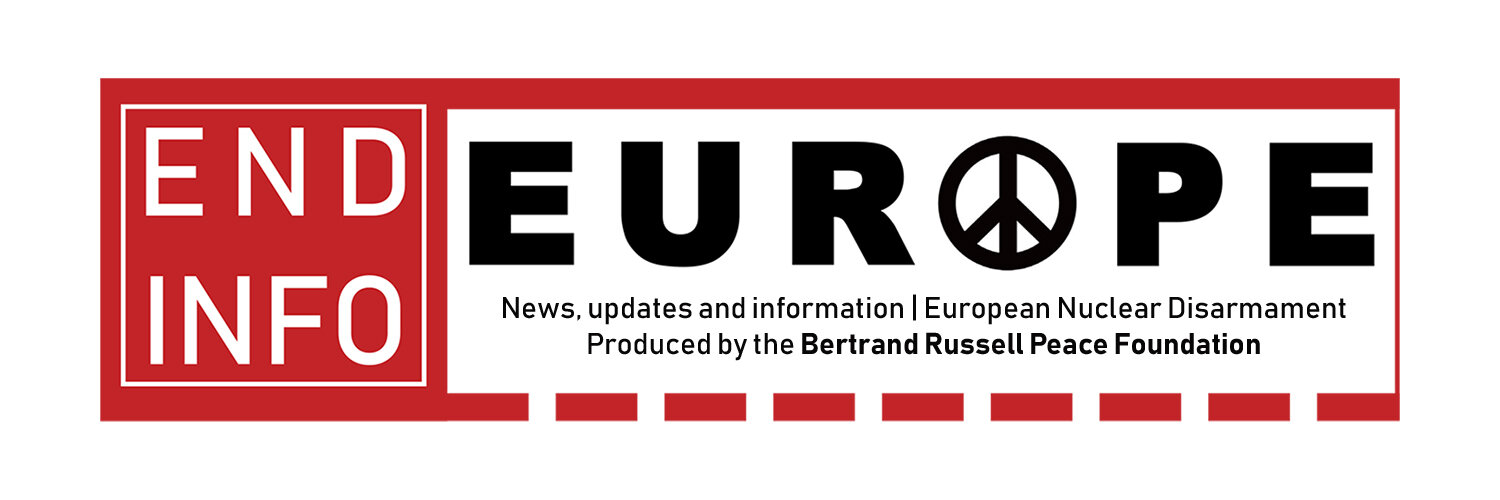
‘Bertrand Russell and the problem of deterrence’ is an abridged version of the first chapter of Ken Coates’ collection of essays and working papers titled The Most Dangerous Decade. Published by Spokesman in 1984, the collection is subtitled: World Militarism and the New Non-aligned Peace Movement. The book is available to buy from spokesmanbooks.org.

* * * 

The new movement for nuclear disarmament in Europe, which has swept across the continent in the first years of the present decade, offers many similarities to the earlier peace movement, remembered now by people entering middle age.

In the late 50s and early 60s, however, life was rather simpler than it is today. The differences between the peace movements of then and now are perhaps as important as their similarities. So, too, are the differences in the contexts in which they seek to act. In 1955, Bertrand Russell and Albert Einstein published the famous manifesto which launched the Pugwash movement, so named because the first international meeting of scientists which it called into being met at Cyrus Eaton’s estate in Pugwash, Nova Scotia.

This document … sets out the classic statement of the perils of nuclear war, which, its authors established, might quite possibly put an end to the human race. Their judgement has lost none of its validity. But the political disputes which divide the world have changed significantly since Russell and Einstein agreed their text. “The world is full of conflicts”, they wrote, “and, overshadowing all minor conflicts, the titanic struggle between communism and anti-communism”. Two-and-a-half decades on, this “titanic struggle” has radically changed its form.

Even in 1955, anti-communism had many exponents, from quasi-feudal despots, to the directors of great capitalist corporations, to social democrats or libertarian socialists. Those opposing communism in 1980 represent a no less incompatible spectrum than before, although the shades of opinion included in it are now perhaps more finely delineated. On the other side, those supporting communism have fragmented into a dizzying variety of schools … Doctrinal disagreements follow these national and regional cleavages, and also, to some degree, overlay them …

Not a whit less divided is the capitalist world. Whilst multinational companies establish a new globalism, serious divisions of economic interest separate the United States from the most potent European nations, and there are widening breaches between both of these power centres and their dynamic competitors in Japan. If conventional socialist doctrines on imperialism are true, then the real world conflict is as likely to follow intercapitalist fractures as it is to remain contained in the ideological rupture of the cold war. At the same time realistic “western” analysis can show that ideological quarrels have relatively easily become exchanges of shot and shell between “communist” states, whilst the basic East-West divide has remained frozen in an uneasy peace …

All this has made the maintenance of peace immeasurably more difficult, since the complex of shifting affinities involves risk that where one dispute between two contenders might be negotiated to a settlement, the actions of a third party may serve to reopen old divisions on a new plane, or create new conflicts immediately after the resolution of existing ones. That more than one of the potential contenders phrase their communiques in the language of Marxism, with quotations from the same scriptures, by no means ameliorates this difficulty.

The fragmentation of interests within the blocs makes the old concept of detente infinitely more difficult to pursue. Even if all the statesmen in all the powers were firmly bent on avoiding war at all costs, they would require consummate expertise and skill to do so. However, it seems rather plain that peace is not exactly the first priority for all of them, so that the avoidance of war requires other advocates, with firmer commitments, if it is to be adequately promoted.

All this would have been a warning to heed even if each of the worlds of Russell and Einstein had simply subdivided: but in fact both parts of their world have also entered other profound crises. Fission has followed crisis, and aggravated it in the process. Apparent economic stability in the West has given way to deep slump, mass unemployment, and aggravated civil disorder in many countries. The once monolithic political conformity of the East has also broken into serial problems, promoting apathy, withdrawal and even non-co-operation on a wide scale. Strident dissidence has become evident among certain minorities. In both halves of this cold peace, troubles now come, not in single spies, but in whole battalions.

However complex the evolution of affairs since they wrote their manifesto, Russell and Einstein were right to pinpoint what has remained the unresolved problem of our time, to which we may find no simple solution in any scriptures, secular or other. In a prophetic moment more than a hundred years earlier, the authors of the Communist Manifesto had spoken of the class struggle (which they clearly saw as a democratic process in the fullest sense of the words), as ending “either in a revolutionary reconstitution of society at large or in the common ruin of the contending classes”.

That “common ruin” now looms over us. It is no longer a question of socialism or barbarism, but of survival or the end of our species. Although this dilemma has confronted us since the Hiroshima explosion in August 1945, we have neither adequately understood it, nor have we yet resolved it. It will be more extensively discussed below.

Yet the existence of this dilemma does not at all annul the other lesser social tensions which demand real change in the structures of our societies, East and West alike. The inhibition of such change itself intensifies the threat of war, while the threat of war is used to reinforce that inhibition.

In his attempt to focus these prospects more than [60] years ago, Bertrand Russell drew three rather evident conclusions: first, that any future large-scale war would bring disaster “not only to belligerents, but to mankind”; second, that little wars would always henceforward contain the risk of becoming great, and that the more of them there were, the more likely it would be that one or another of them might grow to encompass our general destruction; and third, that even were existing nuclear weapons all by agreement to be destroyed, the outbreak of any future major war would ensure that replacements would be used as soon as they could be manufactured.1 So far more than a hundred “little” wars have raged since 1945, and two of them, those in Korea and lndo-China, involved the use of a firepower more horrendously devastating than the totality of that available during the Second World War. To this matter, too, we shall return below. In one sense, this fact does not contradict what Russell said: war in Afghanistan, or in Iran, or in Eritrea, or in Namibia, or in the Lebanon, or who knows where next, does indeed carry the most fearful prospect of escalation, drawing in both active external sponsors and passive bystanders. In another sense, those who have preached the conventional doctrine of deterrence can be yielded (for what it is worth), their claim that ever-enlarging nuclear arsenals in both superpowers have up to now kept them apart from direct engagement one with another, and schooled them in exploring the delicate risks of proxy conflicts. The proxies will take no comfort from this.

This doctrine of deterrence has not stood still, however. Until recently, one of its most loyal British proponents has been Mr Denis Healey, who informed us in the early 1950s that the best guide to the true state of the world was Thomas Hobbes, who understood power politics. For Hobbes, fear was an indispensable component of the impulse to statehood, upon which depended the public peace and the containment of the “war of each against all”, which otherwise raged in the society of natural man. But if this doctrine had been true, Hiroshima would surely have generated sufficient fear to force us all to accept the need for a genuinely international polity. It did not. Instead, it became an obstacle to such a polity. Deterrence theory, founded in one kind of technology, and within a given geo-political balance, has reiterated various rather primitively Hobbesian prescriptions to all who would listen, while both technologies and political realities have been borne along beneath it in a heaving flux of change. Hobbes himself would have been infinitely wiser than his modern epigones. He would never have ignored corporeal being because of a web of words. Order may once have been based on fear, but today fear has reached a point at which it imminently threatens to destroy what it has left of “order”.

When Bertrand Russell sought to explain the confrontation of the nuclear superpowers, back in 1959, he offered a famous analogy:

“Since the nuclear stalemate became apparent, the Governments of East and West have adopted the policy which Mr Dulles calls ‘brinkmanship’. This is a policy adapted from a sport which, I am told, is practised by the sons of very rich Americans. This sport is called ‘Chicken!’ It is played by choosing a long straight road with a white line down the middle and starting two very fast cars towards each other from opposite ends. Each car is expected to keep the wheels of one side on the white line. As they approach each other, mutual destruction becomes more and more imminent. If one of them swerves from the white line before the other, the other, as he passes, shouts ‘Chicken!’, and the one who has swerved becomes an object of contempt. As played by youthful plutocrats, this game is considered decadent and immoral, although only the lives of the players are risked. But when the game is played by eminent statesmen, who risk not only ‘their own lives but those of many hundreds of millions of human beings, it is thought on both sides that the statesmen on the other side are reprehensible. This, of course, is absurd. Both are to blame for playing such an incredibly dangerous game. The game may be played without misfortune a few times, but sooner or later it will come to be felt that loss of face is more dreadful than nuclear annihilation. The moment will come when neither side can face the derisive cry of ‘Chicken!’ from the other side. When that moment is come, the statesmen of both sides will plunge the world into destruction.”2

I do not cite this passage out of piety. Russell’s parable is no longer adequate. As we have seen, various things have changed since 1959. Some were beginning to change, at any rate in minds like Mr Henry Kissinger’s, even before that time.

Some changes were rather evident to ordinary people, more or less instantly. Others were not. Within the game of “chicken” itself, we had the Cuba crisis of 1962. We shall discuss this later, but for our present purposes it is enough to note that Mr Krushchev swerved. This persuaded certain shallow advocates of the game that deterrence actually worked. But rather more significantly, it also persuaded the more faithful Hobbesians among Mr Krushchev’s colleagues that considerably greater effort should be lavished on the perfection of a swerve-proof war machine. Consequently, the nuclear armament balance shifted, if not in the dramatic manner announced by Washington alarmists, at any rate in the direction of something closer to effective parity.

In addition to this, proliferation of nuclear weaponry continued. This is discussed below, and all that we need to say about it here is that it has complicated the rules of the game rather considerably. The French allowed if they did not actually encourage public speculation about the thought that their deterrent was more than unidirectional, if their putative defenders ever showed undue reluctance to perform, in time of need, the allotted role. The arrival of the Chinese as a potential nuclear force produced a new prospect of a three-way “chicken” game, with both main camps holding out at least a possibility that, in appropriate circumstances, they might “play the China card”. But here the metaphor is mixing itself. Staying within the rules Russell advanced, we would have to express it like this: the Chinese “deterrent” could, at least in theory, be set to intervene against either of the other participants in the joust, unpredictably, from any one of a bewildering number of side-entries to the main collision course.

As if this were not problem enough, the war-technology has itself evolved, so that:

a. military costs have escalated to the point where nuclear powers are quite apparently increasingly impotent if they are barred from using what has now become by far their most expensive weaponry; and

b. nuclear weapons technique aspires to (although it may very well fail to meet) infinitely greater precision in attack. This brings nearer the possibility of pre-emptive war, which is a perfectly possible abrupt reversal of standard deterrence presumptions.

To these facts we must add another, of powerful moment:

c. the stability of the world political economy, which seemed effectively unchallengeable in 1959, has been fatally undermined by the collapse of the Keynesian world order, deep slump in the advanced capitalist countries, and growing social tension within the nations of the Soviet sphere of influence, who have not for the most part been able to evolve those democratic and consensual forms of administration which could resolve their political tensions in an orderly and rational manner.

In the interaction of these developments, we have seen the consolidation, amongst other delinquencies, of the doctrine of “limited” nuclear war. We can only reduce this veritable mutation in strategy to Russell’s exemplary folk-tale if we imagine that each participant car in the game enfolds smaller subordinate vehicles, which can be launched down the white line at even greater speed than the velocity of approach of the main challengers. These lesser combatants can, it is apparently believed, be set loose on one another in order that their anticipated crashes may permit time for the principals to decide whether it might _be wise themselves to swerve or not. Any desire of the small fry to change course is already taken care of, because they are already steered by remote control. Of course, the assumption is that those involved in the “lesser” combat will necessarily be destroyed. Maybe their destruction can save their mother vehicles from perishing, although careful analysts think it very much more likely not.

Stated in this way, the game has become even more whimsical than it was in Russell’s original model. But stiffened up with precise and actual designations, it loses all traces of whimsy. The lesser vehicles in the developing game of “limited” war are all of Europe’s nations. Whether or not their sacrifice makes free enterprise safer in New York, or allows Mr Brezhnev’s successors time to build full communism (and we may well be agnostic on both scores) what is securely certain is that after it Europe will be entirely and poisonously dead, and that the civilisations of Leonardo and Galileo, Bacon and Hobbes, Spinoza and Descartes and, yes, Karl Marx, will have evaporated without trace.

Before we consider the project for limited nuclear war in a little more detail, it is necessary to unravel the conventional doctrine of deterrence somewhat further . Advocates of this schema will often repudiate the fable of the chicken game. “It is a malicious travesty”, they will tell us. The vogue question which is then very commonly posed by such people is this: “you complain about the destruction of Hiroshima and Nagasaki: but would these events have taken place, if Japan then had the benefit of a possible nuclear response?” Let us worry this problem a little. First, some obvious points. Did the Japanese in this speculative argument possess an equivalence of weaponry or not? If they were nuclear-armed, but with a smaller number of war-heads, or inadequate delivery systems, it is possible that their retaliatory capacity could be evaluated and discounted, in which case the American attack would presumably have gone ahead. If, on the other hand, the American Government perceived that it might not avoid parity of destruction or worse, it would in all likelihood have drawn back. It might even have hesitated for fear of less than equal devastation. “Aha!” say the deterrent philosophers: “you have conceded our case”. Well, hardly. We must first pursue it for a few steps, but not before pointing out that it has already become completely hypothetical, and already travesties many other known facts about the real Japanese war prospects in August 1945, quite apart from the then existing, real disposition of nuclear weapons. (There are some strong grounds for the assumption that the Japanese would actually have been brought to a very quick surrender if the nuclear bombardment had never taken place, or indeed, even had it not been possible). But for the sake of argument, we are temporarily conceding this special case of the deterrent argument.

Let us then see what happens when we apply it further. In 1967, the Indian Government exploded a “peaceful” nuclear device. Subsequently Pakistan set in train the necessary work of preparation for an answering technology. Since partition, India and Pakistan have more than once been at war. There remain serious territorial claims at issue between them. The secession of Bangladesh inflicted serious humiliation on the Pakistan Government. What possible argument can be advanced against a Pakistan deterrent? We shall instantly be told that the present military rulers of that country are unsavoury to a remarkable degree, that they butchered their last constitutionally elected Prime Minister, and that they maintain a repressive and decidedly unpleasant administration. It is difficult, if not unfortunately impossible, to disagree with these complaints, all of which are founded in reason and justice. But as co-opted theorists of deterrence, we must dismiss them. Our adopted argument is, that if India and Pakistan are to be held apart from their next war, the deterrent is necessary to both sides. Their respective moral shortcomings, if any, or indeed, if all that have ever been alleged, have nothing to do with the case.

Late in April 1981, Mr F.W. De Klerk, the mineral and energy affairs minister of South Africa, publicly admitted that his country was producing a quantity of 45 per cent enriched uranium, which announcement signified that South Africa had the capacity to manufacture its own nuclear armament. This news was scarcely electrifying, since a nuclear device had already apparently been detonated in the South Atlantic during the previous year, arid it had therefore been assumed, almost universally, that the South African bomb already existed. What should the black African “front-line States” then do? Deterrence positively requires that Angola, Zimbabwe and Mozambique should instantly start work on procuring their opposing bombs. After all, South African troops have regularly been in action outside their own frontiers, and the very vulnerability of the Apartheid State makes it perfectly possible that serious military ·contests could break out over the whole contiguous zone. To prevent such war, the Angolan or Zimbabwean bomb represents a prudent and uncontentious investment.

We can say the same thing about the States of the Middle East. To them we might add those of Central America. Would Cuba have been invaded during the Bay of Pigs episode, if she had deployed nuclear weapons? To cap it all, what about Japan? Her experience, surely, would seem to be the most convincing argument for developing an extensive arsenal of thermo-nuclear war-heads. Strangely, these arguments are not heard in Japan. President Mugabe has not voiced them either. Japan’s people have not escaped the customary scissions which are part of advanced industrial society, but if one thing binds them together, it is a virtually unanimous revulsion against nuclear weapons. African States repeatedly insist that they seek protection, not by deterrence, but by the creation of a nuclear-free zone. Clearly they have not yet learnt the lessons which are so monotonously preached in the Establishment newspapers of the allegedly advanced nations.

If we were to admit that all nation States had an intrinsic right to defend their institutions and interests by all the means available to any, then nuclear proliferation would not merely be unavoidable, but unimpeachable within the deterrent model. And it is this incontrovertible fact which reduces it to absurdity; and argues that Russell was in fact right to pose the question as he did. Very soon the chicken game will not only have a cluster of three nuclear States at one end of the white line, and a single super-State at the other, with the Chinese already able to intervene from a random number of side routes: but it will shortly have from 12 to 20 other possible contenders liable to dash, quite possibly unannounced, across the previously single axis of collision.

For those who still believe that this dreadful evolution will be prevented by the treaty on the Non-Proliferation of Nuclear Weapons, we must offer three warning notes. First, the treaty’s Review Conference of August 1980, held in Geneva, failed to agree any “certificate of good health” for its operation, because the nuclear powers had flouted all their solemn promises to scale down their own nuclear stocks. Critics of the treaty said from the beginning that its weakness derived from the fact that under it the nuclear weapons-holding States were assuming the right to police the rest. This could only acquire moral validity if they began themselves to behave according to the same rules which they sought to impose on others. At Geneva, the Review Conference demonstrated that no such behaviour had materialised. Secondly, visible evidence of the collapse of the treaty’s framework has come from the military relationship between the USA and Pakistan since the invasion of Afghanistan by the USSR. Vast conventional weapons shipments to Pakistan have already taken place, and vaster ones are contemplated, in spite of the previous US policy which had withheld arms supplies of all kinds from any State suspected of breaching the non-proliferation treaty. If breaches are now condoned by superpowers wherever their own perceived interests at stake, then the treaty is not merely dead, but rotting away. Thirdly, as an augury, we have the Israeli bombardment of Iraq, which shows what we must expect now that proliferation is effectively uncontrolled. It was, coincidentally, Mr Ismat Kitani of Iraq who presided over the Geneva Review Conference, and who warned that “the failure of the talks would damage world peace”.

Deterrence, in short, was in the beginning, a bi-polar game, and it cannot be played in a multi-polar world. It is therefore collapsing, but the danger is that this collapse will result in universal destruction if alternative approaches are not speedily accepted. This danger arises because deterrence is a doctrine, a hitherto partially shared mythology, a mental scarecrow which may well lose all credibility before the material war potential which gave rise to it has even begun to be dismantled.

There was always, of course, a much simpler rebuttal of the doctrine. It is, was, and has always been, utterly immoral. Unfortunately, this argument, which is unanswerable, is not usually given even the slightest consideration in the world’s war rooms, although there is a fair deal of evidence that the people who staff these sometimes find it difficult to avoid traumatic neuroses about the effects of all their devilish labours.

However, the “lateral” proliferation of nuclear weapons to ever larger numbers of States, is by no means the most drastic process by which such weapons are multiplied. Lateral proliferation will provide more and more problems for the peace of the world, but the “vertical” proliferation of superpower arsenals is fearsome on an infinitely more dreadful scale. And it is the evolution of nuclear war-fighting doctrine and the preparation for limited nuclear war which provides unquestionably the most serious threat we face in the 1980s, disturbed though rational men and women are bound to be by the prospects of the spawning of autonomously controlled atomic war-heads from one troubled region to the next. The ‘’limited’’ nuclear exchange in Europe is likely to take place before one can be prepared on the Indian subcontinent, or yet in Africa. It is also scheduled to deploy as large a proportion of the firepower of the two great arsenals as may be needed.

How did we arrive at this mutation in strategic policy, which has begun to generate weapons designed to fight war rather than to “deter” it?

At the time when Bertrand Russell was campaigning for nuclear disarmament in Britain, there was an imbalance in the nuclear explosive stockpiles, although thermo-nuclear weapons already amply guaranteed the destruction of both superpowers, if they were to venture into war. According to Herbert York, the United States then had between 20 and 40 million kilotons of explosives, “or the energy equivalent of some 10,000 World War II’s”.

“We had reached” wrote York, “a level of supersaturation that some writer characterised by the word ‘overkill’, an understatement in my opinion. Moreover, we possessed two different but reinforcing types of overkill. First, by 1960 we had many more bombs than they had urban targets, and second, with a very few exceptions such as Greater Moscow and Greater New York, the area of destruction and intense lethality that a single bomb could produce was very much larger than the area of the targets. Since all, or practically all, strategic weapons were by then thermo-nuclear, it is safe to assume that those Soviet or Chinese cities which were equivalent in size and importance to Hiroshima and Nagasaki were, by that time, targets for weapons from 100 to 1,000 times as big as the bombs used in history’s only two real demonstrations of what actually happens when large numbers of human beings and their works are hit by nuclear weapons.”3

However, overkill has its limitations: bombs in the megaton class, York tells us, do not become proportionately more lethal as they get bigger. The size of the bombs “outruns the size of the target”. This inevitably wastes much explosive power on “sparsely populated areas”. Nonetheless, if the murderous effect of fallout is considered even in the early ‘60s both superpowers could easily render the entirety of each other’s territories intensely radioactive, and still have many unexpended bombs to spare.

The military doctrine which accompanied the perfection of this technology was one of the “massive retaliation”, in words of Secretary Dulles, or later, “Mutual Assured Destruction” as Defence Secretary McNamara styled it. Although its advocates always insisted that this was a deterrent doctrine designed to prevent war, it did nonetheless, bear an undeniable relationship to Russell’s game of “chicken”, whenever conflict between the two powers entered the stage of open confrontation. But during McNamara’s own period, the seeds of the new doctrine of “flexible response” were already maturing. The assumption out of which this notion was to codify itself was that different levels of nuclear escalation could be defined, permitting an American President a power to move through a spectrum of lesser types of nuclear strike before all-out mutual destruction became unavoidable. In 1964, Mr McNamara specifically mentioned the need for “flexible capability” in nuclear forces. In 1969, Defence Secretary Clark Clifford called for weapons which could be “used effectively in a limited and controlled retaliation as well as for ‘Assured Destruction’.”4

To be fair, this transition was accompanied by much lobbying from European statesmen. Henry Kissinger records some of it in his memoirs; and seeks to place much of the responsibility at the door of his European allies:

“A similar problem existed with respect to tactical nuclear weapons. One might have thought that if our strategic forces tended toward parity with the USSR and if at the same time we were inferior in conventional military strength, greater emphasis would be placed on tactical nuclear forces. This indeed was NATO’s proclaimed strategy of ‘flexible response’. But there was little enthusiasm for this concept within our government. Civilian officials in the State Department and the Pentagon, especially systems analysis experts, were eager to create a clear ‘firebreak’ between conventional and nuclear weapons and to delay the decision to resort to any nuclear weapons as long as possible. They were reluctant, therefore, to rely on tactical nuclear weapons, which they thought would tend to erode all distinctions between nuclear and conventional strategy.

A passage from a study on NATO’s military options reflected this state of mind. This particular study was unable to find any use for nuclear weapons in NATO even though our stockpile there numbered in the thousands: The primary role of our nuclear forces in Europe, the study argued, is to raise the Soviet estimate of the expected costs of aggression and add great uncertainty to their calculations. Nuclear forces do not necessarily have a decisive impact on the likelihood or form of aggression, the study concluded. This was an astonishing statement from a country that had preserved the peace in Europe for over twenty years by relying on its nuclear preponderance. Nor was it clear how forces thought not to have a decisive impact could affect the calculations of a potential aggressor. It was a counsel of defeat to abjure both strategic and tactical nuclear forces, for no NA TO country – including ours – was prepared to undertake the massive buildup in conventional forces that was the sole alternative.

To confuse matters further, while American civilian analysts deprecated the use of nuclear weapons as ineffective and involving a dangerous risk of escalation, our allies pressed a course contradicting the prevailing theory in Washington. They urged both a guaranteed early resort to tactical nuclear weapons and immunity of their territories from their use. Inevitably, discussions that had been going on since 1968 in the NATO Nuclear Planning Group began to produce serious differences of opinion.

This group had been set up by Secretary McNamara as a device by which our allies could participate in nuclear decisions without acquiring nuclear weapons themselves. Denis Healey, then British Minister of Defence, had explained his government’s view when Nixon visited London in February 1969. In Healey’s judgment NATO’s conventional forces would be able to resist for only a matter of days; hence early use of nuclear weapons was essential. Healey stressed the crucial importance of making the Soviets understand that the West would prefer to escalate to a strategic exchange rather than surrender. On the other hand, NA TO should seek to reduce devastation to a minimum. The Nuclear Planning Group was working on solving this riddle; its ‘solution’ was the use of a very small number of tactical weapons as a warning that matters were getting out of hand.

What Britain, supported by West Germany, was urging came to be called the ‘demonstrative use’ of nuclear weapons. This meant setting off a nuclear weapon in some remote location, which did not involve many casualties – in the air over the Mediterranean, for example – as a signal of more drastic use if the warning failed. I never had much use for this concept. I believed that the Soviet Union would not attack Western Europe without anticipating a nuclear response. A reaction that was designed to be of no military relevance would show more hesitation than determination; it would thus be more likely to spur the attack than deter it. If nuclear weapons were to be used, we needed a concept by which they could stop an attack on the ground. A hesitant or ineffective response ran the risk of leaving us with no choices other than surrender or holocaust.

But what was an ‘effective’ response? Given the political impossibility of raising adequate conventional forces, the Europeans saw nuclear weapons as the most effective deterrent. But they feared the use of them on their territories; what seemed ‘limited’ to us could be catastrophic for them. The real goal of our allies - underlining the dilemma of tactical nuclear weapons - has been to commit the United States to the early use of strategic nuclear weapons, which meant a US-Soviet nuclear war fought over their heads. This was precisely what was unacceptable to American planners. Our strategy - then and now - must envisage the ultimate use of strategic nuclear weapons if Europe can be defended in no other way. But it must also seek to develop other options, both to increase the credibility of the deterrent and to permit a flexible application of our power should deterrence fail.”5

It was in March 1974 that the new Defence Secretary, James Schlesinger, announced a comprehensive justification for limited nuclear war. Since then, although United States spokesmen, including President Carter himself, have havered backwards and forwards on this question, “flexible targetting” has apparently gone remorselessly ahead, and the concomitant doctrines of limited war have become military orthodoxy. It is this fact which rendered the revelation, in August 1980, of the contents of Presidential Directive 59 so unsurprising to the specialists. It is also this fact which had previously provoked British military leaders and scientific planners, like Lord Mountbatten and Lord Zuckerman, to unrestrained protest.6

Of course, military doctrine is an arcane science, and while specialists debated these issues they were accorded a respectful if distant, albeit widespread, apathy. But, as the practical conclusions of their debates became plain, public moods began to change. First, the project for an enhanced radiation (or “neutron”) bomb brought home to a wide audience the apparent truth that warfighting, as opposed to “deterrent” weapons were far advanced in preparation. Then, the Soviet installation of SS-20 missiles, which could strike European or Chinese targets, but not American ones, aroused concern not only among Governments. And finally, the NATO decision to “modernise” theatre nuclear forces in Western Europe, by installing Pershing II missiles and land-based cruise missiles throughout Europe, brought forth a storm of objections, and the beginning of a new approach to European disarmament.

Neither the Soviet, nor the American “modernisations” were uniquely responsible for this profound movement of opinion. Europeans had begun to perceive their intended role as victims: limited war in Europe meant that schedules were being evolved which made them prime targets. If any of them, on either side, were over-run, they could anticipate a double jeopardy: nuclear bombardment from the “enemy” while they were themselves a nuclear threat, followed by nuclear bombardment by their “allies” if anyone was left to hit. In this growing realisation, Europe began to generate a continental Resistance, from Scandinavia to Sicily, from Poland to Portugal. This epic movement is still in its infancy, but already it demands attention.

Already there have been two major gatherings of its supporters, at the Brussels Convention for Nuclear Disarmament held in July 1982, and at a second, larger, meeting which was held in Berlin from 9 May-15 1983. In 1984, a third Convention has been scheduled for Perugia, in July. There can be little doubt that Russell’s ghost will draw encouragement from this widening response to the dangers against which he warned so cogently, and with such prescience.

Footnotes

Parts of this text appear in Heresies (Spokesman, 1982). Other parts were included in the Introduction to Alva Myrdal: The Dynamics of European Nuclear Disarmament, (Spokesman, 1981).

1. Bertrand Russell: Commonsense and Nuclear Warfare, London, Allen and Unwin, 1959, p.29.

2. Ibid., p.39.

3. Herbert York: Race to Oblivion -A Participant’s View of the Arms Race, New York, Simon and Schuster, p,42.

4. See Jerry Elmer: Presidential Directive 59 - America’s Counterforce Strategy, Philadelphia, American Friends Service Committee, 1981.

5. The White House Years, Weidenfeld and Nicholson & Michael Joseph, pp.218-9.

6. Apocalypse Now? Spokesman, 1980.
Common security for a New World Order

From END Info 27 - Download

By Alexey Gromyko

Alexey Gromyko is the Director of the Moscow-based Institute of Europe of the Russian Academy of Sciences. He delivered the following talk at the second plenary of the International Peace Bureau’s Second World Peace Congress, (Re)Imagine our World: Action for Peace and Justice, held in Barcelona from 15 to 17 October, 2021.

Earlier this year I was honoured to be invited and become a member of the High-Level Advisory Commission for Common Security 2022. The Commission is a part of a project launched by the Olof Palme International Centre, the International Trade Union Confederation, and the International Peace Bureau with the support of SIPRI [Stockholm International Peace Research Institute]. I am grateful to Reiner Brown and Anna Sundstrom for involving me in this cooperation.

Next year we mark the 40th anniversary of the Report of the Independent Commission on Disarmament and Security Issues under the Chairmanship of Olof Palme. The Report introduced the concept of Common Security and contributed to the end of the Cold War. However, these days the ideas behind Common Security are almost forgotten in spite of the fact that we again live in extremely perilous times.

The pandemic has affected each and every significant aspect of life – global health, global economics and politics, humanitarian and social issues. The pandemic, with all its human drama and tragedy, could and should have brought the world together. Instead political divisions have become only deeper.

The relative levels of poverty and social inequalities across the planet were going up before the pandemic. Covid has enhanced these negative trends. 1% of the world population owns more than 80% of global wealth. The global debt today is about 250 trillion USD (322% of the world GDP). The Euro-Atlantic area has a debt to GDP ratio of 380%; China’s ratio is 310%. Russia is luckier – its national debt is less than 21% of the GDP.

The neoliberal model, originating from Reaganomics and Thatcherism, still dominates the world. Today there are few countries, which can boast of welfare states and social contracts, of a system where the social rights of a human being are protected from cradle to grave. In ‘better days’ the concepts of the Third Way, a stakeholder society, communitarianism and others were put forward. Amitai Etzioni and John Galbraith, Robert Putnam and David Marquand, Will Hutton and John Plender and many others made important contributions to these efforts. Politicians like Jeremy Corbyn made efforts to defend the Welfare State from attack and continue to work for social justice, peace and disarmament.

Despite the Great Recession, neoliberalism continues to dominate the international economy. The global financial oligarchy continues to rule the world. Even the middle class has suffered a lot, which resulted in the rise of a New Populism. To offer just one telling example: while in the 1960s the CEO of a major US company would be paid, on the average, 20 times the wages of a regular employee, today the ratio is roughly 300:1.

Competition between the leading centres of power in the world accelerates and intensifies. The states involved resort to political, economic, ideological, military and information instruments of domination and coercion. Even the work on COVID vaccines has exacerbated tensions between states.

Differences between the United States and China are becoming one of the fundamental elements in this competition. Some experts believe that confrontation between the US and China will result in a new edition of bipolarity. Others maintain that the rivalry between the world’s two leading economies is a bilateral conflict and cannot evolve into a bipolar world order similar to that of the Cold War. In any case, US-China military tensions are a major risk. These tensions are a time bomb. There is a real risk of a dangerous escalation over Taiwan.

International mechanisms are working less and less effectively. Instead, nations tend to rely on regional projects, regional cooperation, localisation. We observe not only strategic decoupling between the United States and its European allies. In addition, Washington now wants to decouple itself economically and technologically from China. Multilateral institutions are stagnant or in crisis. Having just marked 75 years since its creation, the United Nations, this universally recognised organisation, is struggling with all the negative effects of confrontation among its members.

The entire architecture of international security is almost destroyed. Environmental issues and climate change deserve massive attention and action. But the threats of militarisation, a new arms race, risks of an unintentional military conflict between nuclear powers are disproportionately neglected. Many expectations, connected to the end of the Cold War, were dashed. The bitter fact is that the world since then has not become a safer place. Some people say that now it is a more dangerous place than in the 70s and 80s. Russia experienced the first external shock in the 90s, when NATO took a decision to expand. The second shock came with the bombing of Yugoslavia in 1999. The third shock was the invasion of Iraq in 2003.

Still there is hope. The United Nations has survived. The climate change and green agenda are reverberating across the planet. There are more and more people realising that arms control and disarmament are not less important. Let me say that perhaps it is more important because it deals with immediate existential threats.

Today, in 2021, it is so important to look around and to think about what big ideas can help. One of them is the concept of Common Security. Initially it was elaborated in the Olof Palme Commission Report back in 1982. Nowadays the task is to preserve the essence of the Palme commission Report on Common Security and to build upon it. The core of its philosophy should be kept intact while a range of recommendations should be modernised to carry forward the Commission’s mission.

Common Security is a comprehensive phenomenon which embraces in equal manner the spheres of economy, social life and security as such. Security should be treated as equal and indivisible common good. Security at the expanse of others is not achievable. Common security is one of the most important strategies, responsible for the well-being of humankind. The basis of Common Security rests on the fundamental right to life. Therefore it should be treated as a responsibility not a privilege of governments to act in the interests of Common Security.

International and interstate relations will never be free from competition and even rivalry. Therefore, Common Security should be underpinned by strong and viable international mechanisms, in the centre of which should stay the United Nations. Any enforcement in international relations, including military enforcement, should be strictly guided by Chapter VII of the UN Charter. Goodwill and confidence-building measures are indispensable elements of Common Security.

Arms control and disarmament policy are crucial components of Common Security. Robust support should be given to the Gorbachev-Reagan statement of 1985 and the Putin-Biden statement of 2021 that a nuclear war cannot be won and should never be fought [see box 1]. To fight a nuclear war is suicidal and just crazy. One day nuclear deterrence should be replaced by the concept of Common Security.

The politics of nuclear deterrence will last for quite a while. Nevertheless, Common Security to a large extent can be achieved already in the age of nuclear deterrence. The concept and practice of Common Security will play a substantial role in phasing out the policy of nuclear deterrence. Meanwhile the extension of New Start Treaty for 5 years, as well as negotiations of all P5 states on the future of strategic stability, should be fully supported. A multilateral and verifiable moratorium on the deployment of Intermediate Nuclear Forces in Europe should also be supported.

Common Security means enhancing stability by increasing transparency, avoiding dangerous military activities, and providing dedicated political and military-to-military communication channels that would avoid escalation of incidents that might occur.

All nations should exert their efforts to achieve ratification of Comprehensive Test Ban Treaty and to make it judicially enforceable. The development and deployment of weapons in outer space or weapons directed against objects in outer space should be prohibited. The Non-Proliferation Treaty is further jeopardised by the intention of the US and the UK to transfer nuclear technologies to Australia for military purposes.

My grandfather, Andrey Gromyko, told us – children and youngsters – 40 years ago: “When I was negotiating, my brothers – killed in the WWII – whispered in my ears, ‘Andrey, don’t give away what we died for’.” And millions of other Russians who survived the war, could tell the same.

I do not know, how many people these days know that Andrey Gromyko was a sincere supporter of the abolition of nuclear weapons. He was a true supporter of the United Nations, which he helped so much to design and launch. His father fought in two wars, the Russia-Japanese War and then in WWI. The grandmother of my wife, as a girl, saw how her mother was killed by fascists. And millions of other people in Russia experienced similar horrors.

My father was an active member of the famous Pugwash movement and of the Dartmouth meetings. For many years he stood as a scientist for the abolition of apartheid in South Africa. And there were hundreds and thousands in the Soviet Union like him.

Russia was destroyed in 1917, it barely survived in 1941, and then again it collapsed in 1991. Why I am recalling all this? Because I want to say that Russia has suffered a lot in the 20th century. And we have exceeded all quotas for wars, revolutions and counter-revolutions.

In new times Russia is routinely accused of all possible and impossible sins. Russia is a complicated country. But it was Russia which urged the US not to abandon the ABM Treaty in 2002, it urged NATO to ratify the Conventional Forces in Europe Treaty, again it urged the US not to leave the Intermediate Nuclear Forces in Europe Treaty in 2018 and recently it urged them not to abandon the Open Skies Treaty.

Russian scientists continue to exert efforts to re-establish arms control agenda and to stop brinkmanship in Europe. For more than a year now the Institute of Europe and the Institute for the US and Canadian Studies of the Russian Academy of Sciences have been working with the European Leadership Network and many other colleagues from Europe and the United States on de-escalation of relations between Russia and NATO [see box 2]. Last December we published a report on Military Risk Reduction in Europe. It was signed even by two former secretary-generals of NATO.

Common Security remains an indispensable condition for the salvation of humanity from extinction.

Box 1

U.S.-Russia Presidential Joint Statement on Strategic Stability

JUNE 16, 2021

We, President of the United States of America Joseph R. Biden and President of the Russian Federation Vladimir Putin, note the United States and Russia have demonstrated that, even in periods of tension, they are able to make progress on our shared goals of ensuring predictability in the strategic sphere, reducing the risk of armed conflicts and the threat of nuclear war.

The recent extension of the New START Treaty exemplifies our commitment to nuclear arms control. Today, we reaffirm the principle that a nuclear war cannot be won and must never be fought.

Consistent with these goals, the United States and Russia will embark together on an integrated bilateral Strategic Stability Dialogue in the near future that will be deliberate and robust. Through this Dialogue, we seek to lay the groundwork for future arms control and risk reduction measures.

Box 2

Recommendations of the Participants of the Expert Dialogue on NATO-Russia Military Risk Reduction in Europe

DECEMBER 2020

NATO Nuclear Weapons Exercise Over Southern Europe

From END Info 27 - Download

By Hans Kristensen

The following article first appeared on the Federation of American Scientists website, October 20 2021. The original publication was made possible by generous support from the John D. and Catherine T. MacArthur Foundation, the New Land Foundation, the Ploughshares Fund, and the Prospect Hill Foundation. The statements made and views expressed are solely the responsibility of the author.

NATO announced on Monday, 18 October 2021, that it had started its annual nuclear exercise code-named Steadfast Noon. The week-long exercise is taking place over Southern Europe and involves aircraft and personnel from 14 NATO countries.

According to the NATO statement, “Steadfast Noon involves training flights with dual-capable fighter jets, as well as conventional jets, backed by surveillance and refuelling aircraft. No live weapons are used. This exercise helps to ensure that NATO’s nuclear deterrent remains safe, secure and effective.”

The nuclear bases in southern Europe have received several upgrades during the past few years. This includes adding additional security perimeters to strengthen protection of the nuclear weapons stored at the bases. Two of these bases – Aviano in northeast Italy and Incirlik in southern Turkey, were upgraded over the past five years.

The second nuclear base in Italy – Ghedi near Brescia – that might be part of Italy’s hosting of this year’s Steadfast Noon exercise, is currently undergoing several important nuclear weapons related modernizations that are intended to serve the NATO nuclear strike mission for years.

Of the 14 nations involved, Dutch F-16s and German Tornadoes are operating out of Ghedi AB alongside Italian Tornados, while U.S. and Belgian F-16s and possibly Czech Gripen are operating out of Aviano AB.

The timing of the Steadfast Noon exercise coincides with the meeting of the NATO ministers of defense later this week, although it is unclear if the timing is coincidental. NATO has greatly reduced (as has Russia) the number of non-strategic nuclear weapons in Europe since the Cold War. The remaining weapons were probably headed for withdrawal had it not been for Russia’s invasion of Ukraine in 2014. And with claims that Russia is increasing its non-strategic nuclear arsenal, NATO has since reemphasized the importance of the U.S. tactical nuclear weapons in Europe. During the Steadfast Noon exercise at Volkel Air Base in 2020, for example, the NATO Secretary General showed up at the base for a photo-op.

Ghedi: Nuclear Base Profile

NATO announced the Steadfast Noon is taking place over southern Europe but did not identify the main operating base. Steadfast Noon exercises are hosted by a different country each year. Last year it was hosted by the Netherlands and centered at Volkel AB. The reference to southern Europe implies this year’s Steadfast Noon is hosted by Italy and probably centered at Ghedi AB and Aviano AB is northern Italy (Aviano hosted in 2010 and 2013).

Ghedi AB is home to the Italian Air Force’s 6th Stormo wing, which is tasked to employ U.S. B61 bombs with PA-200 Tornado of the 102nd and 154th fighter-bomber squadrons. There are an estimated 15 B61 bombs stored in underground vaults at the base. The bombs are in the custody of the USAF’s 704th Munition Support Squadron (MUNSS), a 130-personnel strong security and maintenance unit embedded at the base.

Ghedi AB is currently undergoing significant upgrades to receive the new F-35A fighter-bomber next year, installing double-fence security perimeters, and having recently completed modernizing the Weapon Storage and Security System (WS3) and Alarm Communication and Display (AC&D) system. The contract for the WS3/AC&D work, which was awarded in September 2016, provided for sustainment upgrades to the WS3 cryptographic system used to encrypt WS3 alarm data, and will perform an AC&D system upgrade by replacing obsolete components and the buried cable. These upgrades are clearly visible on satellite images, as are a new “bunker building” under construction in the 704th MUNSS area along with the new Secure Transportation and Maintenance System (STMS) trucks (see images below).

The new double-fence security perimeters around eight protective aircraft shelters (left side of image) as well as the former nuclear alert area (lower right side) are similar to the security upgrades previously completed at two other bases in southern Europe: Aviano and Incirlik air bases. The area inside the perimeters is commonly referred to as the NATO area, a reference to the NATO nuclear strike mission they support. In the 1990s, NATO installed a total of 11 underground vaults inside 11 protective aircraft shelters at Ghedi AB. Each vault can store up to four B61 bombs (normally only one or two bombs are present).

But there’s a mystery: The new security perimeters only surround 10 of the 11 shelters. One possibility is that the remaining vault in the 11th shelter is a training vault, or that the number of active vaults has been reduced. But a satellite image from April 2018 might provide a hint. The image appears to show the markings from the burying of the new AC&D cables that connect the vaults in the shelters with the monitoring and communications facilities at the base. By retracing the cables markings, a pattern emerges: the cables appear to connect exactly 11 shelters, including seven inside the new security perimeter. Moreover, the cables appear to form two loops, possibly so that damage to a cable in one spot won’t cut off communication with the vaults on the other side (see image below).

There is another mystery: Several shelters connected to the apparent AC&D cable grid are located outside the new security perimeters (right side of image), and several shelter that do not appear to be connect to the grid are inside the perimeter (left side of image). Since survivability was one of the justifications for building vaults instead of a central weapons storage area, it would make sense that vaults would be scattered across the base. But the 11 vaults were completed at a time when there were many more nuclear bombs stored at Ghedi AB than today: over 40 bombs in 2000 compared with about 15 bombs today.

Perhaps the four vaults outside the perimeters are backup vaults that do not contain bombs under normal circumstances. All remaining weapons would be stored in the seven vaults inside the perimeters under normal circumstances. With a capability to store up to four B61 bombs each, even the five vaults inside the main security perimeter have more than enough capacity to store the 15 bombs currently estimated to be located at Ghedi AB.

Weapons And Capabilities

These upgrades at Ghedi AB are intended to support the NATO nuclear strike mission at the base for decades into the future. The F-35A, which will begin arriving at the base probably as early as in 2022, is significantly more capable than the Tornado aircraft it replaces.

Moreover, the B61-12 gravity bomb is about three times as accurate as the B61-3/-4 bombs current stored at the base. The increased accuracy is achieved with a new guided tail kit that will enable strike planners to hold at risk targets more effectively with the B61-12 than with the current B61 versions. Like the B61s currently at the base, the B61-12 is thought to have four selectable yield settings ranging from less than 1 kilotons to about 50 kilotons. But with the increased accuracy, a strike planner would be able to select a lower yield option for the attack and therefore create less radioactive fallout, or attack targets that currently require a higher-yield strategic bomb from a B-2 bomber.

The combination of the F-35A and B61-12 represent a significant improvement of the military capability of the NATO dual-capable aircraft posture in Europe. Following the final drop test from an F-35A in a few weeks ago, for example, the chief of the U.S. Air Force Air Combat Command’s strategic deterrence and nuclear integration division, Lt. Col Daniel Jackson, said that “Having a 5th Generation DCA fighter aircraft with this capability brings an entirely new strategic-level capability.” He explained further: “The B-2 bomber was the prominent nuclear capable stealth aircraft, but “Adding ‘nuclear capable’ to a 5th-Gen fighter that already brings several conventional-level capabilities to the table adds strategic-level implication to this jet.”

Re-published by permission of the author. See https://fas.org/blogs/security/2021/10/steadfastnoon2021/ for original post.

The struggle for a Nuclear Weapons Free World

From END Info 27 - Download

By Tom Unterrainer

Where are we in terms of achieving nuclear abolition? Is it possible to make definite and precise claims about this? It might be more useful to start by looking at the current state of nuclear risks, by way of providing context for later comments. To do this, we must look at the state of play in the United States and allied powers.

I suspect that there is a consensus for the claim that nobody in the last generation did more to highlight the risks posed by nuclear weapons than former US President Donald Trump. It wasn’t just that Trump spoke about nuclear weapons so much or that his Nuclear Posture Review clearly defined such weapons as possible war fighting devices. It wasn’t just that Trump trashed non-proliferation, arms control and similar treaties and disorganised what previously stood as a relatively stable and predictable ‘nuclear order’. It wasn’t just that his administration spoke of ‘useable’ nuclear weapons and moved the US military-industrial complex into a new arms-race footing. It wasn’t even the wide-spread perception of his political unpredictability that ramped up tensions so dramatically, though it surely didn’t help. The actual scale of Trump’s impact on nuclear questions is illustrated by the fact that his own military thought he was capable of ordering a nuclear attack on China in the aftermath of his electoral defeat. General Mark Milley, chairman of the US Joint Chiefs of Staff, was so concerned at the prospect that he telephoned his Chinese counterpart, General Li Zuocheng, not once but twice to assure him that the military would not allow Trump to launch a nuclear assault. The details of these calls are contained in Bob Woodwards book, Peril. Can you imagine? General Milley seemed certain that Trump could be contained in the event of such an order. He seemed to think that such an order was a distinct possibility. What would have happened if such an order was given? Would the Imperial Presidency really have gone quietly into the night, thwarted by a General or two? Nothing seems certain.

Trump is no longer in office and, as such, tensions have most certainly been reduced from this high point. But they have not gone away. There was some hope that a Biden Presidency would open a new era of nuclear diplomacy, risk reduction and progress on disarmament. I’m afraid that none of this looks likely. Nobody thinks that Biden is about to ‘push the button’, of course. But whilst some hoped that his Nuclear Posture Review might open the way to a new, more rational, era of policy such hopes have been dashed by the removal of Leonor Tomero from the process. She was fired. An expert in non-proliferation and arms control, Tomero was seen as someone committed to undoing the damage of recent years and equally committed to taking a serious look at questions around ‘sole use’ and ‘no first use’ of nuclear weapons. What should we now expect from Biden’s Nuclear Posture Review?

His attitude towards and support for the modernisation of US nuclear weapons – in fact, not just modernisation but a whole new generation of such weapons, his failure to re-start US participation in the JCPOA (Iran Deal), the continued ratcheting of tensions with China and Russia: none of this looks promising. Even the eleventh-hour US agreement to accept Russia’s offer of extending New START for five years – a welcome move – was soured by Secretary of State Anthony Blinken’s comments, which portrayed New START in terms of restricting Russian strategic weapons and called for China to be forced into this bilateral treaty. Blinken failed to mention the US’s own strategic nuclear forces at all. The departure of Trump has allowed for the US, under Biden’s leadership, to enthusiastically re-engage with NATO, to assert US commitment to the Alliance and to move ahead with expanding NATOs activities well beyond the Atlantic region.

And then we have AUKUS – a trilateral agreement between Australia, the United Kingdom and the US – which not only tramples over the Non-Proliferation Treaty with respect to supplying nuclear power technology for non-peaceful purposes but which heralds a anglophone military pact in the South Pacific with nuclear at the heart of it.

Of course, the junior nuclear-power in the AUKUS triumvirate – the UK – has breached the NPT all on its own, with the announcement that it will increase the upper threshold of its nuclear warhead stockpile against a long-term trend and commitment to overall reductions. What did Biden and his administration make of the UK’s ‘Integrated Review’? We should assume that its contents and direction were wholly endorsed by US policymakers and military leaders.

All of which paints a troubling picture. But this is no surprise. If the risks posed by nuclear weapons were not troubling, there would be no need for meetings like this and organisational efforts like Nuke Free Europe.

So let us turn our attention towards the pressing organisational and action opportunities that exist in Europe. We have had a successful month of action, where peace and disarmament organisations in Germany, Belgium, Netherlands, Italy, France, England and Scotland mounted activities to highlight the presence of nuclear weapons, to call for an end to nuclear sharing, an end to the arms race and for states to sign the Treaty on the Prohibition of Nuclear Weapons. Such joint activity is a big step forward.

Coming up next week is the COP climate change conference in Scotland, which will see thousands of activists gathering, discussing and planning to meet the challenge posed by impending climate catastrophe. It has been said that those of us in the peace and anti-nuclear movements see a situation where humanity is faced with two existential threats: climate change and its consequences that could become fatal within a generation and the nuclear threat, which could become fatal next year, maybe … or next month, perhaps … or maybe later this evening. Alertness to one of these risks surely opens the door for alertness to both: we should think carefully about building upon work already underway to work across these issues. Perhaps Nuke Free Europe could send a message to those demonstrating at COP, spelling out the connections between our issues.

Then there is the Treaty on the Prohibition of Nuclear Weapons. Support for the Treaty grows and as we come to understand all the opportunities presented by the text, new opportunities for action will develop. The recent decision by Norway to attend the State Parties meeting in Vienna in March 2022 opens the prospect of other NATO member-states doing likewise. People will probably have seen NATO Secretary General Jens Stoltenberg’s comments that the Norwegian government will have to explain itself to NATO. Stoltenberg, a former Norwegian Prime Minister himself, should perhaps concentrate on explaining himself to the Norwegian people. However, NATOs reaction to the Norwegian decision demonstrated the enduring issues with that organisation with respect to prospects for nuclear disarmament.

For the peace movement, Vienna raises the prospect of joint action and joint activity. We should surely try to meet in Vienna, but can we do more? What parts of the TPNW might offer us opportunities for concrete action? One possibility is around the question of nuclear testing. The Treaty commits signatories to seek redress for the legacies of nuclear testing. What can Ireland and Austria – two EU member states and both ratifiers of the TPNW – do, with the support of the peace movements, to hold France to account over the legacies of nuclear testing in Algeria? What about the presence of the US bombs in Germany, Italy, Belgium and the Netherlands? All these weapons are based on designs that have been tested at some point. Where were they tested? What impact did the tests have? What responsibilities might the ‘nuclear sharing’ countries have for hosting instruments of mass annihilation that have been tested at some point? Surely we should work together to find out.

What of the European Union, European Parliament and related bodies? In a recent report, The EU’s Arms Control Challenge: Bridging the nuclear divides (April 2021), Clara Portela of the EU Institute for Security Studies argues that:

the EU could consider relaxing its opposition to the TPNW and developing a modus vivendi with it. Because of the dominance of NATO allies protected [sic] by the US nuclear ‘umbrella’ among EU members, its stance on disarmament appears closer to that of the European [Nuclear Weapon States] than to those states advocating the [TPNW]. The prevalence of conservative views on disarmament accentuates the misalignment between the EU and NPT membership.

She continues:

The EU can help bridge the cleavage between those who contest the compatibility of the Ban Treaty with the NPT – mostly NATO members – and those who defend it. With the TPNW already in force, the EU can highlight that it does not rival the NPT, as its signatories remain active members of the NPT process. The Council should acknowledge thew legitimacy of the Ban Treaty as a reaction to the current disarmament stalemate, and help rebuild an agenda that engages with the entire NPT community.

This all sounds promising, and it should be hoped EU leaders take note of the arguments Portela sets out in this section of her report. Whilst it is clear that the EU is attempting to grapple with the TPNW beyond simple criticism, it seems likely that in the absence of peace movement initiatives it will attempt to reconcile the TPNW framework with a reconstruction of the accepted, ‘gradual’ and ‘step-by-step’ approach to disarmament that the Trump administration overturned. Reassembling a framework of arms control and non-proliferation would undo some of the damage inflicted by Trump but such a process should not be used to obscure or disrupt the abolitionist drives of the TPNW process.

The European peace movements should seek dialogue and cooperation with European Parliamentarians and their political groupings to ensure that the a renewed EU approach to arms control does not undercut the thrust of the TPNW. This means meetings, conferences and appealing to our existing friends in the European Parliament – as well as the two EU states already signed up to the TPNW – for joint work and cooperation.

Nuke Free Europe has focussed efforts on demands for an end to the new nuclear arms race, an end to nuclear sharing and for European states to sign up to and ratify the TPNW. These are important demands that will endure. We should also take this opportunity to think more widely about prospects for establishing a European Nuclear-Weapons-Free Zone. What would such a zone look like? Who would or could take part? How would proposals for establishing such a zone be formulated? What political levers are in place for starting a serious discussion in the political sphere? Even the ‘gradualist’ wing of disarmament exemplified by the ‘Stepping Stones Initiative’ of 2020 calls for states “to support the establishment of Nuclear Weapons-Free Zones in all regions of the world”. Similar wording was included in the 2010 NPT RevCon ‘Action Plan’. If those states and international organisations that wish to focus upon the NPT process and a gradual, incremental move to multilateral disarmament wish to avoid another ‘abolitionist wave’ like the TPNW, then they should think carefully about turning words into actions. The combined efforts of the peace movements across Europe and beyond can play an indispensable role in focussing their attention.

Protests against US nuclear weapons in Germany: Nuclear Sharing Must End!

From END Info 27 - Download

Despite the challenges presented by the Coronavirus, the nationwide campaign Büchel is everywhere! nuclear weapons free now and the International Campaign to Abolish Nuclear Weapons (ICAN), succeeded in leading a broad political discussion about NATO’s dangerous nuclear deterrence policy regarding US nuclear weapons stationed in Büchel. We received prominent support from SPD parliamentary group leader Rolf Mützenich, who publicly raised the issue of ending Germany’s nuclear sharing arrangement. Our campaign group, Abolish nuclear weapons - start with us!, consisting of more than 70 peace movement organizations/groups, has increased pressure on the German government to withdraw the estimated 20 US nuclear bombs from Büchel. Germany must finally sign the 2017 Treaty on the Prohibition of Nuclear Weapons and become nuclear weapons-free, instead of implementing a planned nuclear “modernization”! Against this background, a “human chain” took place alongside the Büchel air base on September 5, 2021, exactly three weeks before the Bundestag elections (see further down in the text). Currently, the German parties of the so-called “traffic light coalition” (Social Democratic Party, Alliance90/the Greens, and Free Democratic Party) are holding coalition talks about their joint approach to nuclear weapons policy.

Political, Military & Industrial Background

Even though the Cold War ended 30 years ago, about 20 US nuclear bombs are still deployed at the German air force base Büchel in West Central Germany. German pilots are trained to take off with these bombs in their Tornado fighter jets when the order comes from the US president, through NATO, to drop them on their targets. This horrifying vision is part of the “nuclear sharing agreement” in NATO, with its nuclear deterrence policy, which includes a nuclear first-strike option.

These weapons of mass destruction – illegal and criminal under German, US, and international law – are scheduled to be replaced in the near future by expensive new, precision-guided nuclear weapons – the B61-12 – in a $10-$12 billion program of the US National Nuclear Security Administration’s nuclear weapons complex.

At least three US national laboratories (the Sandia and Los Alamos Labs in New Mexico, the Y-12 Complex in Tennessee) along with the Kansas City Plant in Missouri, are part of B61-12 construction, mainly through giant weapons contractors including Boeing (tailfin kit: $1.8 billion), Lockheed-Martin, Honeywell, and Bechtel. Around 400 B61-12 bombs are to be refurbished, at a cost of around $25 million per bomb (according to Hans Kristensen, director of the Nuclear Information Project at the Federation of American Scientists) making them more costly than if they were made of solid gold.

New developments in Büchel

Currently, Germany’s Büchel nuclear weapons base is to be expanded between June 2022 and January 2026 at a cost of $299 million (€259 million). This will be done at all six US nuclear weapons sites in Europe that are part of so-called “nuclear sharing” (Belgium, Netherlands, Italy, and Turkey). These construction measures serve to prepare for the deployment of the new B61-12 nuclear bombs, the production of which will begin in the United States at the end of this year. For these four years, Luftwaffe Squadron 33 with its Tornado fighter jets will move from Büchel to the Nörvenich military base near the city of Cologne. In the coming years, the old nuclear bombs (B61-3s and B61-4s) are to be replaced with the new B61-12s. At Büchel, the construction plans include expanding the runway, as well as modernizing the nuclear weapons infrastructure. For example, special containers in the aircraft hangars, where the approximately 20 bombs are stored, are to be renewed.

New nuclear weapon carrier fighter jets

For Germany’s new government, the decision on the acquisition of new nuclear weapons carrier aircraft from the US is pending, and is estimated to cost up to $9.248 billion, or €8 billion. Instead of buying the expensive and faulty US F-35 nuclear weapons carrier – as Belgium, the Netherlands and Italy plan to do – another US fighter jet is up for debate. Until 2040, when the EU’s Future Combat Air System (FCAS) nuclear weapons fighter is to be developed, Boeing’s F/A18, which can also land on US aircraft carriers, is currently favored as an interim solution. The German government wants to join forces with France and Spain to launch the new FCAS nuclear-capable multi-fighter aircraft. This new EU fighter would then perpetuate the controversial nuclear deterrent for decades between Germany and France. As a semi-autonomous weapons system networked with Eurodrones, the FCAS is expected to be operational from 2040 and would cost Germany alone about $578 billion or €500 billion euros. Buying new jets could be put off if the service life of the 40-year-old Tornado fighter jets are extended further.

Climate and nuclear carrier aircraft

Mildly put, the 45 new US F/A 18 fighter jets alone, which German Defense Minister Annegret Kramp-Karrenbauer wants to buy for $10 billion for the nuclear bombs in Büchel, show her climate blindness. The current Tornado fighter jet has been deployed in the Eifel region since 1985. The CO2 pollution per flight hour of the Tornado fighter jet is 12,000 kg (12 t). The Büchel-based nuclear bomber pilots from Luftwaffe Squadron 33 reached their 200,000th Tornado flight hour in April 2019, after 34 years. They celebrated this in Büchel with media attention, which means that over 34 years, the old nuclear fighter jets alone have blown about 2.5 million tons of CO2 into our environment.

The cooperation with Fridays for Future is very important here, because military training flights, and air force “shows of force,” and nuclear attack rehearsals like Steadfast Noon, must also be included in the climate balance. These carbon blasts bear a considerable share of the responsibility for climate change and should be abolished.

Inside nuclear detonations, the nuclear chain reaction creates temperatures of 108 to 180 million degrees Fahrenheit (60 to 100 million degrees Celsius). This is about 10,000 to 20,000 times the surface temperature of our sun. The 500 above-ground nuclear tests, as well as the 1500 below-ground nuclear tests were detonated by states around the world. They share responsibility for global warming. The military belongs, especially with regard to nuclear weapons, within climate change negotiations and outlawed weapons of mass destruction.

Nuclear Weapons Ban Treaty

The entry into force of the international treaty banning nuclear weapons was celebrated around the world on January 22, 2021, and in Germany alone there were over 100 actions. The entry into force means that the Treaty on the Prohibition of Nuclear Weapons is binding international law for any country ratifying or acceding to it. As ICAN Executive Director Beatrice Fihn said, “Nuclear weapons have always been immoral, now they are illegal.”

However, the provisions are binding only on signatory states, but this includes the signatory states that have not yet ratified the treaty: it applies to 86 states! The nuclear weapons states’ room for maneuver is thus becoming ever narrower. Some financial institutions have ethics rules against which they must now be measured if they finance corporations that produce nuclear weapons (parts, delivery and communications systems, etc.). Also, under the treaty, these weapons may no longer be produced in the 86 states that are party to the treaty.

The pressure on Germany’s government is constantly being increased by the Cities and Deputies Appeal and the organization of ‘Mayors for Peace’, so that Germany’s accession to the Treaty on the Prohibition of Nuclear Weapons can finally take place. Together with ICAN, our member organizations are working hard for this: 646 parliamentarians, 171 of them members of the Bundestag, have already signed the appeal, which says in part: “As Members of Parliament, we vow to work towards the signing and ratification of this landmark treaty by our respective states, as we see the abolition of nuclear weapons as a high global public good and an essential step towards promoting the security and well-being of all peoples.” In total, 137 cities and four German states have joined the Cities Appeal to support the Treaty or call on the federal government to join it. Also, over 700 Mayors for Peace in Germany have joined the Mayors for Peace alliance calling for the abolition of nuclear weapons, the third biggest number of mayors in the world behind only Japan and Iran. Because of public interest – a poll shows that about 90% of public opinion is against these nukes – our united campaign includes well-established organizations like IPPNW, IALANA, German Fellowship of Reconciliation, Pax Christi, and DFG-VK.

Büchel could be the key for

nuclear disarmament

Our campaign shows that we are much stronger together when we focus on our united agreed goals: the fourth campaign started in 2016 with the name “20 weeks for 20 bombs.” Dozens of groups have traveled year after year to Büchel to protest directly at the base, which we call the “scene of crime.” Every year, religious leaders and bishops from different churches preach to as many as 1000 people at anti-nuclear gatherings near the base. Many group vigils and/or blockades take place at the base. Over the last several years Büchel has become a symbol of our civil disobedience/resistance to nuclear weapons. During the “20 weeks,” each group gets an introduction about our campaign Büchel is everywhere! nuclear weapons-free now. Many groups believe that besides lobbying and educational work, we also have to create pressure through nonviolent direct actions which uphold international laws prohibiting the planning and preparation of mass destruction (Nuremberg Principles).

Among the action groups is Nonviolent Action Abolish Nuclear Weapons (GAAA), which started the protests in Büchel 25 years ago. And since 2017, GAAA has coordinated an “international week” in July during the 20-week action presence. Among the internationals, we have had annual US delegations partly made up of peace activists working against US production of the new B61 nuclear bombs for Europe. Several “go-in” actions have resulted in court cases. On April 1, 2021, a formal appeal (of a conviction for a July 2018 “go-in” action) was filed by Stefanie Augustine and me with the Federal Constitutional Court (BGH) in Karlsruhe.

This was the 14th constitutional complaint filed this year, with almost 50 court cases of “go-in” actions in the last two years. So far, the Constitutional Court has refused to hear even one of the appeals complaints, ruling, among other things, that taking the cases would not be in the interest of the public. Again and again, all the lower courts have failed to recognize or apply international law, and they have refused to hear the testimony of the legal experts, e.g. Anabel Dwyer (US Adjunct Professor of Human Rights and Humanitarian Law at T. M. Cooley Law School). And this despite the fact that international law is superior to our German law.

In May 2021, the BGH wrote in reply to our complaint that it did not want to accept it, and the letter did not even give reasons for the rejection. This means that we have exhausted all possible legal remedies in Germany, so we are now at the beginning of November filing a complaint with the European Court of Human Rights (ECHR), also known as the Strasbourg Court. With our many well-coordinated proceedings; with individual partial successes and our public relations work, we are making it increasingly difficult for the courts to continue to justify their rejection of our defense of “crime prevention” under intentional law.

Human chain in Büchel sends a signal

In the run-up to the nation-wide Bundestag elections, a “human chain” last September 5, along the highway adjacent to the “Fliegerhorst Büchel” nuclear weapons base, brought together about 800 people of the peace movement. Thus, a clear message was sent to the parties from the civilian population that the new UN nuclear weapons ban treaty must be ratified by Germany, the US nuclear weapons must be withdrawn, and the deployment of the new B61-12 bombs must be halted.

Despite major restrictions due to Corona and the rail strike, more than 40 carrier circle groups of the nationwide campaign Büchel is everywhere! nuclear weapons free now arrived in city buses or cars. In bright sunshine, many peace activists met for the first time after a month-long Corona break, the reunion creating a great mood along the “human chain.” The musical resisters, Lebenslaute, sang songs, dozens carried banners, and from cars there was benevolent honking and waving. Afterwards, an exciting program of speeches – which above all opened up the European perspective – energized the participants at the rally square at the air base’s main gate.

In my remarks, I drew attention to the current development of nuclear armaments in Büchel on behalf of our campaign, and pointed out the real threat of nuclear war posed by NATO’s “nuclear doctrine.” Prof. Karl Hans Bläsius devoted himself to the topic of artificial intelligence and the risk of accidental nuclear war, which is possible at any time. Angelika Claußen, who is European President of the International Section of IPPNW/ Physicians for the Prevention of Nuclear War, presented the need for a European campaign – here is an excerpt from her speech:

“Yes, the peace movement is writing successes, we, the global civil society have pushed through the Nuclear Weapons Ban Treaty (TPNW) in alliance with the countries of the Global South and courageous outstanding women politicians from countries in Europe, from Austria, and from Ireland. We expected the resistance of the nuclear weapon states, because the TPNW is diametrically opposed to their interests! Now it is Europe’s turn! Nuclear sharing must be ended in Europe: in Germany, in Belgium, in the Netherlands and in Italy... The first step is to reject the nuclear dogma of NATO, the dogma of nuclear deterrence.

“And this is where a major current event comes into play: the defeat of the world power USA in Afghanistan. It is now crystal clear that military-based security policy is extremely destructive. The military and arms race, whether nuclear or non-nuclear, are totally inappropriate means to meet the challenges of humanity in times of climate crisis. The military itself is a climate killer. Instead, we need a civilian security and peace policy that implements important steps toward a social-ecological transformation with cooperative relations between our countries. Détente today, cooperative security policy, means drastic disarmament steps for climate justice. Nuclear-free Europe: that’s what we called our joint campaign to bring the peace movement into dialogue with politicians on how a roadmap to end nuclear sharing in Europe will look.... A world free of nuclear weapons, the containment of the climate crisis including climate justice, and our right to life and health — all these goals belong together! This is what we are working for together here in Büchel!”

Speakers from other European “nuclear sharing” countries included Guido van Leemput, a staff member on Foreign Policy and National Defense of the Fraction of the Socialist Party in the Netherlands, and is involved with Bike for Peace Holland. Ludo De Brabander is spokesman for the Belgian peace organization Vrede (“peace” in Flemish), which is organizing protests at the Belgian air base Kleine Brogel. Alfonso Navarra spoke as the Italian representative of the “Demanding Disarmists” and transmitted a joint proposal of Italian peace groups to the next COP26 UN Climate Change Conference in Glasgow demanding that the military’s carbon pollution be included in negotiations. Rudolf Gottfried spoke of the October 9th actions to be held against the NATO nuclear attack maneuver “Steadfast Noon” in Nörvenich.

The entire rally was recorded in a livestream (in German) and can be viewed on Youtube: www.youtube.com/watch?v=wxFABSdzBO0.

European Bike Tour (September 24-26):

Month of Action

Nuke Free Europe is a young European network that proclaimed September 2021 as a “Month of Action” for the abolition of nuclear sharing in NATO states. The human chain in Büchel was the first of many, and afterwards protests at nuclear weapons bases in the Netherlands (Volkel) and Belgium (Kleine Brogel) were connected with a bicycle tour that began in Aachen. On September 24, a delegation of ten set out on their bikes from Aachen’s “Fridays for Future” climate strike, where we distributed leaflets on climate, our network, nuclear weapons, and military CO2 emissions.

Arriving at Volkel (Netherlands) we were welcomed by about 70 people. A rally took place near the air base with members of the Dutch Left and Green parties and local anti-nuclear organizations. Afterwards, we cycled together around the base, where – like in Büchel – about 20 nuclear bombs are maintained and where Dutch pilots practice for their use. Afterward, we set off with our bicycles in the direction of Belgium.

The Belgian peace organization Vrede welcomed us at a campsite where we held networking discussions around a campfire until the early hours of the morning. On Sunday, September 26, we started early and joined 130 cyclists on the last stretch towards the Belgian air base Kleine Brogel, which like in Büchel, has about 20 US B61 nuclear bombs. With an international rally and a small human chain, we protested together and made many acquaintances.

Among the international participants was the American Susan Crane of Redwood City, California, who came via Amsterdam especially for her Büchel trial (September 29th in the Cochem district court). Before her trial, Susan participated in the protests in Volkel and Kleine Brogel!

Europe in danger

Our resistance is already generating a lot of pressure, because otherwise it is hard to explain that currently during the coalition negotiations on October 29, 2021, the head of the Munich Security Conference Wolfgang Ischinger is quoted in about 80 German newspapers warning that “Europe would be in danger without US nuclear weapons in Germany”. I quote from the press release of our campaign:

“A withdrawal of American nuclear weapons from Germany would ‘... pull the rug out from under Poland’s feet in terms of security policy’. Ischinger then raises the possibility that Poland might then ask that nuclear bombs be placed on its territory. The fact that Ischinger is considering this is playing with fire. As the longtime head of the so-called Security Conference in Munich, he must know that security requires trust. One basis for trust is that treaties are honored: ‘pacta sunt servanda’. NATO has made a contractual commitment not to station nuclear weapons in the new accession states, including Poland. This commitment was explicitly emphasized by the Scientific Services of the Bundestag (WD 2-3000-041/20 of April 29, 2020): ‘The NATO-Russia Founding Act (Founding Act on Mutual Relations, Cooperation and Security between the North Atlantic Treaty Organization and the Russian Federation) of May 27, 1997, rules out the stationing of nuclear weapons on the territory of new NATO members’.”

Ischinger knows, when Germany steps out, this will affect future decisions of the other European nuclear sharing countries: A possible domino effect!

In 2018, our campaign received the Oberhausener Church Prize, and in 2019 was awarded the Aachener Peace Prize for our anti-nuclear work in Büchel.

More information is at www.atomwaffenfrei.de; and at www.buechel-atombombenfrei.de

Marion Küpker, spokeswoman for the ‘Büchel is everywhere! nuclear weapons-free now’ campaign, peace officer on nuclear weapons at the Fellowship of Reconciliation Germany, and international coordinator in the DFG-VK against nuclear weapons — October 31, 2021

AUKUS – Catalyst for a Nuclear Arms Race

From END Info 27 - Download

By Steve Bell

The new pact between the Australian, British and US governments is the latest escalation in a new cold war on China, and the developing world. The “enhanced trilateral security partnership called AUKUS”(1) does not name China, but every single serious commentator has interpreted it as being aimed against the People’s Republic of China.

Coming exactly one month after the fall of Kabul, the announcement was a blessed relief for both Joe Biden and Boris Johnson. Biden reasserts US pre-eminence, weeks after it was humiliated by a foe without an air force. Johnson resumes the ‘Global Britain’ adventure, weeks after British power more closely resembled a globule.

For both of them, a policy shift has been made without reckoning with the past, or a messy national debate. The debacle of their governments, and NATO, in Afghanistan has been pushed off the news agenda.

Military aggression with no diplomatic frills

The text of the Joint Leaders Statement is notable not just for the absence of a specific reference to China. Equally notable is the complete absence of any diplomatic purpose in the pact.

There is some conventional diplomatic language – “our enduring ideals and shared commitment to the international rules-based order”: “our common traditions as maritime democracies”, and “our shared values”. But there is nothing which can be interpreted as proposals to actually lower tensions between the states in the Indo-Pacific region. That being the case, the diplomatic phrases simply function as cant concealing the threats to China and the developing nations in the region.

The most immediate, and long-term, significance of the pact is the decision of the US to release the technology required for the Australian Navy to acquire nuclear powered submarines. This is only the second time that the US has done so. The first being the agreement with Britain under the 1958 US-UK Mutual Defence Agreement”. All pact signatories stressed that this does not involve the aquisition of nuclear weapons by Australia.

Yet as the pact is escalating military tensions in the region, there are no guarantees on future developments. Certainly scepticism is in order when we read: “Our three nations are deeply committed to upholding our leadership on global non-proliferation” – this, half a year after Johnson committed Britain to a forty per cent increase in nuclear missiles.

Aside from Australia acquiring weapons grade uranium in its new submarines, the pact stresses growing “interoperability, commonality, and mutual benefit”. All of which strengthens the US without additional cost, taxpayers in Australia and Britain will be funding this. Most certainly the pact does nothing to strengthen the independent “power” of Australia or Britain. Former prime minister of Australia, Paul Keating, nailed this when he characterised the agreement as a “further dramatic loss of Australian sovereignty”.

Finally, the composition of the pact – an oligopoly of white majority, anglo-saxon, imperialist states – is in stark contrast to the majority composition of the peoples of the region.

International opposition to the pact

In the west, opposition to the pact has been presented as most centrally from inside the EU. Australia cancelled its submarine contract with the French firms, worth around $66billion. French Foreign Minister, Jean-Yves Le Drian, said: “This brutal, unilateral and unpredictable decision reminds me a lot of what Mr Trump used to do. I am bitter and angry. This isn’t done between allies”. The French government has withdrawn its ambassadors from the US and Australia. There was no point in withdrawing their ambassador to Britain, as Johnson’s government has no independent agency in the pact. Le Drian, on French television, compared Britain’s role to a “fifth wheel on a wagon”.

The discomfort of the French has been felt, if less strongly, within the EU. The complete absence of consultation with the EU about the timing of the US’s drawdown from Afghanistan remains a recent sore spot. Now, the signing of the pact represents another accomplished fact for the US allies in the EU. Josep Borrell, EU High Representative for Foreign Affairs and Security, said that what was needed was “more cooperation, more coordination and less fragmentation” to achieve peace and stability in the Indo-Pacific Region. This was particularly heartfelt, as the EU’s painfully negotiated, new Indo-Pacific strategy was overshadowed by the pact’s announcement the day before the EU document’s publication.

It is unclear how this diplomatic spat will be resolved. Whether the French, and other governments, will seek to strengthen the EU’s “autonomy” is an open question. The EU has suffered one major blow, as Trump’s US succeeded in wrenching the UK out. But though weakened, the EU and the French government, will also be anxious to restore normal relations with Biden and the US.

But of far greater significance, and much less reported, than European opposition is the response inside the Indo Pacific. China, of course, understands the completely hostile character of the pact. Chinese Foreign Ministry spokesperson, Zhao Lijian, said that the three countries were “severely damaging regional peace and stability, intensifying an arms race, and damaging international nuclear non-proliferation efforts”.

This response was endorsed by other significant states. On 17th September, Indonesia’s foreign affairs spokesperson, Teuku Faizasyah said: “Indonesia is deeply concerned over the continuing arms race and power projection in the region”. He added: “Indonesia calls on Australia to maintain its commitment towards regional peace, stability and security in accordance with the Treaty of Amity and Cooperation”. The Treaty is the code of conduct between the Association of South-East Asian Nations (ASEAN).

Another ASEAN nation strongly opposed the pact. Malaysian Prime Minister, Ismail Sabri Yaakob, defined AUKUS as a “catalyst for a nuclear arms race in the Indo-Pacific region”. He added: “As a country within ASEAN, Malaysia holds the principle of maintaining ASEAN as a Zone of Peace, Freedom and Neutrality”.

Concern to keep the peace in the Pacific led the New Zealand government to oppose the pact. On 16th September, Prime Minister Jacinda Arden stated that Australia’s new nuclear powered submarines would not be allowed into New Zealand’s territorial waters under its 1984 nuclear free policy.

The pact signatories have considerable histories of intervening against national liberation movements in the region. Inevitably there will be concern about their agreement to increase their military profile. The new, nuclear element is a particularly sharp issue for the region. Between 1946 and 1958, the US tested 92 nuclear devices on Pacific islands. Between 1952 and 1958, Britain teasted 21 nuclear devices on Pacific atolls, and in Australian desert locations. It was the peoples of the region who suffered from the resulting fallout.

Building bases for war

Although not highlighted at the time, the pact’s announcement also involves an increase in base-building by the US in Australia. On September 16th, Australia’s Defense Minister, Peter Dutton, reported to a press conference on plans to establish new armed forces facilities with “… combined logistics, sustainment, and capability for maintenance to support enhanced activities, including … for our submarines and surface combatants” and “rotational deployments of all types of US military aircraft to Australia”. The US already has at least seven installations in Australia.(2)

Increasing base numbers cannot be defined as defence, this is increasing forward platforms for offensive action. These will be added to the upwards of 750 US bases worldwide, after the withdrawal from Afghanistan. 750 bases is nearly three times the combined number of embassies, consulates and missions of the US worldwide. Approximately 400 of the bases are situated in countries suitable for offensive action against China.

There has been no new announcement of additional bases for Britain in the region. Currently the UK has around 60 military personnel deployed at various locations in Australia.(3) This includes a drone testing site. Britain has other bases suitable for confronting China, including a naval logistics base in Singapore, a naval base in Brunei, three facilities in Nepal, as well as training facilities in Pakistan, and personnel at unspecified locations in New Zealand. Nor should it be overlooked that Britain has recently acquired naval base facilities in Bahrain and Oman which are linked to the use of the two new aircraft carriers. One of these has already been used in the provocative deployment of a carrier strike group into the seas around China. Again, the location of these bases defends neither the population, nor the territory of the UK, they are forward, aggressive placements. With 145 bases worldwide, that tops the combined number of 84 British embassies and 49 consulates worldwide.

In comparison, the “predatory”, “assertive”, and “rising” China has one overseas military base in Djibouti. In the same tiny country, there is the most extensive, permanent US base in the African continent, alongside the bases of five other countries. It is difficult to see how this deployment is a threat to the US or UK. But facts should not be allowed to interfere with the developing narrative for a new cold war.

Bipartisan politics in support of the new cold war

The House of Commons debate on September 16th demonstrated, once again, that Labour, under Keir Starmer, is in essential agreement with the Tory Party in promoting the cold war on China. A bouyant Boris Johnson explained that: “Australia has … taken the momentous decision to acquire a fleet of nuclear-powered submarines and it asked for our help in achieving this ambition. I am delighted to tell the House that we have agreed to this request…” In his enthusiasm he must have forgotten to explain that it will have been the US that decided on the release of the technology.

He gravely explained how we are joined to Australia by “blood and history” – while presumably the millions of Chinese who died as a result of British colonialism in their country had neither blood, nor history. Nor could he contain his glee that there will be “hundreds of highly skilled jobs across the UK”. Clearly nuclear proliferation is a price worth paying for “hundreds” of jobs.

Starmer’s response was in line with his general approach of supporting Tory foreign policy. Increasing military spending and increasing nuclear warheads had been endorsed when he welcomed the government’s strategic military review, earlier this year. However, he was aware that the international situation was not quite as bright and simple as Johnson suggested. He said: “The lesson of the past few weeks is that Britain must look after our most important relationships, or our influence and security quickly decline”. This was an odd thing to say – given that our “most important” ally had acted entirely without reference to Britain in those “few weeks”. But such painful truths are best suppressed.

Starmer did raise a very interesting question when he said: “…the UK must maintain a commercial relationship with China… So what plan does the Prime Minister have to ensure that this new arrangement increases rather than decreases our ability to influence China?” After all, nuclear escalation is not the best calling card to offer a trading partner. Johnson responded by squaring the circle, explaining that the pact: “is not intended to be adversarial towards any other power: it merely reflects… the close relationship that we have with the United States and Australia”. Immediately after, Tory MP Tobias Ellwood said: “We must work with and stand up to China. This is about a more coordinated, long-term strategy in challenging China’s increasing, hostile dominance in the South China Sea”. Strangely enough, Johnson didn’t bother to correct Ellwood.

Starmer’s parliamentary position was endorsed by Lisa Nandy in a Sky interview, that same day. Whilst she reiterated the general stance of supporting the Tory government position, Nandy did add to Starmer’s question about the tension between war-mongering and trading. She said: “We have to take a far more strategic approach to how we manage that relationship and that involves working with our allies, which is why we welcome today’s announcement and we’d like to see the government go further”.

The luxury, or consolation, of opposition is to criticise the government without explaining your alternative. Nothing in her interview suggested what Labour’s “more strategic approach” might entail. After all, the Shadow Front Bench has endorsed the idea of China as a “systemic competitor”. The Tories record levels of increased military spending and increasing nuke numbers is one possible strategic response to a competitor. Having endorsed this expenditure, and its international furtherance in AUKUS, what really can Labour suggest as a more strategic approach? Do not hold your breath in anticipation.

For the anti-war movement, and socialists inside Labour, AUKUS must be opposed. Locking Britain into decades of nuclear escalation in the Pacific is globally dangerous, hugely expensive and totally unnecessary.

Notes:

(1) Joint leaders statement on AUKUS, 15/9/21

(2) “Drawdown: Improving U.S. and Global Security Through Military Base Closures Abroad”, Quincy Institute 20/9/21

(3) “The UK military’s overseas base network involves 145 sites in 42 countries”, Declassified website, 24/11/20

First published at labouroutlook.org

AUKUS and other troubles

From END Info 27 - download

Norway’s decision to send observers to the TPNW Meeting of State Parties, scheduled for March 2022 in Vienna, should we warmly welcomed. Norway is the first NATO member state to ‘break ranks’ with that organisations’ determined effort to undermine the global nuclear ban. Norway’s decision is the product of a coalition agreement between the Labor Party and Center Party embodied in the ‘Hurdal platform’, named after the Norwegian municipality where it was drafted.

Prior to the elections, Labor had moved decisively to strengthen commitments to making progress on nuclear disarmament. Unlike many other political parties, Labor maintained pre-election commitments on this question after the polls closed.

NATOs reaction to this development, represented by comments from Jens Stoltenberg - himself a former Norwegian Prime Minister - are instructive:

"NATO's position on the Treaty of Prohibition is very clear; we do not believe in that treaty as a path to nuclear disarmament. And I expect everyone to take this into account when addressing nuclear weapons issues and consulting closely with other NATO allies."

Stoltenberg’s school-masterly scolding of the new Norwegian government has not gone down well. Two other former Norwegian Prime Ministers took Stoltenberg to task in the pages of the Verdens Gang newspaper, writing:

73 percent of Norwegians believe that nuclear weapons create more risk than security, according to a survey conducted by Respons Analyze for Norwegian People's Aid. This majority deserves a government that takes the nuclear threat seriously. The Hurdal platform gives us hopes that we now have this. For as the UN Secretary-General says: "We must reject" the toxic and erroneous logic "of nuclear deterrence”, because "humanity remains one misunderstanding, one mistake, one miscalculation, one push of a button away from being wiped out."

Rather than take such matters seriously, Stoltenberg, the organisation he represents and the dominant political forces within it – nuclear powers one and all – continue with their determined crusade re-arm, expand and increase global tensions.

That such efforts continue without pause following the shambolic evacuation of NATO forces from Afghanistan would be remarkable if not for the fact that NATO ultimately serves – as it has always served – the geopolitical and strategic interests of the United States.

One example of the dynamics of these interests is to be found in the recent announcement of the AUKUS agreement between Australia, the UK and United States. What else to make of this agreement other than as another artefact of the ongoing and accelerating ‘tilt to Asia’. Stoltenberg didn’t find the time to issue warnings to the UK and US about “consulting closely with NATO allies” when fellow-NATO member France lost out financially from the agreement.

What of the fact that all NATO members are also full participants in the Non-Proliferation Treaty? What of the serial breaches of nuclear-armed NATO members and the arms race they have sparked? No word from Stoltenberg.

What of the ‘carbon bootprint’ of NATO operations? When the world is focussed on COP26, Stoltenberg’s appearance in Glasgow came with no commitments on this question.

The new Norwegian government was right to follow the instructions of the electorate – and their own political good sense – in deciding to attend the Meeting of State Parties. Will more follow their lead? There is hope!

Europe and NATO Expansion

From END Info 26 DOWNLOAD

Frank Blackaby

download.jpg

Frank Blackaby was Director of the Stockholm International Peace Research Institute from 1981 to 1986. First published as a pamphlet of the same title by Spokesman for the European Labour Forum in July 1996. We republish here for historical context and as a contribution towards further analysis of NATO’s policy, dynamics and the dangers it poses.

* * * * *

Introduction

If you say ‘Europe’ to anyone in Britain these days, it triggers comments on beef, fish, the Conservative Party, and, just possibly, the Inter-Governmental Conference. These are ephemerae. The big issue is as it has always been – how do we make sure that we never again have a great war in Europe? We failed twice this century. It would be wicked to fail again. Could it happen? The way things are going, the answer is – Yes.

Five years ago, peace over the whole of Europe was there for the taking. Western Europe was already a ‘security enclave’, in this sense: that it was absurd to think that the three old contenders – France, Britain and Germany – would ever again resort to military force to settle disputes between them. Germany had been brought into the Western comity of states: it was no longer an expansionist power. Then from 1985 on, Gorbachev set about removing for good the idea of Soviet expansionism.

It is easy to forget the enormity, and the totality, of that change. Indeed it was not one change: it was about nine changes. The Berlin Wall came down. All Soviet troops left Eastern Germany, and all other Warsaw Pact states as well. The Warsaw Pact was dissolved. The USSR broke up, and two new states were created – Belarus and the Ukraine which stood between Russia and Poland. So Russian troops, withdrawn to their new border, were over 1,000 kilometres away from the new German border. The USSR accepted the reunification of Germany.

There was more. In the five years before its dissolution, the USSR assented to a whole series of Western arms control proposals. It accepted a total zero for all ground-launched ballistic and cruise missiles with ranges from 500km to 5,500km – a proposal the US had put forward in the certainty that the USSR would turn it down. The USSR signed a Treaty on Conventional Forces in Europe which meant far more dismantling and destruction of weapon systems on the Eastern than on the Western side. It agreed to a START Treaty reducing Soviet nuclear weapons much more than those of the US.

Finally, any idea of furthering the worldwide spread of Communism was abandoned. What else could the USSR (and later Russia) have done, to convince the world that it was not an aggressive expansionist power?

A chance

Here then was a chance. For the first time in recorded history there was a chance to create a Europe from the Atlantic to the Urals where the risk of inter-state (not intra-state) war could be reduced down towards zero. This had already happened in Western Europe. Within the region of the European Union security was no longer a military matter. In any dispute between EU members, their relative military capability was irrelevant. Even the fiercest British Eurosceptic, angry at the ban on British beef exports, does not suggest calling the chiefs of staff into Cabinet meetings. The idea of settling disputes within the EU by military means is off the map of political possibility.

This ‘security enclave’ could have been extended to Eastern Europe. Two things were needed. One was to bring Russia into the comity of nations as an equal partner as had already been done with the Second World War enemy, Germany. The other was to avoid at all costs the creation of a new dividing line in Europe. There should be no going back to the old pattern – an alliance of selected European states against the threat from a European enemy outside the group.

The opportunity was lost. It is not going to be easy to salvage things now.

NATO was clearly not the right body for the new Europe. The North Atlantic Treaty, the Washington Treaty, is a simple, monochrome Treaty. Security organisations fall into two classic categories. There are collective security treaties, which are concerned primarily with conflicts between their members and there are collective defence treaties, which are created to deal with an enemy or enemies outside the group. The Washington Treaty is a collective defence treaty, addressed to an outside threat. It is not - repeat not a collective security treaty. It has no provisions for dealing with conflicts between its own members. That is one reason why it is so short: it can be printed out on one sheet of A4 paper.

Further, NATO was a single-enemy treaty. It had one purpose and one purpose only – to deter the USSR from an attack on Western Europe. It was a military treaty, and nothing else. It had no concern with human rights – there was no question of suspending Greece or Turkey when they were under military dictatorships. It had nothing to do with economic issues. Its purpose was to confront an enemy, the Soviet Union, with military power.

How has it been possible to promote NATO as the dominant security organisation in Europe, when the Soviet Union was no longer the enemy? There has been no revision to the Washington Treaty of 1949. It is still for collective defence, and that presumes some enemy. These are some answers to that question.

The promotion of NATO

It soon became clear that, in spite of the loss of the enemy, NATO would remain the United States’ chosen instrument of influence in Europe. The US had no intention of allowing the Pan-European Conference on Security and Cooperation in Europe (the CSCE, later the OSCE) to take its place. In NATO, the United States had an undisputed position of leadership. It dominated NATO’s decision-making process – for the threat, spoken or unspoken, of US withdrawal from Europe was always there. The CSCE was much too European for American tastes. The USA had (in its view) won the Cold War. Russia was in a chaotic state, so that there was no need to pay much attention to Russian views on any security issue. The general US attitude was: ‘We are the masters now’.

In the early period after the fall of the Berlin Wall, some of the Eastern European states, former members of the Warsaw Pact, initially favoured the idea of a pan-European security body. They changed their minds when they understood the US position. Their long period of subjection to Soviet hegemony had left them with one main security obsession: to stay out of any Russian sphere of influence. They wanted a guarantee from the United States that this would not be permitted. The only way they saw of obtaining that guarantee was by becoming members of NATO. For them, NATO was still an organisation for deterring Russia. As one Polish diplomat put it – though not on a diplomatic occasion: ‘We are not interested in the fun and games. [He was referring to Partnership for Peace manoeuvres, discussed below]. We just want to make sure that, if there is trouble with Russia, the US marines will be there’.

NATO moved in a somewhat crab-like way to its present position, of accepting the idea that states which were previously members of the Warsaw Pact should be enrolled as full members of NATO. The first move, in 1991, was to establish the North Atlantic Cooperation Council, open to all Central and East European states and later to all the successor states of the old USSR. Virtually all the eligible states joined. The Council’s function was to provide consultation on defence planning and other military matters. Whether in fact Tajikistan, Kyrgyzstan and Uzbekistan have benefited much from such consultations is perhaps doubtful.

The next step was to develop with some of these states Partnership for Peace (PfP) programmes. It is always as well to be wary when military organisations adopt the word ‘Peace’. The US Strategic Air Command had as its motto ‘Peace is our Profession’ at a time when it was sending B52s with nuclear bombs to loiter near the Soviet border. President Reagan decided to christen the MX Intercontinental Ballistic Missile the ‘Peacekeeper’ – though most of those writing about US nuclear weapons seem to have jibbed at using this designation.

‘Partnership for Peace’ programmes might suggest such items as educational programmes in schools designed to encourage children not to hate other nationalities, or the financing of films which show the appalling consequences of modern war. In fact the NATO Partnership for Peace programmes are concerned exclusively with the military: peace was a military matter, to be obtained by military means. So PfP programmes involve such items as joint military exercises, force planning and the development of interoperability. Russia accepted the idea of PfP programmes because it assumed that they were a relatively innocuous substitute for full NATO membership.

Then in January 1994 NATO, at US instigation, decided in principle to admit former Warsaw Pact states as full members of NATO. This epoch-making decision was taken with little public debate in Europe Europeans were preoccupied with Maastricht and all that. So PfP programmes, instead of being substitutes for NATO membership, were billed as part of the necessary preparations for full membership. The promise of full NATO membership has perhaps been made most explicitly to Poland. In July 1994 President Clinton, no doubt with Polish-American votes in mind, stated before the Polish Parliament: ‘Bringing new members into NATO, as I have said many times, is no longer a question of whether, but when and how’.

NATO eventually published a study on enlargement in September 1995. It conveys the message that this enlargement will improve security and stability for all states: the phrase ‘security and stability’, sometimes varied to read ‘stability and security’, appears thirty times in the first 11 pages of the paper. The early part of the paper accepts that things have changed, and that there is virtually no risk of ‘a re-emergent large-scale military threat’. It then refers to ‘risks to European security which are multi-faceted and multi-directional’. The facets or directions are not specified.

However, the later sections which deal with the modalities of expansion imply that nothing has changed. The conditions of membership are the same. There should be no change in the Treaty – it stays a collective defence Treaty. It is strongly suggested that it would be a good idea for new members to accept the stationing of other allied forces on their territory: ‘. . . the stationing of allied forces offers specific military advantages in relation to collective defence’. However, this should be ‘neither a condition of membership nor foreclosed as an option’.

On nuclear weapons, ‘there is no a priori requirement for the stationing of nuclear weapons on the territory of new members’: however, this also is not foreclosed. New members must accept NATO’s nuclear weapon doctrine, which still includes possible first use. President Havel of the Czech Republic recently changed the view he previously held, and now allows for the possibility of nuclear weapons on Czech soil. The document states: ‘New members should concentrate, in the first instance, on interoperability’. That means that new weapon systems should be bought from manufacturers in NATO countries, not any longer from Russia.

Consequences

This decision – the Eastwards expansion of NATO – seems to have been taken without asking what would happen next. Here three questions are asked. What would happen to relations between Russia and the West? What about the new dividing line, between those states which are in NATO and those which are not? If Poland, Hungary, and the Czech Republic join NATO, will they be more secure?

The NATO document on enlargement has a section on relations with Russia. It leaves a vague impression of Russian cooperation, although it does concede that ‘Russia has raised concerns with respect to the enlargement process of the Alliance’. This is a massive understatement. The document offers this anodyne reply to those concerns: ‘. . . The Alliance has made it clear that the enlargement process ... will threaten no-one and contribute to a developing broad European architecture based on true cooperation throughout the whole of Europe, enhancing security and stability for all’.

How does the idea of NATO extension play in Petrozavodsk? Not well. In Russia, unlike Western Europe, the expansion of NATO has been extensively discussed. There is a consensus: it is negative. In 1993 Yevgeniy Primakov, now Foreign Minister, said that if ‘the biggest military grouping in the world with colossal offensive potential moved closer to Russia’s borders, then this would call for ‘a substantial reassessment of the Russian defence concept and a redeployment of armed forces, a change in operative plans’. More recently we have had the speech of the Russian Deputy Defence Minister, Andrei Kokoshin, who in the 1988-92 period had been one of the more prominent advocates of Soviet accommodation with the West. In February this year he reminded a Munich audience that the 1990 Treaty on the Final Settlement with Respect to Germany prohibited the stationing of foreign troops in Germany’s eastern Lander: the point of the prohibition had been precisely to prevent any Eastward move for NATO. Now NATO was proposing an extension which leap-frogged east Germany and which could bring possibly nuclear weapons and very probably foreign troops even further to the East. Kokoshin said that it would usher in a new era of ‘dangerous confrontation’.

In Russia the condemnation of the NATO decision seems universal – in articles, think-tank reports, reactions of political parties and collective statements from the Russian equivalent of the ‘great and good’. Opinions differ about what Russia should do if it happens. These are three of the more moderate proposals (the extremists want a military reoccupation of the Baltic republics):

(a) Russia should move to build up a military-political alliance to counter NATO expansion. Belarus would certainly join, and Russia would put great pressure on Ukraine to join as well. President Kuchma of Ukraine has already spoken in Moscow, opposing NATO expansion. So a new, hostile border would be created, between Poland and the states to the East.

(b) Russia should then reintroduce ground-based tactical nuclear weapons to protect the border. Since NATO would then have a formidable superiority in conventional forces, Russia would have to rely much more on nuclear warheads. The decision to withdraw ground-based tactical nuclear weapons was a kind of gentlemen’s agreement between Bush, Gorbachev and later Yeltsin. There is no Treaty to prevent their reintroduction. Agreement would be sought to put them on the Belarus-Polish border.

(c) Russia should not ratify either the START II Treaty or the Open Skies Treaty until the idea of an Eastward expansion of NATO is jettisoned.

For the moment Western politicians have put the idea of NATO expansion on the back burner. They hope, by their temporary silence, to be of some help to President Yeltsin’s campaign. No doubt President Zyuganov would react more fiercely if the expansion does happen. However, in Russia the hostility to the idea is so widespread that any President would be bound to take some action of some kind - military as well as political – if the expansion goes ahead.

Which states?

The leading candidates for joining NATO are Poland, Hungary and the Czech Republic; Slovakia is more doubtful. The states at the bottom of the list are the Baltic Republics. This is in some ways a rather odd ranking. In spite of disclaimers, the applicant states are interested in NATO membership for one reason and one reason only - as protection against a resurgent Russia. The Baltic states could claim to be in the greatest need, because of their problems with substantial Russian minorities. However, NATO Governments recognise that if these states joined NATO all hell would break loose in Russia: so the Baltic states are at the end of the queue.

So what would happen if Poland, Hungary, and the Czech Republic became full members of NATO? There would be a clear new dividing line in Europe. Further, there would be a de facto declaration of spheres of influence. The Western powers would be saying to Russia, in effect: ‘We will take those three states into the Western sphere of influence. You can have the rest’. There is no way in which this decision could fail to make a new dividing line in Europe – and a hostile one at that. As a consequence Russia might well put pressure on the Baltic states, on Belarus and on the Ukraine to accept the stationing of Russian forces on their territory.

If Poland, Hungary and the Czech Republic joined NATO, would they in fact be more secure? One argument used a good deal is that these three states are in a ‘security vacuum’. This metaphor was extensively used in the debates on NATO expansion in the US Congress. Representative Christopher Smith, for example, described central Europe as a ‘no-man’s land ... between Germany and Russia’. He cited US political, economic, and security interests on the continent, and argued that NATO could fill a vacuum that would sustain progress made towards democracy and free-market economies in the region.

The vacuum metaphor is not helpful. Vacuums have to be filled by something. The implication is clear: if NATO doesn’t move in, Russia will. Why would Russia ‘move in’, whatever that might mean? It has no common border with the three states any longer. Which would be more profitable for Russia - good relations with these three states, or bad relations? Again, the parallel with Western Europe is useful. Belgium and the Netherlands have common borders with militarily powerful states. They are in a ‘security vacuum’: NATO does not fill it, since it has no provision for dealing with disputes between Treaty members. For Belgium and the Netherlands the concept of a security vacuum is meaningless: their relations with France and Germany are such that the overwhelming military power of those two states is not relevant.

The sensible course for the three applicant states is to work on developing good relations with Russia, which should not be difficult. If they join NATO, that will simply help to bring about the very thing they fear – a Russia which stops the decline in military spending, starts to build up more powerful military forces, and moves back to military confrontation with the West.

The applicant states should note that the ‘NATO guarantee’ in Article V of the Washington Treaty is not unequivocal. It does begin by saying that ‘an armed attack against one or more [allies] shall be considered an attack against them all’. However, it then goes on to say that each party to the Treaty will assist the ally under attack with ‘such action as it deems necessary, including the use of armed force.’ There is no unequivocal military commitment. In the US Congressional debate opponents of NATO expansion said that, due to US conventional force reductions in Europe, such expansion would ‘create a dangerous gulf between our commitments in Europe and the resources required to meet them’. Representative Hamilton said that ‘these conventional force reductions would leave too great a reliance on US strategic nuclear forces to meet the US commitment’. Would the US really threaten a nuclear war in defence of Poland?

However, in spite of this questioning, NATO’s military establishment in Brussels has probably already started military contingency planning for three new entrants. It is hard to think of any realistic contingencies – a Russian incursion into Poland through Belarus? – but no doubt military imagination will think of something. There has already been discussion about Poland’s flat terrain: does it give more advantage to the invader or the defender? It clearly suggests the use of heavy armour, and that in turn suggests prepositioning. The next stage would be military exercises, which would provoke counter-exercises on the other side. No doubt some of those on the military side in NATO would find it in some ways comforting to be back to business as usual.

For Poland, Hungary and the Czech Republic, the cost of joining NATO, and obtaining such guarantees as Article V provides, is likely to be a much more hostile border to the East. This is a doubtful bargain.

How to get out of this mess

It will not be easy to find a way out of this foolish and unnecessary confrontation with Russia, because neither side will want to lose face. The Americans – fully conscious of their position as the one remaining superpower – have promised NATO membership particularly to Poland. They seem determined to take no notice of anything the Russians say. The Russians, increasingly angry at being treated as some kind of basket case whose views can be totally ignored, would have to do something if this Eastward expansion went ahead. The NATO decision in principle, and the US refusal to accept any modifications which might make the decision more palatable, has already served to increase Russian hostility to the West.

Once it is accepted that NATO’s present policy will build up great trouble for the future, it should be possible to find a proposal less provocative to the Russians. For example, NATO and Russia could jointly agree to guarantee existing borders in Central and Eastern Europe. There is the Ukrainian proposal, for a nuclear-weapon-free zone from Sweden in the North to Bulgaria in the South, taking in all the Central and East European states. The range of non-provocative possibilities is wide. The dominant requirements for European security remain - that Russia should be within the structure and not outside it, and that there should be no new dividing line in Europe.

According to Article 10 of the Washington Treaty, any invitation to a new state to join NATO has to have the unanimous agreement of all the existing members. In the debates in the US Congress, the representatives seem not to have noticed this particular clause. They clearly regarded NATO expansion as a matter for the United States alone to decide. Perhaps one or other of the European members of NATO might be prepared to incur US displeasure, and indicate that it might be better to wait for a more comprehensive European security agreement.

Envoi

It is silly to keep repeating that NATO’s Eastwards expansion will not create a new dividing line in Europe. Of course it will. It is silly to revert to the old ‘fallacy of the last move’ that once NATO moves Eastwards, it is the end of the game. It is not. The Russian Government – any Russian Government – will react, militarily as well as politically. Those who draft NATO documents seem to believe that, if they intone the mantra ‘security and stability’ thirty times, all problems will disappear. They will not. The course is being set for Europe to drift gradually downwards towards Cold War II – ‘that stale imposture played on us once again’.

Nuclear Disarmament is a precondition for real security in Europe

From END Info 26 DOWNLOAD

Ludo De Brabander – Büchel 07/07/2021

eurorubix.jpg

We can look with optimism or pessimism to the future.

On the negative side: it appears that we are living in a more dangerous decade compared to even the difficult episodes of the cold war. In the last two consecutive years, the Bulletin of the Atomic Scientists set the hands of the ‘Doomsday Clock’ – measuring the likelihood of man-made global catastrophe – at one hundred seconds to midnight – closer than it has ever been before, due to the imminent threats of nuclear war and climate disaster. Arms control treaties are no longer upheld, and governments have started updating and expanding nuclear arsenals.

But there are also hopeful developments. On 22 January 2021, the Treaty on the Prohibition of Nuclear Weapons (TPNW) entered into force. Meanwhile 54 states ratified the Ban Treaty. A milestone in history. Four years ago (the 7th of July 2017), after several years of negotiations, 122 countries voted in favour of the new Ban Treaty, with one against (Netherlands), and 1 official abstention (Singapore).

Unfortunately, 69 nations did not vote at all. They didn’t even take part in the negotiations. Among them the nuclear weapon states and all NATO members except the Netherlands.

NATO: nuclear alliance

NATO and governments of member states claim that the TPNW is incompatible with the Non-Proliferation Treaty (NPT) and even undermines it. It is important to recall that a key motivation of the states that negotiated the TPNW was to take forward the implementation of the nuclear disarmament obligations of article VI of the NPT. This intention is also clearly stated in the preamble of the TPNW. Article VI of the NPT legally obliges all states parties to pursue “negotiations” and “effective measures” “on a treaty on general and complete disarmament under strict and effective international control”. That is exactly what the TPNW does. UN secretary-general, António Guterres, flatly rejected in 2018 in Geneva claims that the TPNW undermines the NPT declaring that the two treaties are “fully compatible” and complementary. The research services division of the German federal parliament, wrote in a detailed paper in January 2021: “The TPNW does not undermine the NPT; it is part of a common nuclear disarmament architecture.”

Nevertheless, despite the obligations under article VI of the NPT, most NATO member states as well as all nuclear states, have been boycotting the negotiations. Worse, NATO started a disinformation campaign with the false claim that the Ban Treaty undermines the nuclear disarmament regime. The real reason is that NATO sees the treaty as a threat to the organization's political unity over its nuclear strategy. According to NATO: “Nuclear weapons are a core component of NATO's overall capabilities for deterrence and defence, alongside conventional and missile defence forces. NATO is committed to arms control, disarmament and non- proliferation, but as long as nuclear weapons exist, it will remain a nuclear alliance.”

However, NATO defined itself only recently as a nuclear alliance. In NATO's earliest years, nuclear weapons were in fact not even mentioned in the alliance's strategic concepts. Nuclear arms were considered as a responsibility of NATO's nuclear states. Only in the last decade did NATO accept a strategic concept in which it considered itself a ‘nuclear alliance’.

The collectivization of nuclear responsibility

From the 1960s, the US began to deploy nuclear weapons in other NATO member states, giving them a role in the planning and preparation of nuclear war. In the years that followed, all countries except France became involved in the nuclear deterrent policy, which was increasingly defined as a form of alliance solidarity. The reason?

International support among the population for nuclear disarmament grew. In the 80’s many hundreds of thousands demonstrated in European and US cities opposing new deployments of nuclear arms. The strengthening of humanitarian and anti-nuclear norms during and after the Cold War played a key role in pushing NATO to adapt.

This led to the collectivization of political responsibility for nuclear weapons.

Why? First, the nuclearization of NATO as an organizational identity allowed pro- nuclear actors to justify costly nuclear modernization programs and nuclear deployments as contributions to alliance "solidarity" and "cohesion". Second, this nuclearization of NATO undercut the potential for intra-alliance resistance to nuclear arms. Calls for nuclear disarmament could thus be seen as anti-NATO.

Nuclear sharing became a core component of NATO’s strategy. Of the three nuclear powers in NATO (France, the United Kingdom and the United States), only the United States has nuclear arms in other member states: Belgium, Germany, Italy, the Netherlands and Turkey. Once there were also US nuclear arms in Canada (1950-1984), Greece (until 2001) and the UK (until 1992). This means, by the way, that it was possible to send nuclear weapons back to the United States without it being considered an act against ‘NATO obligations’.

Currently, the US has about 150 tactical B61 gravity bombs deployed in Europe. They have to be mounted into (not in Turkey) dual capable aircraft (DCA) in war time. This can be considered as a transfer of control by non-nuclear states of nuclear arms which would be in breach with the non-proliferation treaty (NPT) of 1970. The NPT prohibits the direct or indirect transfer or control of nuclear weapons to non-nuclear states. But according to the US the NPT is not valid anymore in war time (argument: the purpose of the NPT to avoid war failed).

These bombs will soon be replaced by new B61-12 bombs. They are equipped with an electronic tail kit that can guide the bomb to its target. They have also lower yield options. The mixture of both, precision and lower yield options could be seen by war planners as more ‘useable’ allowing some targets that previously would not have been attacked because of too much collateral damage to be attacked anyway. This is a very dangerous development. The new B61-12 will increase the danger of a war with nuclear weapons eroding the concept of ‘deterrence’.

European population opposes nuclear weapons

According to recent surveys in several European countries, a majority of the population in Europe is in favour of a ban on nuclear weapons. This is what 77% of those surveyed want in Belgium, 89% in Spain, 87% in Italy, 78% in the Netherlands and Denmark. The challenge for the peace movement is to translate that support from the population into political pressure and to get nuclear weapons back high on the political agenda. For several months, representatives of the peace movement have been preparing a call to hold a month of actions against nuclear weapons in September 2021. We must not miss that opportunity because in a few years' time the new B61-12 bombs will be deployed in Europe. We are also witnessing an increase in investments by nuclear weapon states for the maintainence and renewal of nuclear arsenals in nuclear weapon states. According to an ICAN report the nine nuclear weapon states invested 72.6 billion dollars in 2020, an increase of 1.4 billion compared to 2019. The billions thrown away on nuclear weapons could instead be funding health care, climate measures or for the promotion of social justice.

The world is at a crossroads and Europe has to make a strategic choice: remain part of the arms race or demonstrate global leadership by promoting a peaceful approach towards common global security.

I invite all of you to participate actively in the new "Nuke Free Europe" network against NATO's nuclear sharing policy and for the removal of all nuclear weapons in Europe. During the month of September, in Belgium, Germany, the Netherlands, Italy and the UK there will be actions near military bases with US nuclear weapons. Our first goal is to get nuclear arms back on the political agenda and to raise awareness among other movements (trade unions, the climate movement, women and youth movement) about the planetary threat of nuclear weapons and the need to act.

We need to discuss and find ways to increase pressure on governments of the nuclear sharing countries to embrace the vision of nuclear disarmament as a preventative tool for shaping Europe’s security environment. A first condition is to end nuclear ambiguity which means that the governments of nuclear sharing states acknowledge that nuclear weapons are deployed on its territories. We need a free and open democratic discussion so that the presence of nuclear weapons in the sharing countries can be politically and legally contested. As a peace movement we should join forces with social movements in Europe in making nuclear disarmament a political priority. We must believe that the return of the anti- nuclear mass movement of the eighties is not impossible. Secondly, we need a clear political commitment and time schedule for European nuclear disarmament, starting with negotiations between the US/NATO and Russia to dismantle US nuclear bombs followed by agreements on nuclear disarmament in France, UK and at least the European part of Russia. Once nuclear disarmament is achieved Europe can legally become a nuclear weapon free zone. At the same time the door is open for European countries to fulfil their obligations under the NPT and to sign and ratify the TPNW.

To recall the iconic slogan of Greenpeace: “No time to waste!”

Ludo De Brabander is a Belgian writer and spokesman for the Belgian peace organisation Vrede vzw. https://vrede.be/en

NATO, nuclear weapons and Europe

From END Info 26 DOWNLOAD

Joachim Wernicke

imagepeace.jpg

Evaluation of the communiqué on the NATO summit on 14 June 2021

It was a major endeavor to evaluate the 31-page NATO communiqué of June 14, 2021 (covering 79 topics, with much self-praise and repetition), in search of facts about the possible stationing of new US intermediate-range missiles in Europe. Following US President Trump’s termination of the 1987 INF Treaty in 2019, new such missiles – Long-Range Hypersonic Weapons (LRHW) for the US Army and Conventional Prompt Strike (CPS) for the US Navy – were tested and ordered, for delivery from 2024.

What follows are selected and annotated citations from the communiqué (topic numbers in brackets), in their own translation, as the original NATO text is published in English, French, Russian and Ukrainian, but not in German:

(3) “Russia’s aggressive actions pose a threat to Euro-Atlantic security.” So NATO officially states Russia is a military adversary.

(9) “While NATO adheres to international agreements, Russia continues to break the values, principles, trust and agreements that underlie the NATO-Russia relationship.” No indication of which agreements have been broken from NATO’s point of view. And the claim conceals the Western breaches of international agreements, for example: promises to the Soviet head of state Gorbachev in 1990 and the breaking of these promises by NATO’s eastward expansion since 1997; permanent stationing of NATO units in countries of the former Warsaw Pact, thereby breaking the NATO-Russia Basic Act.

(11) “(...) the creation of modern dual-capable [i.e. conventional and nuclear] missiles in Kaliningrad (...), which increasingly threaten the security of the Euro-Atlantic area.” NATO does not specify how, in its view, these missiles which have been stationed in the Russian enclave of Kaliningrad (formerly German North-East Prussia) since US President Trump’s termination of the INF Treaty in 2019 “increasingly threatens the security of the Euro-Atlantic area”. What is the difference between whether the missiles are stationed in Kaliningrad, in the Russian heartland or on Russian naval ships? Unfortunately, NATO is silent about the presumably important reason that Russia stations missiles in vulnerable circumstances in the small Kaliningrad area which is only the size of Thuringia and in the crosshairs of NATO guns from Poland, Lithuania and the Baltic Sea. And NATO fails to mention that it was US President Trump’s termination of the INF Treaty that allowed Russia to produce and deploy the intermediate-range missiles necessary to shell the US command structure in West Germany from Kaliningrad. Thus, this threat was caused by the NATO chief himself. The communiqué does not ask why this happened.

(22) “NATO is advancing a new military strategy through the implementation of two significant military concepts that will further strengthen our ability to deter and defend against any potential adversary and to maintain and develop our military lead in the future.” Thus, NATO confirms its superiority over the Russian armed forces, which is also known and documented by a comparison of the military budgets (the USA spends more than ten times that of Russia).

“The concept of warfare envisages a long-term vision for the maintenance and further development of NATO’s decisive military lead.” NATO confirms that it is preparing for warfare. But it fails to specify where the battlefield would be.

There is a general consensus that any warfare in Europe is incompatible with the protection of civilians in European countries, including Russia. That is why warfare in Europe inevitably means genocide. Successful military defence is no longer possible in Europe. On the other hand, non-violent civil defense is possible. Political problems in Europe can no longer be solved by military force. The main task of any European government is to prevent any warring party from bringing the effects of weapons of war to its territory. The reasons for this are Europe’s centralized infrastructure, the extreme dependence on electrical power and the lack of shelters for the civilian population.

(25) “We will not be constrained by any possible adversary regarding the movement of Alliance troops on land, in the air or at sea and within any part of the Alliance territory.” Thus, NATO claims the right to deploy new US intermediate-range missiles near Russia’s borders, despite the violation of the NATO-Russia Basic Act, and on Europe’s inland seas. NATO fails to mention that the presence and movement of foreign NATO troops on the soil of NATO members requires the prior permission of these members.

(26) “We reaffirm our commitment to respond in an appropriate, balanced, coordinated and timely manner to Russia’s growing and evolving range of conventional and nuclear-equipped missiles, which is increasing in scale and complexity, and which poses significant risks to security and stability in the Euro-Atlantic area from all strategic directions (...) We have no intention of stationing land-based nuclear missiles in Europe.” Thus, the new US intermediate-range missiles are claimed as a “response” to Russian missiles (following the example of NATO’s argument for the stationing of US intermediate-range missiles in Europe in the 1980s). And of the Russian missiles, it is claimed that they are “conventional and nuclear-deployable”. However, NATO fails to add that the new US LRHW and CPS intermediate-range missiles have the same technical feature of dual capability.

NATO avoids talking more precisely about its intentions with regard to new US medium-range missiles. Land-based conventionally equipped missiles and sea-based nuclear and conventionally equipped missiles are expressly not excluded. The U.S. government claims that the new LRHW and CPS missiles will only carry conventional warheads — the “C” stands for “conventional”. There are reasons to doubt the truth of this claim. Replacing conventional warheads with nuclear warheads is technically easy, and the lower weights of recent nuclear warheads gives the missile greater range.

(31) “In cases of hybrid warfare, the [NATO] Council could decide to invoke Article 5 of the Washington Treaty, as in the case of an armed attack.” The success of “hybrid warfare” against a state presupposes that it has delivered its critical infrastructure to insecure data networks – a self-inflicted vulnerability that can be easily avoided by appropriate technical protection measures and by humans instead of remote-controlled robots at critical control points. It is therefore doubtful that “hybrid warfare” or a “cyber attack” can be considered a military attack under Article 5 of the Charter of the United Nations – or whether it is merely a euphemism for and irresponsible dereliction of duty to exercise caution in data security. If I leave my front door open and then complain about a stolen item, who is to blame? The thieves or me? In World War II, no one could shut down a power plant or waterworks via a telephone line or a radio link.

NATO gives the impression here that the proclamation of Article 5 of the NATO Treaty is a strong measure of the NATO Council, which inevitably leads to military action against an adversary. However, this is not the case. NATO is ‘sovereignty-friendly’. Each member state decides individually how to proceed in the event of a NATO alliance case, ranging from a diplomatic touch of compassion to military participation. There is no obligation of any kind for the individual member state to participate in warfare that NATO intends or begins.

The only exception is those NATO member states that allow foreign troops on their soil. The sovereignty of these states is undermined because, under international law, foreign troops are allowed to stage military actions in alleged “self-defense”, at their own discretion, with weapons of their own choice, regardless of the decisions or wishes of the host country. This problem affects Germany and Great Britain, for example. On the other hand, France, Denmark, the Czech Republic and other NATO members act differently: no deployment of US troops.

(34) “We continue to improve our increased forward presence in Estonia, Latvia, Lithuania and Poland by adapting to plans and by ensuring the ability of the four combat-ready battle groups to operate in conjunction with the national homeland defense forces.” Thus, NATO acknowledges that there is a permanent ‘reinforced forward estate’ in the territory of the former Warsaw Pact, consequently in violation of the NATO-Russia Founding Act.

(40) “The Alliance’s strategic forces, especially those of the United States, are the highest guarantee of allies’ security. The independent strategic nuclear forces of the United Kingdom and France have their own role and contribute significantly to the overall security of the Alliance. The separate decision-making centers of these allies contribute to deterrence by complicating the calculations of possible adversaries. NATO’s nuclear deterrence set-up is also based on United States nuclear weapons deployed forward in Europe and infrastructure provided by the allies concerned.” This fundamentally correct description results from the fact that NATO is legally a foreign legion of the US president. The Commander-in-Chief of U.S. Forces in Europe also serves as NATO Commander-in-Chief. The US nuclear weapons stationed forward in Europe allow the US president to cause crisis in Europe while keeping his the ‘homeland’ safe.

The French nuclear forces are outside this purely US national chain of command of NATO. Britain’s nuclear weapons use Trident II launchers leased from the US, so they must realistically be seen as part of the US national chain of command, at least as long as it is only a matter of blocking British actions that are not acceptable to the US government.

(44) “We have told Russia many times that the BMD system [ballistic missile defense] cannot work against Russia’s strategic nuclear deterrent [intercontinental ballistic missiles] and that there is no intention to redevelop this system in the future to give it the capability.” This claim is obviously false, because the GMD/GBI heavy defense system against intercontinental ballistic missiles is in use in California and Alaska.

(46) “NATO will continue to respond in an appropriate and responsible manner to the material risks posed by the Russian 9M729 missile to the security of the Alliance and by other short- and medium-range missiles (...) Russia’s proposal for a moratorium on the stationing of mid-lying missiles in Europe does not fit in with Russia’s unilateral and continued deployment of such systems on the continent and would not prevent Russia from deploying such missiles outside its European territory; this proposal is therefore not credible and unacceptable.” What kind of “essential risk” do Russian cruise missiles 9M729 (SSC-8) pose compared to Russian sea-based cruise missiles 3M14 (SS-N-30)? What other Russian short- and medium-range missiles pose such a “significant risk”?

Russia’s rejection of US claims of violation of the INF Treaty by SSC-8 has never been independently investigated. The SSC-8 thus serves as a pretext for stationing new US missiles in Europe, as the Soviet SS-20 missiles did in the 1980s.

This paragraph reveals the structure of NATO’s public relations work for the stationing of new US medium-range LRHW and CPS missiles in Europe: unlike in the 1980s, there will be no negotiations on a new INF Treaty, claiming that the Russian proposal was “not credible and unacceptable”. Due to the prevailing media coverage of corona and climate change, the European public has not yet noticed the situation of the new US missile stationing and its consequences.

(47) “Allies remain strongly committed to the full fulfillment of the NPT [Nuclear Non-Proliferation Treaty of 1968] and all its aspects, as an irreplaceable platform, and to strengthening the NPT through its mutually reinforcing three pillars (...) NATO’s nuclear arrangements have always been fully in line with the NPT, which is the only credible path to nuclear disarmament.” This NATO claim is obviously false: for more than 50 years, the three nuclear-weapon states in NATO have been permanently violating Article VI of the NPT, because during this time they have never sought nuclear disarmament “in good faith”, but have continuously participated in an international nuclear arms race.

“We reiterate our opposition to the Treaty on the Prohibition of Nuclear Weapons (TPNW), which does not fit with the Alliance’s nuclear deterrence strategy, is incompatible with the existing non-proliferation and disarmament architecture, risks undermining the NPT and does not take into account the current security environment. The TPNW does not change the legal obligations of our countries regarding nuclear weapons. We do not accept any argument that the TPNW in any way reflects or contributes to the development of customary international law.” NATO’s business model is based on nuclear weapons. That is why NATO rejects the TPNW, against the majority will of the peoples of NATO member states. But NATO’s claim that the TPNW “does not get along with the existing architecture for non-proliferation and disarmament” and “undermines the NPT” is false. The TPNW is based on the NPT and essentially corrects its fatal shortcoming, namely not to give a date for nuclear disarmament. Since 1968, the five nuclear-weapon states in the NPT have been taking advantage of this deficiency by mutual agreement, with the USA and Russia endangering the existence of civilization through their excessive nuclear armament. That is why signing the TPNW is the most important task of all governments today, even with priority over domestic tasks such as corona pandemic, climate protection, education, social services, etc.

All NATO member states except the US and Turkey are members of the International Criminal Court (ICC), which has been prosecuting and convicting war criminals since 2002. The legal standard for war crimes is the ICC’s interpretation of the international humanitarian law of war. The state of customary international law on nuclear weapons was established by the International Court of Justice in 1986, at the request of the UN General Assembly. The TPNW continues to strengthen this status, which also becomes important for states that are not participants in the TPNW.

As Richard Falk points out in The Spokesman 147 (Bertrand Russell Peace Foundation, 2021), UN General Assembly Resolution 1653 (XVI) of 1961 also has significance; it declared the threat of and use of nuclear weapons to be unconditionally illegal under the UN Charter. In addition, Falk points to the taboo on the use of nuclear weapons, which has been observed internationally since 1945, and to the NPT itself. Both documents have weight in delegitimizing and stigmatizing nuclear weapons, with 122 of the 193 UN members (63 percent) voting for the TPNW in 2017. Regardless of NATO positions, compliance with international humanitarian law is a duty of every single citizen of the European NATO states. After committing a war crime, he or she stands alone before the ICC – neither their government nor NATO are able to protect him or her against prosecution, conviction and punishment.

Conclusion

Russia is now in a much worse military situation than the Soviet Union was in 1984. At that time, there was a security strip about 1000 km wide as a separation from NATO territory. The Pershing II missiles in West Germany, with their accuracy of meters and flight time of about ten minutes, were seen in Moscow as presenting an acute danger of decapitation strike against the underground bunkered Soviet command structure. The Soviet missiles of that time did not yet have the accuracy necessary to reliably destroy deep underground bunker targets. Therefore, in a situation of acute military tension in Europe in the 1980s, the Soviet military would have led a massive area-wide first strike as far as foreseeable, primarily the mass of the European-based US military, concentrated in West Germany, with destruction of the entire country as collateral damage, with an atmospheric total explosive force of a few tens of megatons, complete loss of the German population, moderate damage caused by radioactive fallout in neighboring states (mainly in eastern states due to the main wind direction) and a large area in Central Europe uninhabitable for at least future centuries.

The US forces in West Germany would have been destroyed in this proxy war. But by mutual agreement, both sides would have strictly avoided nuclear hits on the core countries of the USA and the Soviet Union. Both sides (Reagan/Gorbachev) recognized the remaining risks for their countries and defused the nuclear duel in Europe by concluding the INF Treaty with each other in 1987.

Today, the situation is fundamentally different. As a part of NATO’s eastward expansion, the new US medium-range missiles will be stationed directly near the Russian land border and in the Baltic Sea and the Black Sea. As a result of their longer range (around 2700 km), these missiles will be LRHW and CPS – faster than the old Pershing II, which will shorten flight times. This makes a nuclear decapitation strike on the command bunkers in Moscow possible within about five minutes. Given this stronger US position, there will be no new INF Treaty, not even negotiations with Russia, as NATO has made explicitly clear.

On the other hand, instead of a few tens of megatons of nuclear explosive power on West Germany in the past, Russia has gained a unique new and advantageous situation, thanks to the termination of the INF Treaty by US President Trump. With this termination, Russia was again given the freedom to produce and station land-based medium-range missiles. Due to technical progress in accuracy, a first strike with “only” a small number of nuclear hits of so-called “small” explosive force (comparable to Hiroshima/Nagasaki) would be sufficient to decapitate the bunkered US command system in Europe, which is located (also for the new missiles) in West Germany (at least with targets in Stuttgart, Ramstein, Wiesbaden and Spangdahlem). The enclave of Kaliningrad (formerly Königsberg, East Prussia) is in a sufficiently close firing position for medium-range ballistic missiles, about 1000 km or seven minutes flight time away from the US bunkers in Germany. The required total nuclear explosive force would be a few tens of kilotons – a thousand times lower than in the 1980s.

This Russian first strike can be carried out at little risk for Russia, because the area of damage is limited to Germany, and a pretext is at hand, namely a ‘regrettable computer error in the automatic alarm system, which is unfortunately required since the US stationed the new missiles’. Russia could even immediately take responsibility and offer help and compensation. The hard-hit target areas (explosion areas and radioactive fallout drags) would make up a few percent of the area of Germany, with less than one percent of the population as victims of the attack. In view of this “minor” damage only to economic rival Germany and the now non-existent operational capability of US troops in Europe, the US government would possibly refrain from reacting militarily, because the Russian command system and the intercontinental ballistic missiles targeted at the USA would be fully functional and in a high state of alert.

The German-Russian relationship would be severely disrupted. Russia would have lost export customers for a while. But presumably the US would have permanently lost the role it had held as a European power since 1945, so Russia would have significantly and permanently increased its security. When Stalin annexed the area around Königsberg in 1945, he was reportedly interested in an ice-free Baltic Sea port. He probably never expected that one day this small enclave could play an existential military role for Russia.

The scenario described above must never happen. It can easily be prevented: The nuclear-weapon-free zone in Central Europe and in the European inland seas must be urgently established, starting with Germany immediately following Austria’s example (since 2017) and signing the UN Nuclear Ban Treaty. This is a sovereign German decision, regardless of the assessments and wishes of the US and NATO. The German signature of the Treaty on the Prohibition of Nuclear Weapons is demanded by 80 percent of the German population. The territory of the former GDR – a third of today’s Germany – has been a nuclear-weapon-free zone since 1990, thanks to the Two-plus-Four Treaty. Now the rest of Germany must achieve the same status. Thus, there will be no more US targets for Russian missiles in Central Europe. The next step: NATO and Russia embedded in the pan-European peace order of the OSCE, and a ban on any future attempt to solve political problems in Europe through military force, with gradual demilitarization of the continent and meaningful reallocation of the saved funds for urgent civilian tasks.

Translated from German. Any errors the responsibility of END Info.

Hypersonic threat

From END Info 26 DOWNLOAD

Capture.JPG

According to Hypersonic Weapons: Background Issues for Congress, produced by the Congressional Research Service (accessed at: www.fas.org/sgp/crs/weapons/R45811.pdf):

The Department of Defense (DOD) is currently developing hypersonic weapons under the Navy’s Conventional Prompt Strike program, which is intended to provide the U.S. military with the ability to strike hardened or time-sensitive targets with conventional warheads, as well as through several Air Force, Army, and DARPA programs. Those who support these development efforts argue that hypersonic weapons could enhance deterrence, as well as provide the U.S. military with an ability to defeat capabilities such as advanced air and missile defense systems that form the foundation of U.S. competitors’ anti-access/area denial strategies. In recognition of this, the 2018 National Defense Strategy identifies hypersonic weapons as one of the key technologies “[ensuring the United States] will be able to fight and win the wars of the future.” Similarly, the House Armed Services Committee’s bipartisan Future of Defense Task Force Report notes that hypersonic weapons could present challenges to the United States in the years to come.

The report notes further that:

U.S. hypersonic weapons are to be conventionally armed. As a result, U.S. hypersonic weapons will likely require greater accuracy and will be more technically challenging to develop than nuclear-armed Chinese and Russian systems. Indeed, according to one expert, “a nuclear-armed glider would be effective if it were 10 or even 100 times less accurate [than a conventionally-armed glider]” due to nuclear blast effects.

The different branches of the US armed forces are developing their own hypersonic weapons systems:

U.S. Navy

In a June 2018 memorandum, DOD announced that the Navy would lead the development of a common glide vehicle for use across the services. The common glide vehicle is being adapted from a Mach 6 Army prototype warhead, the Alternate Re-Entry System, which was successfully tested in 2011 and 2017. Once development is complete, “Sandia National Laboratories, the designer of the original concept, then will build the common glide vehicles. ... Booster systems are being developed separately.”

The Navy’s Conventional Prompt Strike (CPS) is expected to pair the common glide vehicle with a booster system to create a common All Up Round (AUR) for use by both the Navy and Army ...

U.S. Army

The Army’s Long-Range Hypersonic Weapon program is expected to pair the common glide vehicle with the Navy’s booster system. The system is intended to have a range of over 1,725 miles and “provide the Army with a prototype strategic attack weapon system to defeat A2/AD capabilities, suppress adversary Long Range Fires, and engage other high payoff/time sensitive targets.”

U.S. Air Force

The AGM-183 Air-Launched Rapid Response Weapon is expected to leverage DARPA’s Tactical

Boost Glide technology to develop an air-launched hypersonic glide vehicle prototype capable of travelling at average speeds of between Mach 6.5 and Mach 8 at a range of approximately 1,000 miles. Despite testing delays due to technical challenges, ARRW successfully completed a “captive carry” test flight in June 2019; its first free-flight test failed in April 2021.

The development of these weapons is in part a response to similar developments in Russia and China, which the US and allies view as strategic competitor nations. The race to develop and deploy such weapons systems is part of the new ‘arms race’ which seeks to enhance existing military capabilities by introducing new technologies, robotics, artificial intelligence etc... into the battlefield.

The questions that remain unanswered are: when will these weapons be deployed and where will they be stationed?

According to a report (11 August 2021) on the Breaking Defense website:

The US Army is steadily progressing with its Long Range Hypersonic Weapon (LRHW) prototype, to the point the service plans to start training operations staff on ground-based equipment by mid October, says Bob Strider, deputy director of the Army Hypersonic Project Office.

“We are moving very rapidly toward getting this capability put in place,” he told the annual Space and Missile Defense Symposium on Tuesday. “We’re very, very confident that we’re going to meet our 2023 fielding date.”

The U.S. Navy and Air Force versions of these weapons will be in use wherever the Navy and Air Force deploy their ships and planes (the US has an extensive ‘boot print’) and as such the range of the weapons will not limit the scope of deployment as they will be carried by machines that themselves have significant ranges. The exact positioning of the ground-based hypersonic weapons by the US Army has not been revealed.

Various news reports on the operational requirements of the LRHW indicate that nearby airfields will be required to supply the equipment and military bases will be needed to house troops, conduct repairs etc...

The nature of the ground-based LRHW’s, their capabilities and the fact that they are intended to ‘meet the threat’ posed by Russia and China narrows down the likely field of deployment.

For example, with a reported range of 2,775km the LRHW could reach China from Guam. Likewise, if the LRHW was deployed in any part of Europe then Russia would be in range. It is worth noting that if LRHW was based in London, UK, for example, then it would be within comfortable range of Moscow, Russia, and the complex of command-and-control facilities in the area.

When these new weapon systems are deployed in Europe, it looks likely that they will be stationed in Germany or a neighbouring NATO member state (Poland, for example). It seems unlikely, but not impossible, that they will be stationed in the UK and whether or not the US is able to station them in Germany will depend to one degree or another on the outcome of the upcoming Federal elections.

Wherever these missiles are based in Europe, they are unlikely to increase security on the continent. More likely, the presence of such weapons will increase tensions further and lead to a deterioration of general security. There deployment will surely spark reciprocal deployments by Russia.

A further concern is addressed in more detail in Joachim Wernicke’s article on page 18. Although the LRHW’s are to ‘conventionally’ armed upon deployment, it appears that the missile technology is capable of ‘dual use’, which means that a conventional payload could be replaced with a nuclear payload. A similar situation exists with the Aegis Ashore missile systems: a fact we have pointed out on a number of occasions.

The European peace movements should be alert to the prospect of LRHW’s being stationed in Germany, Poland, Romania or elsewhere on the continent. We should be clear that any such stationing will degrade security and increase risk. Wherever possible, the alarm should be raised on this prospect and plans formulated to resist the deployment.

Reflections on Hiroshima

From END Info 26 DOWNLOAD

Tom Unterrainer

hiroshima-gettyimages-78964772.jpg

Tom Unterrainer delivered the following ‘reflection’ on behalf of the Campaign for Nuclear Disarmament at Coventry Cathedral, UK, on Hiroshima Day 2021.

On October 21, 1945, the physicist Daniel Posin wrote to an esteemed colleague in the following terms:

The final total confirmation of your principle … should mark the beginning of an era of light; but we stand perturbed and seem to see ahead an impenetrable night …

The recipient of this letter was, of course, Albert Einstein.

How could Einstein have possibly known the destructive, genocidal consequences of his discoveries in advance?

Is the world in which such creative impulses are inhibited by fear a desirable one? I think not.

Instead, we should question why an era of light gave way to impenetrable night. Einstein’s last public act, in 1955, was to put his name to the ‘Russell-Einstein Manifesto’, which stated:

Remember your humanity, and forget the rest.

And continued:

If you can do so, the way lies open to a new Paradise; if you cannot, there lies before you the risk of universal death.

The light-seekers set an example for us all.

Take Setsuko Thurlow as an example. Thurlow was a 13-year-old schoolgirl when the United States dropped an atomic bomb on the Japanese city of Hiroshima, her home.

She recalls:

I still vividly remember that morning. At 8:15, I saw a blinding bluish-white flash from the window. I remember having the sensation of floating in the air … Then, suddenly, I felt hands touching my left shoulder, and heard a man saying: “Don’t give up! Keep pushing! I am trying to free you. See the light coming through that opening? Crawl towards it as quickly as you can.”

Setsuko survived the bombing. She moved towards the light. Not everyone who survived the initial blast, not everyone who – like her – emerged from the rubble of a city destroyed by the American bomb made it. She continues:

As I crawled out, the ruins were on fire. Most of my classmates in that building were burned to death alive. I saw all around me utter, unimaginable devastation.

In the decades that followed Setsuko Thurlow deployed her powerful testimony and a determination that such events should never occur again to build an international movement to ban nuclear weapons once and for all. The fruits of her efforts and those of thousands of others can be found in the Treaty on the Prohibition of Nuclear Weapons, or ‘The Ban’.

‘The Ban’ is now in force. It is international law. The non-nuclear-armed world has come together to say “enough”. Yet the nuclear-armed states retain their nuclear machines of mass death. ‘The Ban’ opened the prospect of a “new era of light”, but the nuclear powers seem hellbent on perpetuating the “impenetrable night”.

Yet we continue with our work, for to do otherwise is to abandon hope for the world. Our task is obvious: the abolition of nuclear weapons, war and injustice.

The great American abolitionist John Brown once wrote that:

I cannot remember a night so dark as to have hindered the coming day.

Despite his forceful character and heroic efforts, Brown did not live to see the abolition of slavery in the United States. Will we live to see the abolition of nuclear weapons, war and injustice? Will the demands of “no more Hiroshima’s, no more Nagasaki’s” be heard in our lifetimes?

The night is, after all, pretty dark and it is getting darker.

When the world faces the triple threats of climate catastrophe, pandemic and nuclear dangers you would hope to see increased international cooperation and solidarity. Instead, a carrier strike group is making its way from these shores to the other side of the world. Whether this voyage of provocation results in acute embarrassment or acute danger largely relies on the tolerance of others.

When international laws are broken and additional billions of pounds are expended on an increased nuclear warhead stockpile, sharp questions must be raised.

When poverty and inequality stalk the land, the world is re-arming: developing new nuclear weapons, new killer drones, automatic death machines and much else. There is a new arms race when the race that really matters – to vaccinate the world, to end poverty, eradicate inequality – has hardly begun.

In all this darkness, we must keep pointing and moving towards the light. In these efforts, we are not alone. We number in the millions. We exist in every village, town and city in every corner of the world.

With John Brown, surely we cannot remember a night so dark as to have hindered the coming day.

German elections: what prospects for peace and disarmament?

From END Info 26 DOWNLOAD

German voters go to the polls on Sunday, 26 September. The outcome of this election will determine not only who will replace Angela Merkel as German Chancellor, but the political composition of the Bundestag. Merkel is standing down from office after almost sixteen years, a period during which Germany has maintained and extended its position as Europe’s most influential nation. Consequently, Germany is an important voice in international affairs.

Polling in the first week of September suggests that Merkel’s party, the Christian Democratic Union (CDU), will not maintain control of the Chancellory. The polling may or may not change. The German electoral system has resulted in broad representation in the Bundestag. However, the much prized ‘stability’ of the German system has meant that the Chancellor comes from the party with the largest vote share: this will likely mean either the CDU or Social Democratic Party (SDP).

With a single party unlikely to achieve a basic majority of votes, a coalition government will be formed again. The political composition and dynamics of such a coalition is therefore important for determining the dimensions of future foreign, defence and security policy. If, for example, either the Green Party or Left Party were to join a coalition, what impact might this have? It is not possible to guess, but a brief survey of the stated positions of the main contending parties may provide some clues.

According to the ‘Alliance for Securing Democracy’, a US organisation with links to the security services and government:

The four centrist parties—CDU/CSU, FDP, Greens, and SPD—all have a strong commitment to the European and transatlantic orientation of German foreign policy. Despite varying policies, the parties all advocate for further European integration through the European Union (EU) and consider the transatlantic relationship and its defense alliance NATO to be integral to German foreign and defense policy. In contrast, the [Left] calls on the EU to make major policy changes and structural reforms, while the AfD [right-wing] demands a renationalization of European politics. Furthermore, the AfD calls for NATO to limit itself to defense measures and refrain from deployments outside member countries. The [Left] considers NATO a relic of the Cold War and advocates for a new collective security alliance that includes Russia.

So in terms of the basic approach to the ‘broad stroke’ foreign policy agenda, the main parties look likely to continue as before. It is unlikely that Alternative für Deutschland (AfD) will be invited to join a coalition but it is not beyond the realms of possibility that the Left might achieve some influence. What might be achieved if they get the opportunity?

German policy towards Russia and China has been more nuanced than in the USA and UK. With regards to Russia, a continual process of engagement has been balanced with the ‘containment’ approach pursued by NATO. The Left calls for further engagement whilst the Greens call for maintaining EU sanctions. The ‘Nord Stream 2’ gas pipeline is an issue where the parties differentiate themselves, with the Greens calling for an immediate end to the scheme in contrast to the other parties. Whatever the exact approach to Russia, those interested in peace and security will not want to see a deterioration in relations.

The CDU, Greens, SPD and others parties of the ‘centre’ call for a coordinated European approach to China. At the same time, the Greens and CDU characterise China as having ‘authoritarian, hegemonic aspirations’, as wanting to ‘divide Europe’ and call for a ‘transatlantic’ approach.

The American Institute for Contemporary German Studies argues that the question of China is not a major concern for the German public. 53% of German’s see China’s growing influence as either ‘neutral’ (43%) or ‘positive’ (10%). The same poll indicates that 82% think that Germany should remain ‘neutral’ in “the case of a new US-Chinese cold war”. Will public opinion guide the new government or will existing alliances and demands determine Germany’s course? If the outcome of the election looks unlikely to usher in a new, much less confrontational and completely independent, approach, it should be hoped that some constructive nuance and partial independence is maintained.

How will the new government approach the question of the ‘militarisation of Europe’? The existing CDU/SDP coalition has failed to generate an overall strategic approach to defence questions but has been a key participant in the steady militarisation of the EU. Writing on the European Council on Foreign Relations website, Ulrike Franke speculates on what a ‘Black-Green’ (CDU-Green) coalition might produce in terms of defence policy. She writes:

[H]ow could a Black-Green coalition, of all things, improve this situation? After all, the Greens partly developed out of the peace movement of the 1970s, and they oppose most of the CDU’s views on military and defence. The Greens want to introduce highly restrictive arms export rules, and are critical of what they see as the “militarisation” of the European Union.

There are three reasons to be optimistic. Firstly, the bar is low. It would be difficult for a new coalition to do worse than the current one. For the last few years, the CDU/CSU and its current coalition partner, the Social Democratic Party, have been at loggerheads with each other, especially over defence questions.

Whilst there is room for optimism for those keen to see greater European military integration and spending, those who oppose such developments have fewer options. It seems that only the Left Party, which has consistently opposed European militarisation and which has used its platform in both the Bundestag and European Parliament to coordinate opposition, provides hope.

Although Germany is not itself nuclear-armed, the question of nuclear weapons is a live public issue in German politics. The questions of ‘nuclear sharing’ and the Treaty on the Prohibition of Nuclear Weapons (TPNW) are issues of debate. Germany hosts US nuclear weapons and under ‘sharing’ agreements the German armed forces are obliged to ‘deliver’ these weapons upon request. This arrangement is deeply contentious in the ranks of the SDP and in all political organisations to the left of it. Despite voices within the SDP being opposed to the continuation of this arrangement, the party itself has no settled view on the matter. Both the Greens and the Left are pledged to ending nuclear sharing as soon as possible. Such a move will be popular with the German public (see page 13). However, as Steven Pifer reports in a recent paper for the Brookings Institute (Germany’s Upcoming Election and the Future of Nuclear Sharing):

[Some] argue that the Greens would not want to cause problems with NATO; while maintaining the aspirational goal of withdrawal of US nuclear weapons, they would be prepared to “stomach” continued nuclear sharing for the time being.

The 2009 coalition agreement between the CDU/CSU and FDP offers a warning. Guido Westerwelle, then leader of the FDP who went on to become German Foreign Minister, secured the following clause in the agreement:

[The German government] will work to support the conclusion of new disarmament and arms control agreements internationally ... In this context and in the course of developing a strategic concept for NATO, we will work in the alliance and with our American allies to ensure that the nuclear weapons remaining in Germany are withdrawn.

No progress was made towards the goal of withdrawing US nuclear weapons following this agreement. What stopped the progress? Westerwelle encountered very strong opposition within NATO. It looks unlikely that progress will be made in the future without the question of NATO being confronted in a serious fashion.

Both the Greens and the Left are pledged to Germany signing and ratifying the TPNW. The significance of Europe’s ‘leading nation’ taking such a move would be enormous. Writing a pledge to join the TPNW into any coalition agreement will be a massive step forward. However, Germany is likely to meet sharp resistance within NATO for any such move. NATO and Germany’s membership of it remains a key issue for peace and disarmament in Europe.

Scottish independence and the future of Trident

From END Info 26 DOWNLOAD

FLEET-20210614-AP0017-093.jpg

According to reports in the Financial Times (1 September 2021), the British government has “drawn up secret contingency plans to move its Trident nuclear submarine bases from Scotland to the US or France in the event of Scottish independence.”

The background to the formulation of these plans is that the Scottish National Party remains committed to pursuing independence; opposes nuclear weapons and was recently re-elected to head the devolved government with a strong mandate. In short, it is not out of the question that the people of Scotland will have the opportunity to vote again for independence and it seems possible that a majority will vote in favour.

Whatever your specific thoughts on independence, two things are clear: firstly, that the London government of Boris Johnson is deeply unattractive, reactionary and has pursued policies against the will of the majority of Scottish voters and to their material detriment; secondly, that an independent Scotland would pitch Britain’s nuclear weapons systems into crisis.

Writing in The National newspaper (6 September 2021), the SNP’s Stewart McDonald comments:

Negotiating Trident’s removal will be one of the most important tasks a newly independent Scotland will face, and capitals across Europe – indeed the world – will be looking to Edinburgh for assurance that we will be a reliable and trustworthy partner in this and in future international negotiations.

How we handle Trident’s removal will be our first big test on the international stage.

Building and maintaining strong international relationships is about more than stability, shared values and shared interests. It also relies on each state recognising and respecting the national interests of other states, even when they might diverge from their own.

Submarines armed with the UK’s nuclear weapons are based at the Faslane naval base at HMNB Clyde, near Glasgow, Scotland. The base is also home to a number of nuclear-powered but conventionally armed ‘hunter killer’ submarines, which are used to escort the nuclear armed, Trident subs. Glasgow itself is Scotland’s most populated city and locals are very well informed about the fact that their city is itself a potential target for nuclear attack.

The FT article raises possibilities for alternative arrangements for Trident should Scotland become an independent state:

The first [option] would be to relocate the bases elsewhere on the British Isles, with the Royal Navy’s Devonport base cited as the most likely location to replace Faslane...

The second option would be to move the UK’s nuclear bases to an allied country such as the US, with one defence expert citing Kings Bay, Georgia, the base for the US Navy’s Atlantic fleet of Trident submarines. Officials also examined moving the UK’s submarine base to Île Longue in Brittany, France.

The third option is to negotiate a new British Overseas Territory within an independent Scottish state that would contain the Faslane and Coulport bases, dubbed by one insider as a “Nuclear Gibraltar”.

The late John Ainslie, of Scottish CND, provides an indispensable guide for the questions raised by the FT and the SNP’s commitment to removing nuclear weapons from Scotland, in his 2013 report Trident: Nowhere to Go. Ainslie’s report makes clear that incredible barriers exist to the relocation of Trident to an alternative location in the British Isles. He writes:

50 years ago the [Ministry of Defence] drew up a list of possible locations for Polaris [the old nuclear missile system], including sites in England and Wales. Today these papers will be dusted off. Officials may also revive an option that was raised in 1981 - basing the UK Trident fleet in the United States. A second overseas possibility would be Ile Longue in France. Building a floating support ship might be a further option.

There were three English sites on the Polaris shortlist. One was Portland, near Weymouth. This was dismissed because there was no suitable location for a nuclear warhead depot nearby. Today there are houses adjacent to the required area. The site was the venue for the sailing events in the 2012 Olympics.

A second alternative was Devonport. In 1963 the MOD considered transforming part of the Cornish shore, opposite the dockyard, into a nuclear weapons’ store. A modern equivalent would be far larger. It would be adjacent to a residential estate as well as being close to the city of Plymouth. It is inconceivable that this would be permitted.

The third location was Falmouth. The proposed submarine base would be on National Trust land close to St Just in Roseland. Acquiring this would be very difficult. The warhead depot would be North of Falmouth. Two villages would be so close to the depot that they would have to be abandoned. In 1963 the MOD concluded that the costs of acquiring and developing this site for Polaris would be so great that the project wasn’t feasible. A Trident depot would be much larger and even less viable ...

An existing nuclear site that might be considered is Barrow in Furness, where the submarines are built. This might be suitable if the Navy only deploys Trident when there is a full moon and a high tide. Otherwise it is a non-starter. Walney Channel is too shallow. The Barrow option was not seriously considered in 1963.

The one Welsh location on the old shortlist was Milford Haven. Siting Polaris here would have resulted in the closure of one oil refinery. Introducing Trident in this estuary today would end four major petrochemical facilities and cut off one of Britain’s main sources of gas. The grounds for dismissing Milford Haven, as with all the other sites, are even stronger today than they were fifty years ago.

In 1963 each of these options was rejected.

So it would seem that the first option listed by the FT and considered in the “secret contingency plans” looks like a complete non-starter.

What of option 2? What the British government still fancifully refers to as an “independent nuclear deterrent” is completely dependent on US nuclear operations. The FT refers to Kings Bay in Georgia, US, as being the base for the US Navy’s Atlantic fleet, but fails to mention that this naval base is also the first stop for subs in Britain’s nuclear submarine fleet on each voyages. As Commander Robert Forsyth points out is his book, Why Trident? (Spokesman, 2020):

When the government says UK Trident is ‘Independent’ they are being very economical with the facts. Whilst it is correct to say that RN missiles do not require specific US aid for targetting, launch or guidance in flight, with the notable exception of supply of missiles in the first case, the UK’s deep dependency on US technical and political support means that the US does have the tools to inhibit or frustrate launch if it so wished ...

The UK Parliament’s Defence Select Committee detailed report of UK dependency on US support shows that the level of dependency is significantly higher than the Government would lead the public to believe. Not included in the report is the fact that the UK is designing and building (with US assistance) a common 12 missile module for both USN and RN Trident successor submarines.

Britain’s ‘independent nuclear deterrent’ is wholly reliant on US missile capabilities, repair and renewal facilities. Not so ‘independent’. Relocating the fleet to the US would expose this fantasy once and for all. For this reason alone, the British government may be reluctant to pursue such an option. If such a relocation did take place, how would the development, renewal and transit of nuclear warheads from Britain to the US function? Major obstacles exist to such an option, even though it may be entirely logical and consistent with reality.

What of relocating the fleet to France? Any such move would be a major political humiliation for the British government and would doubtless meet fierce resistance from the French peace movement.

The ‘third option’ is, in fact, no option at all. A follow-up report in the FT makes clear that a future independent Scotland would not accept the creation of a ‘British Overseas Territory’ at the existing base:

“There is just not a snowball’s chance in hell of nuclear weapons being based here for any longer than is necessary,” said one senior SNP member familiar with the party leadership’s thinking on defence issues.

“It will become obvious to [UK policymakers] that madcap ideas like treaty ports from 100 years ago in Ireland will not be accepted and are unworkable for any state wanting to credibly operate a strategic nuclear deterrent,” the senior party member said.

Britain’s nuclear weapons may well have ‘nowhere to go’ in the event of Scottish independence. Such a possibility should cheer the hearts of all nuclear disarmers. The prospect of the British government going cap-in-hand to the US or France for assistance reveals the fragile nature of the nuclear infrastructure in the UK. John Ainslie struck an appropriately optimistic tone when he wrote:

Because there is no viable alternative site for Trident, Scottish independence could result in there being no nuclear weapons in Britain. This would be welcomed by all those around the world who seek disarmament, and it could encourage other countries to follow suit. A Scotland which votes for independence and then sustains a clear policy of banning these Weapons of Mass Destruction will also to set an example to the world.

Peace, Power and Politics

From END Info 26 DOWNLOAD

nobomb.JPG

The Australia, New Zealand, United States Security Treaty (ANZUS), signed in 1951, extended Washington’s ‘nuclear umbrella’ to two key states in the Pacific Region. Billed as a ‘collective security’ agreement, ANZUS clearly exposed the centrality of nuclear weapons in the US approach to foreign relations. One New Zealand government website describes the situation as follows:

Nuclear weapons played a major part in the United States’ military arrangements, and the possible use of nuclear weapons or nuclear-powered vessels was implicit in any United States response to an attack on New Zealand.1

Despite long-term objections to nuclear testing in the region, expressed from the 1960s onwards, the ANZUS agreement meant concessions on the part of the New Zealand government with respect to US nuclear weapons, military and naval operations and related issues.

By the early 1980s and following a determined campaign by nuclear disarmers, majority opinion in New Zealand was set firmly against the presence of US nuclear arms and nuclear powered ships in the country. The opposition Labour Party entered the 1984 election with the clear aim of introducing a ‘Nuclear Free New Zealand Bill’, campaigning throughout the election against nuclear weapons and propulsion but not against ANZUS itself.

Labour swept to victory and the new Prime Minister, David Lange, made clear that the electoral promise of a Nuclear Free NZ would be acted upon. The new government faced immediate problems. The US policy of ‘neither confirm nor deny’ with respect to nuclear weapons put a significant question mark over the future of ANZUS, which allowed for the presence of US Navy vessels in New Zealand harbours. How could the country be both nuclear free and tied to US military operations?

Lange’s attempts to renegotiate ANZUS were met with hostility. Writing of the reaction some years later, Lange pointed out that:

Far from developing an irresponsible national policy on the subject, as most of our Western allies found it expedient to insinuate, New Zealand was in fact acting in a rational and calculated way, in the name of the traditional concept of strengthening national security. We were, simply, safer without nuclear weapons in our defence than with them ... [T]he policy as expressed in law stands as a statement of the political will to eliminate nuclear weapons and a rejection of the doctrine of nuclear deterrence.2

Robert Green describes the international reaction to New Zealand’s move towards nuclear free status:

With the US fearing that the ‘Kiwi disease’ might spread to other allies such as Japan, Australia, the Philipines and Denmark, New Zealand was demoted from US ally to ‘friend’; military co-operation under ANZUS was curtailed; the US and UK threatened trade; and New Zealand officials were ostracised from the Western group in the UN. Yet the government held firm, bolstered by massive mobilisation of public support by the peace movement in New Zealand and the US ...3

These moves against New Zealand by the US and allies would be more than your average political leader would be capable of withstanding. It is to David Lange’s enormous credit that he stuck to the policy. It is also to his enormous credit that he respected and acted in tandem with the majority opinion of his own party, the international peace movements and, vitally, the majority of New Zealanders. Politicians who are willing to stand up to the US are an all-too-uncommon species.

In 1985 the US attempted to stage a provocation against Lange’s government, in an attempt to test resolve. The previously cited government website takes up the story:

Following confidential discussions over the selection of an acceptable ship, in late 1984 the United States requested that the ageing guided-missile destroyer USS Buchanan visit New Zealand. The Americans hoped that a perception that it was not nuclear-armed would be enough for it to slip under the political radar, and believed they had Lange’s agreement. But on 4 February 1985 the government said no. ‘Near-uncertainty was not now enough for us,’ Lange later explained. ‘Whatever the truth of its armaments, its arrival in New Zealand would be seen as a surrender by the government.’ In response, Washington severed visible intelligence and military ties with New Zealand and downgraded political and diplomatic exchanges.4

The US Secretary of State at the time quickly confirmed that the security arrangements of ANZUS would no longer be maintained. This was the effective end of the Treaty. By 1987 New Zealand passed the ‘New Zealand Nuclear Free Zone, Disarmament, and Arms Control Act 1987’, legislation that is still in place and legislation accepted as the ‘norm’. The country signed and ratified the Treaty on the Prohibition of Nuclear Weapons and the current prime minister is an important voice for nuclear disarmament.

What are the lessons of New Zealand’s approach to nuclear disarmament for those in Europe who wish to achieve the same? There are surely thousands of lessons and we should aim to absorb, learn and act on them but the following examples seem clear enough:

1. Military and ‘security’ agreements with the United States like ANZUS and NATO have nuclear weapons at their core. The US expects total adherence to the nuclear dogma in exchange for ‘security’ assurances. It is unlikely that Europe will become nuclear free as long as European states adhere to NATO.

2. Independent, courageous and consistent political support is essential. More than that, this support must endure when political power is attained. Positive sentiments should not be taken at face value. Enduring commitment is key.

3. The peace movements play an essential role in sparking, building and sustaining both political and wider public support for nuclear disarmament. Without strong, coordinated peace movements our aim of a nuclear-weapon-free zone in Europe will not arise.

If more European states are to sign up to the TPNW, if the ‘nuclear-sharing’ states are to send the nuclear weapons back to the US and if we are to make progress towards a nuclear-free zone, then the points above will serve us well.

Notes

1. https://nzhistory.govt.nz/politics/nuclear-free-nz

2. Quoted from Green, Robert (2018) Security without Nuclear Deterrence, Spokesman, Nottingham

3. Ibid

4. https://nzhistory.govt.nz/politics/nuclear-free-nz

Europe’s turn

From END Info 26 DOWNLOAD

Angelika Claußen, Germany

cropped-NUKE-FREE-EUROPE-Logo.png

Speech made by Angelika Claußen, IPPNW Chairperson and European Vice-President at Büchel military base, 05.09.2021.

From a peace and security policy perspective, the year 2021 has been particularly marked by two events in particular:

1. The entry into force of the Treaty on the Prohibition of Nuclear Weapons in January 2021 and

2. The defeat of the USA as a world power in Afghanistan.

The entry into force of the Treaty on the Prohibition of Nuclear Weapons is a huge success story for the worldwide peace movement! The peace movement is a real success story. We, global civil society, in alliance with the countries of the global South and courageous, outstanding politicians from countries in Europe, from Austria and from Ireland, have achieved a nuclear ban. We expected resistance from the nuclear weapons states, as the TPNW is diametrically opposed to their interests!

Now it's Europe's turn! Nuclear sharing must end in Europe: in Germany, in Belgium, in the Netherlands and in Italy. We can also achieve this goal together if we are clever in our approach.

The first step is to call NATO's nuclear dogma, the dogma of nuclear deterrence, into question.

And this is where the second major event comes into play: the defeat of the world power USA in Afghanistan. It is now crystal clear that military-based security policy is extremely destructive. The military and the arms race, whether nuclear or non-nuclear, are completely unsuitable as means to meet the humanity’s challenges in times of climate crisis. The military itself is a climate killer.

Instead, we need a civil security and peace policy that implements the important steps towards a socio-ecological transformation in cooperation with other countries. Détente and cooperative security policies require drastic disarmament steps for climate justice.

The European peace movement is therefore putting nuclear disarmament in NATO on the agenda. Why does NATO need to use nuclear weapons at all?

Now is the time for nuclear sharing countries to take concrete steps together. “Nuclear free Europe” is the name of our joint campaign to create a dialogue between the peace movement and politicians on what a roadmap to end nuclear sharing in Europe could look like.

We are in the process of building our network in Western and Eastern Europe including Russia. Many NGOs and some willing politicians from European nuclear weapon states and non-nuclear weapon states are involved; ICAN, IPPNW, the IPB and the trade unions are also members.

Our deadline for ending nuclear sharing is in five years. That is the time that the START treaty between the US and Russia has been extended. Talks have begun between experts from the two states with the aim of reducing military-related nuclear risks. But this is not enough for us.

Let's build the campaign for a nuclear weapons-free Europe together in all of our countries! A campaign for a new policy of détente in Europe that explicitly includes Russia.

Let us jointly expand the cooperative relations that have long since begun in the area of climate policy to the area of security and peace! Let us look to our strengths, to our successes.

A world free of nuclear weapons, stemming the climate crisis including climate justice and our right to life and health - all these goals belong together! That is what we are working for together here in Büchel!

Human chain against nuclear arms in Büchel

From END Info 26 DOWNLOAD

Ludo De Brabander, Belgium

anmeldung-menschenkette-gegen-atomwaffen-am-5921-in-buechel-4143.png

On Sunday 5 September, the European month of action against nuclear weapons in Europe kicked off in Büchel, Germany. 800 peace activists formed a human chain to protest against the US nuclear bombs stationed at the Fliegerhorst air base as part of NATO's nuclear sharing arrangements.

The action took place just weeks before the September 26 federal elections to call on Germany to join the UN nuclear weapons ban (TPNW), which has been in force since January 22, 2021. The peace movement has been campaigning against nuclear arms at the air base for 25 years. The human chain was organized by the campaign “Büchel is everywhere! Nuclear Weapon Free Now".

“The deadlock in nuclear disarmament must finally be broken. The incoming federal government can no longer ignore the nuclear weapons ban that came into effect in January and must finally join the treaty! The current government's arguments against this historic treaty are poor. That does not alter the fact that billions are being invested in nuclear armament," said Marion Küpker, spokeswoman for the campaign. "Despite railway strikes and the deteriorating corona situation, we were able to send out a strong message with 800 participants," Küpker continues.

At around 1 p.m., a mile-long human chain was formed. To respect corona distances, the protesters used peace ribbons and banners. The participants also included activists from other European countries. Several speeches were held afterwards. To emphasize the European dimension, there were also speakers from Belgium, the Netherlands and Italy.

“The European peace movement is working together to end NATO’s nuclear sharing. There is a need for a policy of détente, which means the extension of international cooperation on climate to security and peace,” said Angelika Claußen, President of IPPNW Europe and Co-President of IPPNW Germany. Her organization, the International Physicians for the Prevention of Nuclear War (IPPNW), won the Nobel Peace Prize in 1985 for its efforts to highlight the medical and environmental consequences of nuclear war.

Büchel Air Base is the last remaining US nuclear weapons site in Germany (Pershing II and Cruise Missiles were also deployed in Germany in the 1980s). As in Belgium, the Netherlands, Italy and Turkey, the current nuclear bombs will soon be replaced by B61-12 nuclear bombs with a variable explosive power and a greater precision due to the digital guidance system. Germany has committed itself to expanding and modernizing the airbase, an investment for which EUR 256 million has been earmarked. In addition, it is also planned that new jets will be purchased to transport these nuclear bombs, which will cost billions. The German peace movement speaks of a 'ridiculous expenditure'. Representative opinion polls show that a large majority of the population wants the withdrawal of nuclear weapons (see page 13).

In the coming weeks, actions are also planned in Volkel (Netherlands, on September 25), Great Britain (in a dozen places on September 26) and in Italy. In Belgium, the Belgian Coalition against Nuclear Weapons calls on you to participate in the 'Bikes not Bombs' cycling tour on Sunday 26 September. That day has been declared by the UN as the International Day for the Elimination of Nuclear Weapons.

Published at https://vrede.be/