Nuclear Ukraine

From END Info 30 download

Up until the dissolution of the USSR, Ukraine hosted about a third of all Soviet nuclear weapons. Following a 1991 referendum, where an overwhelming proportion voted for independence, the fate of these Soviet weapons was in the hands of the Commonwealth of Independent States. Ukraine was a ‘founder’ of the CIS but did not actually join after declining to sign the CIS Charter in 1993.

It was not until 1994 that Ukraine formally agreed to dismantle the ‘left behind’ nuclear weapons system. That same year it signed the Non-Proliferation Treaty and renounced nuclear weapons possession for good.

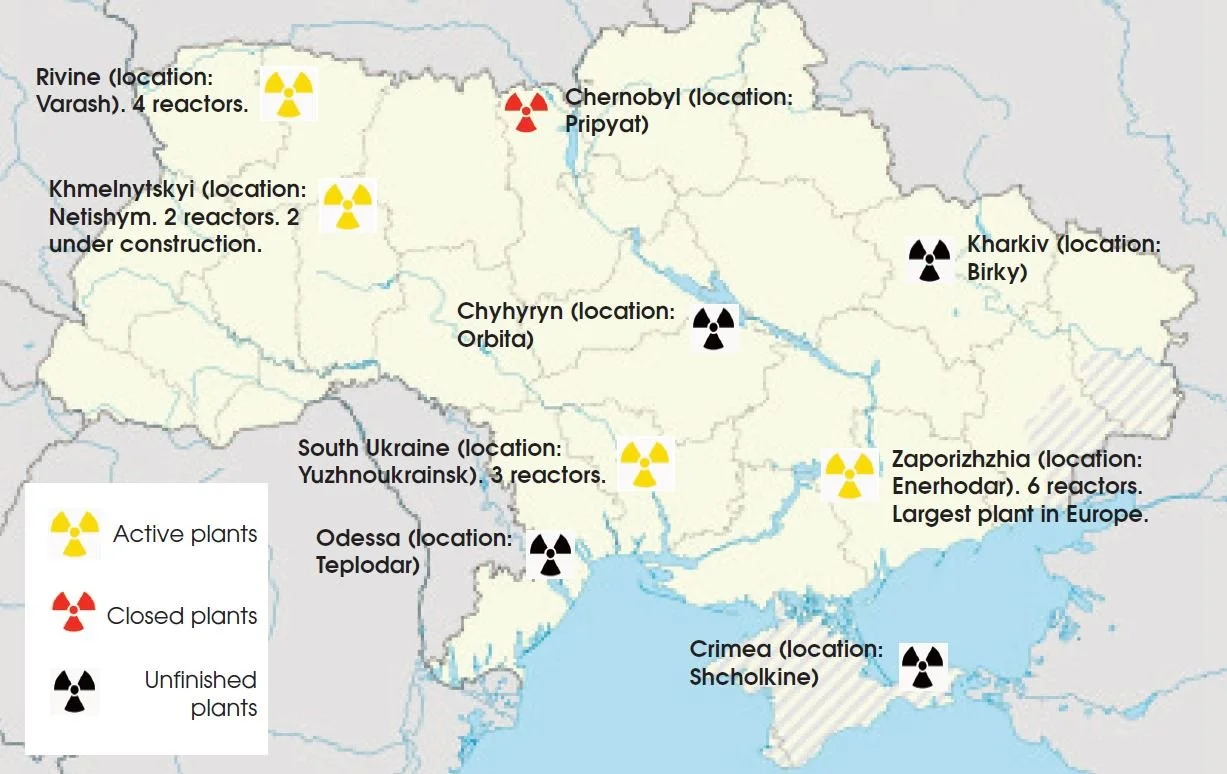
Nuclear weapons possession was firmly and quite rightly renounced in 1994 but nuclear power has been an enduring feature of Ukraine’s infrastructure. The risks and hazards of nuclear power have been well documented, not least in the recent Spokesman Dossier titled Nuclear Power? But the people of Ukraine have no need for book-length summaries of the potentially deadly consequences of nuclear power for in the north of the country, on the Belarus border, sits Chernobyl. Such peace-time risks have now been joined by the acute risks of nuclear power in times of war.

As Jan Vande Putte, co-author of a recent Greenpeace study, points out: “For the first time in history a major war is being waged in a country with multiple nuclear reactors and thousands of tons of highly radioactive spent fuel”.

The Greenpeace study (02/03/22) focuses on severe nuclear hazards at just one of Ukraine’s nuclear power sites: the Zaporizhzhia plant, which with six nuclear reactors is the largest such plant in the whole of Europe. The study sets out the risks:

“In a worst-case scenario, where explosions destroy the reactor containment and cooling systems, the potential release of radioactivity from both the reactor core and spent fuel pool into the atmosphere could create a disaster far worse than [at Fukushima] ... with areas of land hundreds of kilometres from the reactor site potentially becoming inhospitable for decades. Even without direct damage to the plant, the reactors rely on the electric grid for operating cooling systems, on the availability of nuclear technicians and personnel and access to heavy equipment and logistics.”

If Putin’s invasion of Ukraine and his subsequent nuclear threats weren’t bad enough - and they are very bad indeed - then the prospect of nuclear disaster, either deliberate or accidental, compounds an already awful situation.

If those who attempt to maintain some form of safety at the Chernobyl site are prevented from doing so, if supplies are cut off, if shifts cannot change or similar then Putin will have yet more death and destruction to account for. If a single shell or missile ‘accidentally’ hits just one reactor at one of the active plants then the consequences could be immense. If electricity supplies are disrupted and cooling systems fail, then nuclear-meltdown and all that means could unfold. These are risks of waging ‘conventional war’ in places with nuclear power plants. The world knows all of the risks of nuclear power but has failed to act. Will it take another ‘unthinkable’ disaster like Chernobyl to force the issue? We must hope that it doesn’t.

Meanwhile, as energy supplies are impacted as a consequence of Putin’s actions, there will be many who rush towards nuclear power as a means of ‘energy independence’. Such a rush is misjudged on many levels - not least the questions of timescale and interdependence of nuclear fuel supply - but it will be fundamentally misjudged because nuclear power is dirty, dangerous and - as can be seen from events in Ukraine - potentially deadly.

"Remember your humanity"

From END Info 30 download

Bertrand Russell Peace Foundation

The following statements were published by the Bertrand Russell Peace Foundation immediately following President Putin’s nuclear threats. In issuing such threats, the Russian leader has put the existential risks associated with nuclear confrontation firmly on the agenda. The Russian leader now not only threatens the people of Ukraine with his illegal invasion and occupation. His nuclear threats put humanity itself in peril.

The writer Arundhati Roy said this of nuclear weapons: “It is such a supreme folly to believe that nuclear weapons are deadly only if they're used. The fact that they exist at all, their presence in our lives, will wreak more havoc than we can begin to fathom. Nuclear weapons pervade our thinking. Control our behaviour. Administer our societies. Inform our dreams. They bury themselves like meat hooks deep in the base of our brains. They are purveyors of madness...” Bertrand Russell grappled with these issues many decades ago. He asked us all to “remember your humanity”.

* * * * * 

Remember your humanity

Humanity is confronted by increasing danger of nuclear war. Even before Russia’s illegal invasion of Ukraine, worsening relations between the world’s nuclear-armed states and alliances made our planet a tinderbox where one false move – or misunderstanding – could result in nuclear war. President Putin’s order to invade Ukraine makes this perilous situation much worse. He publicly warns others not to interfere otherwise they will suffer ‘consequences greater than any you have faced in history’. Such nuclear blackmail must be exposed and resisted. For the sake of humanity, Russia should cease its aggression and withdraw from Ukraine without delay.

In recent years, Russia, the United States and the United Kingdom have steadily lowered the ‘threshold’ to be crossed when ordering the use of nuclear weapons. They openly state that nuclear devices could be used in response to threatened non-nuclear attacks such as ‘conventional’, biological, chemical or cyber. Nuclear capabilities are closely integrated with ‘conventional’ force in current military doctrine. ‘Useable’ nuclear weapons, hypersonic missiles, artificial intelligence, armed drones and cyberwarfare are all part of the contemporary battlefield. Europe is at evident risk of becoming such a battlefield – even a nuclear one.

Millions of people in Russia, Ukraine and the wider world know that war is not the answer to Europe’s common and enduring need for security. Since NATO waged war on Yugoslavia in 1999, the political failure to address our common need for security has brought Europe to its current tragedy -- Russia’s onslaught on Ukraine, which had embraced neutrality prior to 2014. The work to build peace and security begins again. In doing so, it is timely to recall that, long ago, Bertrand Russell confronted humankind’s peril from nuclear weapons and appealed ‘as a human being to human beings: remember your humanity, and forget the rest’.

Bertrand Russell Peace Foundation

25/02/2022

Threatening megadeath

Putin publicly puts Russia’s ‘deterrence’ forces on special alert, apparently shocking his defence minister and military chief of staff in the process. He didn’t use the word ‘nuclear’, but those are the weapons he’s told them to prepare. This is the latest clinch in Putin’s long embrace of Russia’s nuclear arsenal. In breaking the nuclear taboo, Putin exposes the duplicity of nuclear ‘deterrence’, which really means threatening megadeath. In 1945, the United States twice visited megadeath on Japan, and has refined its nuclear weapons practice ever since. When the French Foreign Minister recently reminded Putin that NATO is a nuclear-armed alliance, the threat of megadeath was implicit in his few words.

Nor does the pretence that NATO is purely defensive and no threat to Russia help us to perceive clearly the acute danger we are currently in. Long ago, Putin absorbed the lessons of NATO’s attack on Yugoslavia in 1999 and he is hyper sensitive to any perceived aggression, even while he orders Russia’s military to mount an illegal and faltering assault on Ukraine. He publicly told President Macron that ‘there would be no winners’. He publicly threatened anyone who interfered in Russia’s war on Ukraine that they would suffer unprecedented consequences. Now he orders Russia’s high command to actively participate in nuclear blackmail. NATO’s Secretary-General decries such nuclear ‘rhetoric’, but who can be certain that Putin is bluffing? The fearful possibility is that Putin may be approaching the point where he decides he has nothing to lose by breaking the taboo and using some of Russia’s many nuclear weapons. ‘Deterrence’ will have flipped.

Who will provide a ladder for Putin to climb down?

Bertrand Russell Peace Foundation

28/02/2022

Where does that end?

Putin’s nuclear threats elicit changes in US military operations. Scheduled testing of an intercontinental ballistic missile is postponed in case it disturbs the delicate balance of mutual threats of mass death. Heavy US nuclear capable bombers fly west from southern England instead of eastwards towards Central Europe where one of them recently refuelled. Such caution is prudent when taboos on nuclear threats and possible use are broken. As a nuclear-armed alliance, NATO is similarly constrained in militarily assisting Ukraine in its hour of need. Stalled columns of Russian fighting vehicles present easy targets from the air, but NATO cannot dispatch its substantial air power against them for fear of engaging Russia directly and triggering Putin’s nuclear arsenal, which includes many so-called tactical warheads. His ‘deterrence’ flips to ‘escalate to de-escalate’. Where does that end?

Bertrand Russell Peace Foundation

03/03/2022

No Nuclear War

From END Info 30 download

By Tom Unterrainer

Editorial Comments

Yelena Osipova survived the Siege of Leningrad. The Siege, enforced by Nazi invaders, imposed gruesome cruelty on the inhabitants of what is now Saint Petersburg for two years, four months, two weeks and five days. Between September 1941 and January 1944 the people of that city were subjected to systematic starvation and deliberate destruction. It is estimated that 1.5 million Russians died in the city over this time and that of 1.4 million evacuees, a significant number perished due to starvation and bombardment. Yelena Osipova knows more than one thing about the barbarity of war.

That is why she joined thousands of other Russians who have taken to the streets in opposition to President Putin’s illegal war against Ukraine and his repeated nuclear threats. A video of Mrs Osipova, and her placards which say “No to Nuclear Weapons in the All the World”, was distributed on social media. The video shows the reaction of the Saint Petersburg police, who were on the scene in force to confiscate such banners and arrest those who oppose Putin’s war.

Those protesting across Russia, and the anti-war movement they are building, are part of an international movement for peace and against war. This movement exists in every corner of our planet: in every country, in every city and in every community. We are united at this moment with a clear message to President Putin: Stop your war on Ukraine, No to Nuclear War.

President Putin has not only broken international law to wage his war against Ukraine but he has shattered the ‘nuclear taboo’. In threatening “consequences greater than any you have faced in history” to those who might come to the aid of the Ukrainian people and putting Russia’s ‘deterrence’ [sic] on ‘special alert’, he has placed the question of possible nuclear war front-and-centre. He has exposed the central role that nuclear weapons play in world affairs and the relations between states - nuclear-armed or not - and he has reminded us all that when two nuclear-armed blocs confront one another, for whatever reason, the future of humanity is put in peril.

School history books and some misguided teachers tell us that nuclear weapons have only been ‘used’ twice: at Hiroshima and Nagasaki. Daniel Ellsberg, former nuclear planner turned anti-nuclear and peace campaigner, begs to disagree:

“a gun is used when you point it at someone’s head in a direct confrontation, whether or not the trigger is pulled”.

When there are two sides who have been pointing guns at each other for decades, when the guns get progressively bigger, when one side distributes smaller guns to their friends and then edges towards their foe we have the makings of a deadly situation. We are in such a deadly situation.

There can be no excuse for Putin’s illegal war or for his nuclear threats. He has chosen a course of action and he has chosen to make the threats all by himself. Yet the peace and anti-war movements have been warning of such risks for decades. We have been campaigning against nuclear weapons, against militarism, against NATO and the expansion of this nuclear-armed alliance. We have been arguing that security is for everyone or it is for none of us, for a nuclear-free Europe, for common security and the strengthening of international and transnational organisations to ensure such security.

We were ignored. Instead, the nuclear stockpiles have been maintained. The nuclear-armed alliance spread. All sides have indulged in breaches of international law, with horrendous consequences. Arms sales soar. An arms-race is underway. Security has not been ensured. Brinkmanship replaced diplomacy. Treaties and agreements were disregarded, sabotaged and put on the bonfire. Even more money was committed to war and destruction, whilst ordinary citizens suffered.

So our work starts again and it starts in the most dangerous of moments: when the prospect of nuclear war is on the agenda. It starts again when the people of Ukraine are under attack and when the nuclear-armed world has revealed itself. Our work is urgent and we now have hundreds of thousands of Russian citizens in our ranks. We will doubtless be joined by those in Ukraine who are witnessing the horrors of war first-hand and who, like Yelena Osipova, will oppose anything like it happening again.

Dialogue, discussion, debate and understanding are essential components of what comes next. Just as security cannot be for one side only, ‘guaranteed’ - or not - by nuclear weapons, security cannot be imposed. Neither can real and lasting peace be imposed. These things need to be built, through cooperation and democratic means, between peoples and across borders. This is why recognising the heroic efforts of anti-war opinion in Russia is vital. This is why links must be established and nurtured.

While starting this work, however, we must dedicate ourselves to the urgent tasks of opposing Putin’s war, preventing the spread of war and of alerting the world to the acute dangers presented by nuclear threats. If the dull hum of a nuclear warhead ever mutates to a deafening and life-ending roar of a nuclear explosion, humanity will be extinguished. We cannot and will not let this happen.

‘On the Brink: Understanding the Ukraine Crisis...’

From END Info 29 | Feb 2022 | DOWNLOAD

Professor Richard Sakwa

The following text is a transcript of Professor Sakwa’s presentation to a Massachusetts Peace Action/Campaign for Peace, Disarmament and Common Security webinar titled ‘On the Brink: Understanding the Ukraine Crisis and Paths Towards a Just Peace’.

I want to make four basic points. My first point will try to provide some sort of overview, explaining how we got to where we are today. And in a few minutes, I won’t be able to do too much. But simply, I will argue, as follows: between 1989 and 2019, effectively, though, some will take [as an end point] 2014, we had a ‘Cold Peace’ that sort of reprises some of the issues associated with a Cold War. But it’s accompanied by attempts – genuine attempts – to try to resolve the conflictual potential. It’s [like] a new version of what E H Carr called, in interwar years, the 20 years crisis. And you could call this a 30 years crisis. And in the last few years, this has tilted over into what I would argue is now Cold War 2. This is a full-scale confrontation, with all of the mechanisms. I won’t go into the detail of how you would define a Cold War, but it’s clearly ideological contestation, demonization of the enemy, or the protagonist, and a whole stack of other features, which are extremely reminiscent of that first Cold War, all of which take place under the umbrella of nuclear deterrence.

We could also characterize these years as a slow-motion Cuban Missile Crisis … certainly, in these last few months, it’s accompanied by what some people would say, would be a rash move. In October 1962 [the rash move] was putting the missiles on Cuba, today the mobilization and the saber rattling and militarization. [It’s] an attempt to force a some sort of a solution, if not a diplomatic one, to what was perceived to be a fundamental problem. In [1962 it was] Berlin, Jupiter missiles in Turkey, and so on. Today [it’s] the failure to establish what the Russians would call an indivisible security order. So [we have a] slow motion Cuban Missile Crisis, and we’ll have to see in my final section, how it could possibly being resolved.

My bottom line is when answering how did we get to where we are today is that at the end of the first Cold War, in the Gorbachev years – let’s use the date 1989 as the symbolic end of the first Cold War. So we had two peace orders on offer. These were two peace orders, not dissimilar, quite reasonably compatible, but not the same. And the first one was the vision put forward most eloquently by Gorbachev, and indeed, which had long matured within the Soviet Union, which under the moniker of the ‘new political thinking’. This was a view that international politics in the nuclear age, facing environmental issues – which became very prominent in Gorbachev’s thinking at a later point – could be transcended. That with the end of the Cold War, which wasn’t just the end of the [decades] since 1945, it was also the end – perhaps in a different way from Fukuyama – but a sense that that long term internal civil war in advanced capitalist democracies between … socialism and capitalism was transcended. In other words, a whole stack of things were coming together to create the possibility of a genuinely transformed new type of international politics, a new peace order, which really would be indivisible security, and that within that framework, all countries could develop.

In a specific European context it was focused on a common European home … This was a really fundamental vision which culminated in the formulation, based on the Helsinki principles, of two key principles in the Paris Charter of November 1990: free choice of states to join in whatever alliances they wished to, many commentators in Russia today lament the fact that they agreed to that. But the second point, and if you look at that Paris charter of November 1990, it also picks up some of those issues in Helsinki, repeated in the Istanbul Declaration of 1999, the Standard Commemorative Declaration of 2010: that it is balanced by a commitment to indivisible security. Lavrov, in some of his speeches lately, has forgotten that that … formulation is in the November 1990 document. So that’s the first model, a transformative model: that Russia would join the historic West, the political West, as established in the Cold War, to create a greater West, and then the European continent would join to create a greater Europe.

The second view, very specifically, is a challenge to that. And this was announced in George H W Bush’s speech in Mainz [1989] and a slogan just put it just symbolically: ‘A Europe Whole and Free’, which was deliberately designed to challenge the first model, that transformative model. Again, I simply can’t go into detail now, but simply will say it was quite clearly … makes it explicit to seize the intellectual, and indeed the political initiative and stop that upstart. Gorbachev seizing the … Global Intellectual agenda, in other words, every imposition of US hegemony, and dominance. And of course, this then formed and moved into more specific political challenges to a unipolar world. So basically, two models, one based on transformation – an agenda, which, by the way, continues to this day – versus simple enlargement. On enlargement: we could say all sorts of things about that, because it homogenizes political space, it reduces political pluralism, and so on. And it’s only within this logic of competitive visions of post-Cold War peace orders that a NATO enlargement took place … NATO enlargement, in other words, is a symptom of that larger failure, after 1989. It exacerbated [the failure]. Even Zbigniew Brzezinski in1995 said NATO enlargement should go forwards – he was a passionate advocate for it – but he said: ‘well, maybe at the same time, we should establish some larger framework, diplomatic and political, a military security framework with Russia’. Okay, that’s the first point.

My second point would simply say that it’s hardly surprising that Ukraine then becomes the cockpit of these two visions of world order. Both of these earlier visions, by the way, support what I call the ‘charter international system’ established in 1945. So the confrontation takes place over Ukraine, because there was no resolution of the status of post-Soviet space, different types of models of nation building, and state building, and so on. So the Ukrainian crisis is of course a reflection of deep internal divisions and debates about the appropriate model of state development. I’ve argued in my book, Frontline Ukraine, that two models were on offer: the monist model, which can be tolerant, can be quite inclusive, but it’s got a specific vision of how the Ukrainian state should develop monolingually, and … obviously, you can keep the Russian language and any other language ‘in the kitchen’, as they would kindly say, but [it would] not be given civic public status. And the other version is this more pluralistic vision, which would be the one that most Western commentators have been supporting: the sort of way that the multi-plural society has developed in post-authoritarian societies like Spain, and you could argue, Canada, and many, many other federal states.

These were the two models, that’s why these tensions have exploded, because of two models of international politics, two models of Ukrainian state-building and the whole thing blows up.

My third very brief section: ‘why now?’ … The feeling that the trendlines were moving against Russia, that today Russia is at a peak of its power, in the sense that those hypersonic missiles and all the other stuff announced in 2018 gives you a shot in the arms control, arms race business. [Russia] is probably at the peak of its power before the United States, with its massive intellectual and financial resources will quickly catch up and outpace it. Again, a type of 1950s alleged ‘missile gap’ and catching up. In 2018, Putin’s ‘State of the Nation’ speech is quite clear. He says: ‘you didn’t listen to us then, listen to us now’ – referring to the Munich Security Conference speech of 2007. And of course, there are specific issues: the Nagorno Karabakh war, the second war where Azerbaijan seized territory. Plus, the development of two drone technologies and a whole stack of things: the failure, the blockage, in the development or implementation of Minsk II, the strengthening alignment with China. … In other words, it was time to grasp that ‘Ukrainian nettle’, and with it, that whole failure of the last 30 years.

My fourth and final section is simply to say: what are the options today? And there are three possible ways forward, where we could really go now. The first model of where we could possibly go is ‘pathways to peace’. I will say that the US response to Russia’s draft security treaties of the 17th of December [2021], was relatively positive – surprisingly so, talking about diplomatic engagement … But clearly, we’re talking about possibly a moratorium on NATO enlargement, it’s not excluded … Ukraine was not going to be joining NATO anyway in the short term. Some sort of neutrality for Ukraine is not really going to be negotiable. Implementation of Minsk II, yes, the Normandy Format has been meeting … and is due to meet again. Obviously, there’s not going to be a new Helsinki … Helsinki II … or a change of regime in Kiev or Moscow anytime soon.

I actually think that the NATO response was outrageous, but the US response was opening the door to diplomacy. That’s the first part. So there’s paths to peace, which will learn those lessons of how the first Cold War ended.

The second approach is managed competition. Okay, we accept we’re in a Cold War … then how do we go and manage it? Russia will develop its alliance and relations with China, perhaps establish bases in Venezuela, Cuba, Nicaragua … I think, possibly creates permanent deployment of strategic weapons and submarines off the coast of the US, NATO continues. And so we keep on that march of folly, as before 1914.

And the third option is war, quite simply. And just as in the Cuban missile crisis of October 1962, [when] we came closest to war … until today. And I actually don’t think that Russia is planning to invade Ukraine. All of this was to try to kickstart a diplomatic process. Russia believes that it simply hasn’t been listened to for the last 30 years and so it’s all about trying to kick the door open to diplomacy. [It’s] a rather crude way of doing it but nevertheless, if the door is opened one way or another, then there is a possibility to avoid war. But clearly, the stakes could not be higher. I do believe that it’s quite clear that NATO and its members, egged on by some, you know, better embittered Eastern European countries and London, of course – it really isn’t in a mood for diplomacy. If Reagan and George HW Bush and Gorbachev had use this [type of] language back in the late 1980s, we would never have ended the first Cold War. And so today, I think we need to learn from how the first Cold War ended to maybe mitigate the second.

The whole webinar can be viewed at: https://tinyurl.com/4fwzy4cn

‘Indivisible, equal and undiminished security’

From END Info 29 | Feb 2022 | DOWNLOAD

Editorial Comments, Tom Unterrainer

The Russell Foundation has issued this extra edition of END Info in response to the growing tensions in and around Ukraine. In issue 28 we warned that we “should all be alert to the sharpening of tensions and to any developments connected to them. But we should also pay close attention to the causes as well as the dynamics of the fault lines in Europe. The insistence of the nuclear-armed states and their allies that the capacity to exterminate life on this planet is ‘essential for security’ has been examined again and again.” Tensions have certainly sharpened and developments accumulate by the hour.

Nuclear weapons, the possession and stationing of such weapons and the risks associated with them cannot be ignored in the context of Ukraine in the same way that the expansion of NATO – the nuclear-armed alliance – cannot be ignored. The argument that ‘security in Europe’ is maintained by the possession and stationing of nuclear weapons – be they British, French or American – is in tatters. Rather than providing ‘security’, such weapons embed insecurity. One need only look at Article 7 of the proposed draft treaty between Russia and the United States (released on 17 December 2021 and available to read in full at https://mid.ru/ru/foreign_policy/rso/nato/1790818/?lang-en) to see how large the issue of nuclear weapons loom. Article 7 reads:

The Parties shall refrain from deploying nuclear weapons outside their national territories and return such weapons already deployed outside their national territories at the time of entry into force of the Treaty to their national territories. The Parties shall eliminate all existing infrastructure for deployment of nuclear weapons outside their national territories.

The Parties shall not train military and civilian personnel from non-nuclear countries to use nuclear weapons. The Parties shall not conduct exercises or training for general-purpose forces, that include scenarios involving the use of nuclear weapons.

Article 5 of the draft treaty includes the following:

The Parties shall refrain from flying heaving bombers equipped for nuclear or non-nuclear armaments or deploying warships of any type, including in the framework of international organizations, military alliances or coalitions, in the areas outside national airspace and national territorial waters respectively, from where they can attack targets in the territory of the other Party.

The preamble of the draft treaty asserts:

that a nuclear war cannot be won and must never be fought ... [we recognize] the need to make every effort to prevent the risk of outbreak of such a war among States that possess nuclear weapons.

Article 1 opens with:

The Parties shall cooperate on the basis of principles of indivisible, equal and undiminished security and to these ends:

shall not undertake actions nor participate in or support activities that affect the security of the other party;

shall not implement security measures adopted by each Party individually or in the framework of an international organization, military alliance or coalition that could undermine core security interests of the other party.

These all seem like very sensible and acceptable commitments to ensure peace and security between the US and Russia and – importantly – within Europe. The remarkable thing about the draft treaty is that, in fact, such commitments have already been made: in 1971, 1972, 1987 and 1989. They must surely be reaffirmed by both sides and implemented in full in very short order.

To understand why these commitments need reaffirmation and implementation now, in 2022, and why they have not been affirmed or consistently implemented to date is to understand that NATO has expanded, all sides are re-arming and that the situation is very dangerous indeed. However, there is a further thing to understand: for as long as NATO and the nuclear-armed states within it insist on turning Europe into a potential nuclear battleground, for as long as the US insists on deploying its nuclear and other weapons systems in Europe and for as long as politicians in the ‘Anglosphere’ indulge themselves in crass hypocrisy then the idea of ‘indivisible security’ will be completely undermined. As Russian Foreign Minister Sergey Lavrov pointed out in his letter to Heads of Foreign/External Affairs Ministers/Secretaries of the US, Canada and several European countries: 

The principle of indivisible security is selectively interpreted as a justification for the ongoing course toward irresponsible expansion of NATO.

It is revealing that Western representatives, while expressing their readiness to engage in dialogue on the European security architecture avoid making reference to the Charter for European Security ...

It will not work that way. The very essence of the agreements on indivisible security is that either there is security for all or there is no security for anyone.

Russian sources have been quoted here not because every action or opinion expressed within or by them are defensible or agreeable. They have been quoted in this way because as compared to the statements from US and British government representatives, they are a breath of fresh and clear air.

Security is for everyone or it is for none of us. Nuclear weapons in Europe – whatever their origin and wherever they are based – must be removed if any meaningful form of security is to be established. This means creating a European nuclear-weapons-free zone as part of an infrastructure of ‘indivisible, equal and undiminished security’ – a system of common security.

To achieve peace, we must identify and then remove the roadblocks to peace. NATO and nuclear weapons must be removed.

The Non-Proliferation Treaty

From END Info 28 - Jan/Feb 2022 - DOWNLOAD

By Peggy Duff

Peggy Duff (1910-1981) served as the first Organising Secretary and later the first General Secretary of the Campaign for Nuclear Disarmament. She was a firm and active supporter of the END campaign in the 1980s. This article forms Part I of her chapter in Eleventh Hour for Europe, Edited by Ken Coates and published by Spokesman in 1981.

* * * * 

Introduction

The Non-Proliferation Treaty which was finally agreed in 1968 and came into operation in 1970 was described by Alva Myrdal in her book The Game of Disarmament (Spokesman, 1980) as “a grossly discriminatory treaty”. “Obligations”, she wrote, “were laid on the non-nuclear weapon countries, and only on them, to accept international control over nuclear installations. In the end they were able to extract only a promise (Article VI) from the superpowers to negotiate in good faith the cessation of the nuclear arms race at an early date.”

“There was no balance, no mutuality of obligations and benefits. I said then that it was necessary to emphasise the reluctance of the non-nuclear powers to shoulder a particular and, as matter of fact, a solitary obligation to make renunciatory decisions in regard to proliferation of nuclear weapons. To place the major responsibility on their shoulders amounted to a clever design to get the NPT to function as a seal on the superpowers’ hegemonic world policy.”

The First Review Conference of the Non-Proliferation Treaty in 1975 did nothing to remedy these deficiencies. The Second Review Conference will take place in Geneva in August 1980, however, at a time when pressure for disarmament from many of the Non-Aligned Countries and from movements have increased and many of the processes for negotiating disarmament have improved, as a result of the UN General Assembly Special Session on Disarmament in 1978.

It is, therefore, very important that movements concerned with disarmament should join with states genuinely committed to it in seeking to change this imbalance between the obligations of the Non-Nuclear-Weapon States (NNWS) and the Nuclear-Weapon States (NWS). To do this effectively, we have to understand what are the essential issues to which priority should be given.

We will examine the security aspects, that is, the limitation and disarmament measures required not just to prevent a dangerous increase in the number of nuclear-armed countries, but to control the nuclear arms race between the superpowers: an obligation which is only minimal in the Treaty and which has only too clearly been avoided. We have to pinpoint not only the sort of security guarantees that should be given by the nuclear superpowers to countries that renounce nuclear weapons, but also the most important disarmament measures that ought to be rapidly agreed, if the threat of nuclear weapon proliferation is to be countered.

We shall also examine the additional threat of proliferation of nuclear weapons through the spread of nuclear power technology which means that, by the end of this century, about 40 countries will have the capacity to produce nuclear arms.

The Beginnings of Proliferation, the Incentives and the Dangers

It was inevitable that the American monopoly of nuclear weapons at the end of World War II would not last very long. When the Soviet Union caught up, this intensified the Cold War. Yet, in spite of the rivalry between the two superpowers, there has existed, since the death of Stalin and the beginnings of detente, a common desire to act jointly as the world’s policemen and to control negotiations on disarmament. This was reflected in their joint chairmanship of the Geneva Disarmament Committee. Though there are obvious conflicts of interest in many regions of the world; on disarmament, they speak the same language. They see themselves as the custodians of world order; and the cohesion of their alliances remains more important than progress towards disarmament. This is why they have tried, and succeeded, to keep negotiations on a bi-lateral or tri-lateral, rather than on a multilateral basis. (The negotiations in the early 60s on the partial Test Ban Treaty and current negotiations for a Comprehensive Ban are restricted to the US, the USSR and Britain). It is significant that in all the talks that have gone on they have never been ready to accept anything more than minimum control of rearmament. During the negotiations on the Non-Proliferation Treaty they both rejected pressure for a reduction of nuclear weapons which they demanded from the others. They have never been willing to accept what is called now “A Low Posture” and which was initiated in the 60s by Professor Pat Blackett as a “Minimum Deterrent” policy. This called for a reduction of their nuclear weapon stockpiles to 100 missiles, capable of inflicting ‘’unacceptable damage”; as a step towards the elimination of all nuclear weapons. The NNWS, during the negotiations on the Non-Proliferation Treaty, pressed for a similar limitation through a moratorium on both quantitative and qualitative development of nuclear arms - but with no success.

Proliferation began in Britain and then in France. The main incentive for both countries was prestige. Both believed that by acquiring even, a small nuclear arsenal they established themselves as major powers. Both of them Alva Myrdal suggested “are in a sense compensating for the loss of status as colonial empires”. The Americans were no;t too happy. McNamara, then Secretary for Defense, said that small independent deterrents were dangerous, expensive, incredible and prone to obsolescence. Nevertheless, the United States helped Britain to acquire their four Polaris submarines - and Mrs Thatcher is now asking them for Trident submarines to replace them.

But, for de Gaulle, there was another incentive. He did not trust the American “nuclear umbrella”. He did not believe that the United States would use its nuclear weapons in defence of Europe at the cost of the destruction of its own cities and the death of millions of Americans. This lack of faith in the US “nuclear umbrella” has even, recently, been encouraged by Kissinger. Current moves to establish medium range nuclear missiles in Europe must also be seen as an intention to limit, if possible, any nuclear war to Europe, but including Russia.

China’s motives were, partly, the same, but here there was also another incentive, regional confrontations, between China and the USSR and between China and India. This applies also, now, to two countries which are believed to have produced some sort of nuclear device - Israel and South Africa (and there is little doubt that South Africa recently tested a nuclear weapon in the South Atlantic).

It is hardly necessary to stress the dangers of spread. They are listed in the book produced by the Stockholm International Peace Research Institute (SIPRI), Postures for Non-Proliferation: Arms Limitation and Security Policies to Minimize Nuclear Proliferation. Any increase in the number of NWS can have a domino effect. It increases the risk of an accidental nuclear war, and the risk that local wars can escalate into a nuclear war, involving the superpowers. It encourages the nuclear arms race between the superpowers. It makes disarmament negotiations more difficult. The use of a nuclear weapon by a small nuclear power would break the present ‘taboo’ on their use. There is the risk that they may be acquired by a ‘crazy’ state, or by a state where a new ‘crazy’ government takes over. It complicates international politics and fuels regional rivalries. The more nuclear weapons there are and the more countries which have them, the greater the danger that they will eventually be used. But here we must stress that it is not only the number of states armed with nuclear weapons that matters but also the steady increase in the size and quality of the stockpiles of the superpowers. That is also a form of proliferation.

The 1965-1968 Negotiations

If we are to decide correctly on which issues we should concentrate during the Second Review Conference of the NPT, it is important to study and analyse the negotiations which took place between 1965 and 1968 and during the First Review Conference.

During the negotiations on the Treaty there were major disagreements between the NWS and the NNWS on three points:

1. What measures for the limitation of nuclear arms and for disarmament should be included in the Treaty as a counterpart to the renunciation of nuclear weapons by the NNWS?

2. What types of security guarantees should be given to the NNWS by the NWS?

3. The duration of the Treaty, and the provisions for review and withdrawal.

The procedure was as follows: at the opening of the conference, the two superpowers tabled two draft treaties, as a basis for discussion. On August 8, 1967, after two years of discussion, two more draft treaties were tabled, with minor changes. In January, 1968, two more identical treaties were tabled. Two more identical treaties followed in March 1968. These were linked to the text of a Security Council resolution on guarantees. Revised versions of both were tabled in May 1968. The Treaty then was approved by the UN on June 12, 1968 and, a few days later, the Security Council passed the resolution. The Treaty came into operation in 1970.

Neither of the two first draft treaties contained any reference to collateral measures. They both argued that these were unimportant compared with the urgent need to stop spread. This was stressed by Lord Chalfont, speaking for Britain:

“I would ask the non-aligned delegations to ponder on this point in case it turned out to be impossible to get agreement among the nuclear powers to some measures of reduction ... I should like to ask the non-nuclear Powers most seriously whether, if this position is reached - a treaty within our grasp, but the choice of collateral measures still in dispute - it would not still be in the interest of every non-nuclear State to call a halt to the spread of nuclear weapons even if the nuclear weapon Powers themselves had not actually begun to disarm.”

Ambassador Foster of the US referred to the demand that the Treaty contain obligations on the nuclear weapon States to cease all nuclear weapon tests, to halt production of fissionable material for weapons, to stop making nuclear delivery vehicles, or “even to begin nuclear disarmament”, as a hurdle which was getting in the way.

The argument, on all three points at issue, went on for two years. Counter-proposals were tabled by India, Sweden, Brazil, Burma, Egypt, Morocco and Nigeria. India, for instance, put forward five points.

1. An undertaking by the nuclear powers not to transfer nuclear weapons or nuclear weapons technology to others;

2. An undertaking not to use nuclear weapons against any countries which do not possess them;

3. An undertaking through the United Nations to safeguard the security of countries which may be threatened by Powers having a nuclear weapons capability or about to have a nuclear weapons capability;

4. Tangible progress towards disarmament, including a comprehensive Test Ban Treaty, a complete freeze on production of nuclear weapons and means of delivery as well as substantial reduction in the existing stocks; and

5. An undertaking by non-nuclear Powers not to acquire or manufacture nuclear weapons.

India also suggested a two stage Treaty, in which the collateral measures came first. Sweden proposed, as essential collateral measures, a comprehensive test ban treaty and a cut off in the production of fissile material for weapons, together with an agreement on non-dissemination.

By early 1967, it was clear that neither of the two superpowers would accept any related disarmament measures in the Treaty. Article VI contained some vague references which the NNWS saw as binding, legally, but which the nuclear powers did not. It contained only a vague statement of intention. There is “no balance” Indian Ambassador Trevede said, “between a platitude on the one hand and a prohibition on the other.”

On security guarantees, in their first, 1965 drafts, the US favoured positive guarantees, that is, they offered the states agreeing not to acquire nuclear weapons the ‘protection’ of their ‘nuclear’ umbrella; while the USSR offered negative guarantees, a promise not to attack with nuclear weapons States that were signatories to the Treaty. There were also arguments on the question of de-nuclearised zones. The 1967 draft treaties contained a paragraph in the Preamble “noting that nothing in this Treaty affects the right of any group of States to conclude regional treaties in order to assure the total absence of nuclear weapons in their respective territories”. The 1968 identical draft treaties contained a new Article VII: “Nothing in this Treaty affects the right of any group of States to conclude regional treaties in order to assure the total absence of nuclear weapons in their respective territories.” But there were no references to broader security guarantees.

On duration, review and withdrawal, in their 1965 treaties, both the US and the USSR wanted an unlimited, indefinite duration to the Treaty, subject to withdrawals, but no further conferences unless demanded by two-thirds of the parties to the Treaty. In the years that followed the NNWS continued to press for regular reviews in order to monitor the extent to which the NWS had fulfilled their obligations under Article VI. It was only in the last stages of the negotiations that the US and the USSR agreed to periodic review conferences, at intervals of 5 years. This was put into Article VIII.

Here we give four paragraphs from the Preamble, Articles VI and VII and Paragraph 3 of Article VII which represent the very meagre victories achieved by the NNWS:

From the Preamble

“Declaring their intention to achieve at the earliest possible date the cessation of the nuclear arms race and to undertake effective measures in the direction of nuclear disarmament,

“Urging the cooperation of all States in the attainment of this objective,

“Recalling the determination expressed by the Parties to the Partial Test Ban Treaty of 1963 in its preamble to seek to achieve the discontinuance of all test explosions of nuclear weapons for all time and to continue negotiations to this end,

“Desiring to further the easing of international tension and the strengthening of trust between States in order to facilitate the cessation of the manufacture of nuclear weapons, the liquidation of all their existing stockpiles, and the elimination from national arsenals of nuclear weapons and the means of their delivery pursuant to a Treaty on general and complete disarmament under strict and effective international control.”

Article VI: “Each of the Parties to this Treaty undertakes to pursue negotiations in good faith on effective measures relating to cessation of the nuclear arms race at an early date and to nuclear disarmament, and on a Treaty on general and complete disarmament under strict and effective international control.”

Article VII: “Nothing in this Treaty affects the right of any group of States to conclude regional treaties in order to assure the total absence of nuclear weapons in their respective territories.”

Article VIII, Para 3: “Five years after the entry into force of this Treaty, a conference of the Parties to the Treaty shall be held in Geneva, Switzerland, in order to review the operation of this Treaty with a view to assuring that the purpose of the Preamble and the provisions of the Treaty are being realised. At intervals of five years thereafter, a majority of the Parties to the Treaty may obtain, by submitting a proposal to this effect to the Depositary Governments, the convening of further conferences with the same objective of reviewing the operation of the Treaty.”

It could be said that the only part of these pious assurances which has been put into practice is that concerning strict international inspection. This is now assured by the satellites of the superpowers sweeping around through space. The Security Council Resolution had three points:

“l. Recognises that aggression with nuclear weapons or the threat of such aggression against a non-nuclear State would create a situation inwhich the Security Council, and above all its nuclear-weapons State permanent members, would have to act immediately in accordance with their obligations under the United Nations’ Charter;

2. Welcomes the intention expressed by certain States that they will provide or support immediate assistance, in accordance with the Charter, to any non-nuclear-weapon State Party to the Treaty on the Non-Proliferation of Nuclear Weapons that is a victim of an act or an object of a threat of aggression in which nuclear weapons are used;

3. Reaffirms in particular the inherent right, recognised under Article 51 of the Charter, of individual and collective self-defense if an armed attack occurs against a Member of the United Nations, until the Security Council has taken measures to maintain international peace and security.”

After it was passed, three of the nuclear-weapon States, the US, the USSR and Britain, made identical unilateral statements to the same effect. All this, of course, was utterly meaningless. Four of the five nuclear-weapon States in the security Council had vetoes, and the fifth, People’s China, now also has a veto.

One immediate result of the deficiencies of the Treaty, as Alva Myrdal points out, was that, between 1968 and 1970 when the Treaty came into force, only four Powers that had the capacity to produce nuclear weapons had ratified: Canada, Sweden, East Germany and Australia. West Germany, Italy, Belgium and the Netherlands ratified only a few days before the First Review Conference, and Japan in May 1976. Among those refusing were Argentina, Brazil, Egypt, Israel, Spain, South Africa and Pakistan.

She cites five crucial points which illustrate the lack of balance between obligations and benefits: l. The pledge in Article VI to cease the nuclear arms race is still unfulfilled and is unlikely to be honoured in the foreseeable future; 2. The obligation in Article III for the NNWS to accept safeguards, as set forth in an agreement to be negotiated and concluded with the International Atomic Energy Agency ... for the exclusive purpose of verification, etc. is one-sided. It has been implemented by most of the States that have ratified, but not by the US and Britain; 3. There is an undertaking in Article IV, combined with Article I that Parties to the NPT would be favoured with regard to the supply of nuclear technology. This has not happened; 4. Article V promised that the benefits from peaceful nuclear explosions would be made available to signatories to the Treaty at low cost, through a special international agreement and an international body. No such agreement has been reached. No such body has been set up; 5. The security guarantees in the Security Council Resolution restricts rather than adds to their obligations to render assistance. As we have already pointed out, at that time four of the five nuclear armed Powers had a veto. All five now have the veto.

The First Review Conference: 1975

This was seen by most of the NNWS as an opportunity to attack the NWS for their failure to implement Article VI, and to strengthen their obligations on limitation and disarmament measures. In this, they failed miserably. The scales were weighed against them in every way. The Conference was financed by the major superpowers. They conferred in London before it took place. The United States showed its contempt by conducting a big nuclear weapon test during the conference.

The NNWS wanted three types of documents agreed: a General Declaration; a Resolution covering substantive items on the agenda; some additional Protocols to the Treaty.

After 26 days of argument, there was no agreement on any of these. Only a compromise was agreed, a draft Final Declaration to be adopted by consensus, amplified by interpretative statements. There was no agreement on two resolutions and the Protocols which the NNWS tried to add to the Treaty were only put into an annex to the Declaration.

The NWS refused to consider any proposals imposing additional obligations on them. They insisted that they were fulfilling Article VI, that there had been progress, both bilateral and multilateral - and they cited the Sea Bed Treaty, the Treaty banning Biological Weapons, the Anti-Ballistic-Missile Treaty, and the Strategic Arms Limitation Talks (SALT).

The Soviet Union pushed its own policies: the demand for a World Disarmament Conference; that Resolution 2936 of the Security Council on the renunciation of the use or threat of force in international relations and the permanent prohibition of the use of nuclear weapons be made legally binding. Both the US and the USSR stressed their commitment to the SALT negotiations. US Ambassador Ikle claimed that:

“In the five years that had elapsed since the Treaty on the Non-Proliferation of Nuclear Weapons had come into effect, far more had been accomplished in the control of nuclear arms than in the preceding twenty five years. The Treaty had proved to be both a prerequisite and a catalyst for progress towards nuclear disarmament. The disarmament process was under way and it was up to all States to encourage and sustain it.”

These protestations were rejected by the NNWS. They said that SALT had only ratified pre-existing trends and had permitted substantial quantitative and qualitative improvements, institutionalising the nuclear arms race. Ambassador Roberts of New Zealand said:

“It is small wonder that the countries outside the Treaty remained unconvinced that the nuclear-weapon parties were serious in their intention to give effect to their undertakings. The most valid test of progress was surely to ask whether or not there were fewer nuclear weapons in existence today than there had been in 1970; whether or not there had been any abatement in nuclear weapons testing during that period; and whether or not there had been any halt in the further refinement and sophistication of nuclear weapons. The answer to all three questions was patently no. The limited and peripheral agreements negotiated so far gave little ground for reassurance.”

The NNWS emphasised that they were obliged to fulfill their obligations when they signed the Treaty, while the NWS were not bound by any specific date. If horizontal non-proliferation was to be achieved, they insisted that the NWS had not only to pursue but to agree on some collateral measures and they quoted, in particular: a Comprehensive Test Ban Treaty; a cut off of the production of fissile material for weapons; and a limit on missile test flights.

Three important draft protocols to the Treaty were put forward. The first was sponsored by 20 NNWS (Bolivia, Ecuador, Ghana, Honduras, Jamaica, Lebanon, Liberia, Mexico, Morocco, Nepal, Nicaragua, Nigeria, Peru, the Philippines, Romania, Senegal, the Sudan, Syria, Yugoslavia and Zaire). It was designed to lead to the complete cessation of all nuclear testing.

“to decree the suspension of all nuclear tests for a period of ten years, as soon as the number of parties to the Treaty reaches one hundred; ... to extend by three years the moratorium ... each time that five additional States become party to the Treaty, ... (and) to transform the moratorium into a permanent cessation of all nuclear weapon tests, through the conclusion of a multilateral treaty for that purpose, as soon as the other nuclear weapon States indicate their willingness to become parties to the said treaty.”

Protocol II sponsored by the same States, except for the Philippines, called for substantial reductions in the nuclear weapon capabilities of the United States and the Soviet Union:

“To undertake, as soon as the number of Parties to the Treaty has reached one hundred (a) to reduce by fifty per cent the ceiling of 2,400 nuclear strategic vehicles contemplated for each side under the Vladivostok accords; (b) to refrain from first use of nuclear weapons against any other non-nuclear-weapon States Parties to the Treaty.

They undertake to encourage negotiations initiated by any group of States parties to the Treaty or others to establish nuclear weapon free zones in their respective territories or regions, and to respect the statute of nuclear weapon free zones established.

In the event a non-nuclear-weapon State Party to the Treaty becomes a victim of an attack with nuclear weapons or of a threat with the use of such weapons, the States Parties to this Protocol, at the request of the victim of such threat or attack, undertake to provide to it immediate assistance without prejudice to their obligations under the United Nations Charter.”

There were also a number of resolutions.

Since the major superpowers refused to accept any of these Protocols or draft resolutions, or to give any additional guarantees, the Conference ended with a useless final declaration, drafted by Sweden’s Ambassador, Inge Thorsson. This only outlined their concerns and avoided specific criticisms of the major nuclear powers. It outlined the concerns of the NNWS, welcomed the various agreements on arms limitation and disarmament that have been reached, and urged greater efforts by all, but especially the NWS, “to achieve an early and effective implementation of Article VI of the Treaty. It urged limitations on the number of underground tests pending a halt to all of them.” It also appealed to the United States and the Soviet Union to try to conclude the SALT agreement outlined in Vladivostok, which at the end of 1979, had still not gone through the US Congress.

The Second Review Conference: 1980, Prospects and Priorities

Since the First Review Conference in 1975, there have been some important changes in the disarmament process. The Conference of Non-Aligned Countries has become more active and radical. They sponsored and initiated the Special Session on Disarmament of the UN General Assembly in 1978. Their Co-ordinating Bureau produced a Working Paper for the Preparatory Committee which fiercely condemned the lack of progress:

“Since disarmament negotiations within the framework, or under the auspices of the United Nations, as well as the regional and bilateral negotiations, have not produced the expected results in most cases, it is necessary to exert fresh efforts to overcome this situation. The contradiction between the urgent necessity to curb the arms race and the stand-still in disarmament efforts is becoming increasingly intolerable. Expenditure, particularly on the development of new and more sophisticated weapons systems, is spiralling. The continuation of the arms race poses a direct threat to international peace and security and slackens economic social development. Disarmament has thus become one of the most urgent international problems, requiring the greatest attention.”

It included a wide range of concrete proposals, rejecting “partial measures” and calling for rapid progress to total nuclear disarmament and to general and complete disarmament.

While the Final Declaration was a compromise document accepted by consensus containing far too many platitudes, there were some important changes in the disarmament process. The two major superpowers, the US and the USSR, ceased to be Joint Chairmen of the Geneva Disarmament Committee. The Committee was enlarged and its plenary sessions were opened to the public.

The Special Session also encouraged a considerable upsurge in activity on disarmament by non-governmental organisations, and in international co-operation between them on a much wider scale - and this has continued.

But it is important not to be too optimistic about these changes. SALT negotiations are still bilateral, between the US and the USSR, though if we ever get as far as talking about SALT III, the NATO and Warsaw Pact powers may be included. Nevertheless, there are greater opportunities for action now both by the NNWS and by movements, and the Second Review Conference is one of these.

But there is also a [negative] side to the picture. Developments in the Middle East - on energy, and in Iran, with the hostages still held - have led to a massive increase in the belligerency not only of the hawks but of the American public in general. SALT II has failed to get through Congress this year, may fail again in 1980 and we cannot be sure that it will even be accepted after the next Presidential election. Direct intervention by US forces, banned since Vietnam, is now once again acceptable, especially in defence of American supplies of energy in the Middle East. Military budgets are being increased, in the United States, in Britain, by both NATO and the Warsaw Pact, including the Soviet Union. The Conservative Government in Britain is aiming to replace its ageing Polaris submarines with the much more powerful Tridents. Defence Minister Pym has stated on television that, if necessary, they would be used independently of the US, though he was followed by a retired General who insisted that that would be tantamount to suicide.

In addition there is the new threat of the deployment in Europe of medium rang: nuclear missiles, which has, in fact, already begun. This involves the basing of 108 Pershing II missiles in West Germany and 464 land based Cruise missiles, which are sub-sonic, pilotless and very accurate flying bombs - 160 in Britain, 112 in Italy, 96 in West Germany and, in the original US proposal, 48 in both Belgium and Holland. The United States would meet the cost of production and they would remain under US control. Only one finger on the button.

These proposals have alarmed the Soviets though they themselves have started to deploy SS-20 missiles which can reach any European cities or installations. On October 4, Brezhnev announced the unilateral withdrawal of 20,000 Soviet forces and 1,000 tanks from Central Europe. This has begun and was highly publicised. But they have not yet made any proposals for the withdrawal of their SS-20s. But they have made it clear that if the proposal was accepted by NATO which, more or less, it has, they would still be ready to talk.

The NATO countries are not united on the proposals. While Britain, West Germany and Italy accepted (Schimdt got it through his party conference by putting it forward as a means to obtain talks, the Italian Parliament agreed, with few signs of opposition from the Italian Communist Party, the British parliament was not even allowed to discuss it); the Dutch parliament rejected it and their Prime Minister, Andreas Van Agt, faced a situation that, if he ignored their decision, his government might fall, since several members of his Christian Democrat Party voted against it, and there is strong opposition from the Dutch public and from the Churches. In Belgium, the coalition government also had problems since two socialist parties in it were opposed. There was also disquiet in Norway and Denmark though neither country was directly involved as it was not proposed to base any of the new missiles on their territory.

Finally, at a meeting of NATO Foreign and Defence Ministers on December 12 and 13, NATO agreed to press ahead, though the Dutch, the Belgians and the Danes had proposed a delay. Their reservations were submerged by a compromise decision that accepted the deployment of the missiles in West Germany, Italy and Britain. The Dutch Defence Minister, pressed his doubts, hoping, no doubt, to satisfy his opposition at home:

“The Netherlands agrees that there is a need for a political and military answer to the threatening developments in relation to Soviet long-range theatre nuclear forces, particularly the SS 20 missile and the Backfire bomber. In view of the importance we attach to arms control and to the zero option as the ultimate objective in this field, the Netherlands cannot yet commit herself to the stationing of ground-launched Cruise missiles on her territory. The Netherlands will take a decision in December, 1981, in consultation with the Allies, on the basis of the criterion whether or not arms control negotiations have by then achieved success in the form of concrete results. The Netherlands believes that any stationtioning of new weapons systems on Dutch territory should result in a reduction of the Netherlands existing nuclear tasks. The Netherlands Government proceeds on the assumption that SALT II will have been ratified by December, 1981.”

But, since they agreed to contribute £250 million to the cost of the infrastructure required, this enabled the decision to be publicised as ‘unanimous’.

The Belgian Government agreed both to production and deployment, but their decision was to be reviewed in 6 months time - which allowed them to try and pacify the opposition at home.

As a counterpart to this, the NATO meeting agreed to withdraw 1,000 of their present nuclear warheads in Europe, many of which are obsolescent and, of course, have a much smaller range; and the new missile will be counted within that reduced level, that is, 6,000. They have also agreed to undertake negotiations, as soon as possible, for mutual reduction of nuclear weapons in Europe. Secretary of State Vance said that he hoped they would start within a few months, and that they will be held as part of the next round of SALT Talks - a somewhat pious proposal, since SALT II is still not ratified. The NATO meeting set up a group to participate in any such talks.

At their meeting on December 13, the NATO Ministers also agreed on new proposals to be tabled at the Vienna Talks on troop reductions in Europe. They proposed, as a first phase, a withdrawal of 13,000 US troops and 30,000 Soviet troops - based on a West German proposal. These are lower than the original NATO proposals for the first stage. The problem that has stymied progress in Vienna is that the US and the USSR have not been able to agree on the number of Soviet troops in Central Europe. NATO says there are 987,000, the Warsaw Pact insists that the figure is 837,000.

We can be sure that the United States and its allies will cite these proposals as signs of progress during the Second Review Conference - though what the NNWS are demanding is not proposals, but agreements.

Priorities

In the light of all this past history, the most important priorities for pressure on governments, and especially on the NWS, are as follows:

1. A Comprehensive Test Ban Treaty

Another Session of the Tripartite Talks (the US, USSR and Britain) has just ended with no significant progress. There has been a year of virtual stagnation. The Partial Test Ban Treaty was signed in 1963. Since then, these three have conducted only underground tests. France, since 1975, has also tested underground, though there is grave doubt that there may be leaks from their sites in Polynesia into the ocean. In 1974 the United States and the Soviet Union signed the Threshhold Test Ban Treaty, prohibiting underground tests of more than 150 kilotons. They also promised to restrict them.

According to the 1979 SIPRI Year Book, there have been 1,165 test explosions between 1945 and 1978, and 667 since the Partial Test Ban Treat (PTBT) was signed - most of them designed to improve the efficiency of nuclear weapons. More than 90 per cent of them were carried out by the original three signatories to the PTBT - 60 by the Soviets, 37 by the Americans, and 3 by the British. In 1979, the Soviet union conducted more tests than in any year since 1963. The Chinese figure is 8.

But the Russians have made some concessions. They agreed to include peaceful nuclear explosions in the Treaty and accepted the principle of on-site inspection, to accept 10 seismic installations in the Soviet Union. The US also agreed to 10. The Soviet Union also proposed 10 for Britain, which was refused, because they test in the United States. So the USSR proposed 1 in Britain and 9 in various British dependencies, such as Hong Kong and the Falkland Islands. Britain insists on offering only 1 site at Eskdalemuir, where one already exists. There are also disputes over the question of renewal after a first 3 year moratorium.

But the most serious obstacle is in the United States where the military believe that a comprehensive ban would undermine their technological superiority - and that the Russians would cheat. It is certainly doubtful whether SALT II and a Comprehensive Test Ban Treaty could get through Congress during 1980.

2. The Establishment of De-nuclearised Zones with Guarantees from the NWS not to Deploy or Use Nuclear Weapons in such areas

This proposal is prejudiced by the increasing militarisation of both the Pacific and Indian Oceans, where there is considerable pressure for them, both from public opinion and from some of the littoral States.

3. Negative Guarantees From NWS Not to Attack NNWS With Nuclear Weapons

So far, the superpowers have produced only the Security Council Resolution of 1975, which is nullified by their vetoes.

4. A Moratorium on Research, Development, Manufacture and Deployment of New Nuclear Weapons and Their Delivery Systems

The Mobilisation for Survival in United States has been collecting signatures for such a moratorium, including a moratorium on nuclear power. It will be presented to Congress in April, 1980.

5. Cuts in Military Budgets and the Diversion of the Funds to Aid for Developing Countries

This has been proposed by the Soviet Union. At present, they are all increasing.

6. A Moratorium on the Production and Deployment of Medium Range Nuclear Missiles in Europe, Pending Negotiations

Here we must emphasise that the increase in the range of theatre nuclear missiles in Europe, which has been in the pipe line for some time, produces a new situation. Previously, the comparative small range of tactical nuclear weapons in Central Europe made it possible, as de Gaulle believed and Kissinger has recently confirmed, that a limited nuclear war could occur in Central Europe, leaving the territory of the US and USSR untouched.

Even such a ‘limited’ war would wipe out Europe. Schmidt, in 1971, realised this. In his book, The Balance of Power: Germany’s Peace Policy and the Super Powers, (William Kimber, London, 1971, p.196) he recognised that such a war would lead rapidly to the destruction of Europe. Even a brief and locally limited war could mean 10 million deaths and cause total destruction of Germany as an industrial society, according to Carl-Friedrich v. Weizsacker. Yet as Alva Myrdal points out in her book, The Game of Disarmament, p.43/44:

“What are the political and public reactions to these obvious dangers. The peoples of Europe - West, East and neutral - have not been kept much aware of what is in store for them if the superpowers rivalry leads to a military confrontation in Europe. There has been a carefully kept official silence as to the consequences. Only once, in 1955, when a NATO military field exercise, ‘Carte Blanche’, resulted in 1. 7 million Germans ‘killed’ and 3.5 million ‘incapacitated’, was a short-lived furore caused ...

Since 1967 there has been little public discussion about any fundamental change in the policies of nuclear defence for Europe, little of the early clairvoyant anxiety of Helmut Schmidt. West European official postures have become frozen in a kind of frozen approval of the status quo.”

The new proposals, and the increase in the range of the nuclear missiles do not mean that Europe would be spared. But they do mean that the Soviet Union would not. The United States would be out of range, but not the USSR. This, no doubt, explains their current anxieties. (Though, in our opinion, it is doubtful whether a nuclear war which began in Europe could be restricted to a medium range missile exchange).

Some Final Points

We haven’t dealt here with the question of ‘vertical’ proliferation which, to put it in simple English, means increase in the quantity and quality of the nuclear arsenals of the superpowers. The main contention of the NNWS in all these negotiations is that such ‘vertical’ proliferation cannot be separated from the question of ‘horizontal’ proliferation the spread of nuclear weapons to more and more States.

As we have already stressed, prospects can hardly be called good. Relations between superpowers and States are increasingly unstable. More arms, nuclear and conventional are being produced, deployed and sold. But there is one argument which we ought to use in trying to educate public opinion and in promoting support for disarmament. It is still argued by States that possess nuclear weapons, that they are a deterrent and they quote as proof of this that no nuclear weapons have been used since 1945. But this does not mean that wars have been eliminated. 25 million people have died in conventional wars since World War II. Millions more have died for lack of food and medical care the money spent on arms could have provided.

But we must also stress that all this money has been spent to no purpose. The possession of nuclear weapons by the United States did not prevent a stalemate in Korea, they did not save France or the United States from defeat in Vietnam. The Soviet arsenals did not prevent them being thrown out of Egypt. And all their nuclear arms cannot help the United States to rescue 50 hostages in Iran. One can also ask the new nuclear powers, Israel and South Africa, where or how they could use them? We have to convince the people in the nuclear armed states, and those in states with nuclear ambitions, that they are useless and very expensive playthings, that they do not bring security, that more of them mean less security, that they and their children can only be safe if they are totally abolished.
Nuclear Power?

From END Info 28 - Jan/Feb 2022 - DOWNLOAD

By Tom Unterrainer

The following text is from the introduction to the new Spokesman Dossier titled Nuclear Power?

The papers and articles collected in this Spokesman Dossier span five decades. As such, you might expect many of the arguments to be dated or even irrelevant in the third decade of the twenty-first century. Sadly – and a little surprisingly – this is not generally the case.

Take, for example, Tony Benn’s evidence to the Sizewell Inquiry (1984). Benn argued that coal and other fossil fuels present a preferable means of securing energy supplies than would nuclear. Given what we now know, such an argument alone would be unviable, to say the least. However, this is not his central argument. In fact, Benn’s evidence to the Sizewell Inquiry opens an invaluable window on the mechanisms by which sections of government and industry work together to further a complex of financial and military interests. Benn is clear on the link between nuclear power generation and the needs of British and associated nuclear weapons systems: a link still ‘submerged’ in general understanding of the issues, as Phil Johnstone and Andy Stirling explain in their more recent article.

The first item re-published here is by Malcolm Caldwell. It is part of a longer article on ‘The Energy Crisis’, published in 1972 in a remarkable collection titled Socialism and the Environment. Edited by Ken Coates, this volume brings together a series of papers presented to a conference organised by the German Metal-workers’ Union, I.G. Metall on ‘The Quality of Life’. Caldwell dissects the claims made for nuclear energy and finds that the hopes behind the claims are “sagging, if not receding”. Why this conclusion? The costs, delays, dangers and damaging environmental impact of nuclear energy production was as evident in 1972 as it is in 2022. So why do certain governments persist in this wasteful and dangerous enterprise? Why do some entertain the idea that nuclear energy has ‘green credentials’?

Alan Roberts, who went on to become a campaigning Labour MP, points out in ‘The Politics of Nuclear Power’ (1977), that the drive towards nuclear energy generation is intimately linked with the overall dynamics of capitalism; an argument addressed again by Dave Cullen in the final essay in this Dossier (2021).

The stirring words of Petra Kelly in her 1986 article, ‘Neither Safe Nor Essential’, should have removed all uncertainty about the dangers of nuclear energy. Written shortly after the disaster at Chernobyl and delivered as an address to the Oxford Union, Kelly starkly outlines the perils presented by nuclear reactors. The world did not listen. Nearly two decades later, we have Rosalie Bertell writing that ‘Chernobyl Still Matters’ (2003). Still, the world ignored the warnings. By the 2010s, we have the deadly lessons of Fukushima. Still, the world ignores the warnings.

By the 2020s, not only are billions of pounds to be ploughed into new nuclear reactors, but so also is the fantasy of ‘nuclear fusion’ (always ‘25 years away’) still tickling the synapses of all-too-many. We are now supposed to believe that nuclear energy generation will be the saviour of a world on the brink of climate catastrophe! The grotesque proportions of this transformation are the main motivation for producing this Dossier at a time when the world faces very many other dangers and acute crises.

We are supposed to forget the political-economic-military nexus driving nuclear power. We are supposed to forget Chernobyl, forget Fukushima, and forget all the other deadly nuclear incidents. We are supposed to forget about the toxic nuclear waste that will be created by a new generation of nuclear reactors. The public is supposed to believe that the billions to be spent on new nuclear reactors would not be better spent on clean, renewable, truly ‘green’ energy sources.

The writers collected here devoted their talents and energies to exposing the dangers posed by nuclear power. We should follow their example.

December 2021

“Its pulse is weak and it will only survive if we keep our promises”

From END Info 28 - Jan/Feb 2022 - DOWNLOAD

By Tom Unterrainer

“We can now say with credibility that we have kept 1.5 degress alive. But, its pulse is weak and it will only survive if we keep our promises and translate commitments into rapid action.”

Alok Sharma MP, COP26 President

The claim that the world is on the brink of catastrophic climate change is accepted by all but a handful of people. This consenses among and between scientists, politicians, campaigners and the public at large is of fundamental importance if we are to avoid the worst. But consensus on the facts is not a sufficient condition for saving humanity.

Take, for example, the general consensus amongst politicians - even those from nuclear-armed states - with regards to nuclear weapons. Recently, Presidents Biden and Putin issued a joint statement along these lines: ‘nuclear war can never be won and should never be fought.’ Both know that a nuclear exchange of any type could destroy all life on this planet. Yet each and every nuclear-armed state is modernising its arsenals of mass death. There is a new nuclear arms race and an increase in nuclear tensions not seen since the height of the Cold War. Recognising reality and acting rationally based on this recognition seem to be divorced from one another in the context of certain global issues.

The leaders of the world assembled in Glasgow, Scotland, in November 2022 with the promise of securing the future of life on this planet. Central to this promise is limiting global temperature rises to 1.5oC: any rise above this figure will likely see climate disaster turn into climate catastrophe. In his final statement of the conference, COP26 President Alok Sharma assured us that this aim is “alive” but that “its pulse is weak”. Not terribly reassuring given the potential consequences.

The Glasgow Climate Pact issued at the close of COP26 lists four “achievements”:

1. Mitigation: secured near-global net zero. [Emissions targets] from 153 countries and future strengthening of mitigation measures ...

2. Adaptation & Loss and Damage: boosted efforts to deal with climate impacts ...

3. Finance: mobilised billions and trillions ... to realign trillions towards global net zero ...

4. Collaboration: worked together to deliver

[Glasgow Climate Pact, Page 5]

Contrast these with the demands raised by the COP26 Coalition of NGOs, trade unions, community and youth groups, which organised a series of lively protests and workshops alongside official proceedings:

No More Cooking The Books: No To Fossil Fuels, Net-zero And False Solutions

• Fight For 1.5

• We Need Real Zero, Not Net Zero

• Keep It In The Ground: No New Fossil Fuel Investments Or Infrastructure

• Reject False Solutions: No To Carbon Markets And Risky And Unproven Technologies

Rewire The System: Start The Justice Transition Now

• Start The Justice Transition

Global Climate Justice: Reparations And Redistribution To Indigenous Communities and The Gobal South

• Fair share of effort from all rich countries

• Cancel the debts of Global South by all creditors

• Grant-based climate finance for the Global South

• Reparations for the loss and damage already happening in the Global South

[https://cop26coalition.org/demands/]

If the contrast between the demands of civil society and the world’s most powerful nations was not obvious enough, here is the COP26 Coalition’s press response to The Glasgow Climate Pact:

“This agreement is an utter betrayal of the people. It is hollow words on the climate emergency from the richest countries, with an utter disregard of science and justice. The UK Government greenwash and PR have spun us off course.

The rich refused to do their fair share, with more empty words on climate finance and turning their back on the poorest who are facing a crisis of covid coupled with economic and climate apartheid – all caused by the actions of the richest.

It’s immoral for the rich to sit there talking about their future children and grandchildren, when the children of the South are suffering now.

This COP has failed to keep 1.5c alive, and set us on a pathway to 2.5c. All while claiming to act as they set the planet on fire.

At COP26, the richest got what they came here for, and the poorest leave with nothing.

The people are rising up across the globe to hold our governments and corporations to account – and make them act.”

[https://cop26coalition.org/cop26-coalition-final-press-statement/]

Even if those gathered in Glasgow ‘keep their promises’, the COP26 Coalition and expert comentators are not convinced that sufficient commitments have been made to avert climate catastrophe.

How can it be that everyone knows of the global catastrophic risks posed by climate change and nuclear weapons but that our society and its major institutions seem incapable of seriously addressing the risks? Writing in the mid-1980s, Noam Chomsky addressed himself to the ‘Rational Basis’ of the Race to Destruction*. He wrote:

Surveying the historical record, we can find examples of socities so organised that they drifted towards catastrophe with a certain inevitability, systematically avoiding steps that could have changed this course. Our own society is an example, except that in this case the catastrophe that lies ahead involves national and perhaps global suicide. It is hardly unrealistic to surmise that we are entering the terminal phase of history.

Chomsky was, of course, writing specifically in the context of the nuclear arms race of the time, but the force of his argument applies to the risk of climate catastrophe. He continues:

The course that we pursue is deeply rooted in our social institutions and relatively independent of the choice of individuals who happen to fill institutional roles in the political or economic system. Furthermore, the steps taken towards destruction have a certain short-term rationality within the framework of existing institutions and the kind of planning they engender. Such planning is largely a matter of short-term calculation of gain.

Short-term ‘rationality’ will have determined the decision to opt for ‘net zero’ rather than ‘real zero’ carbon emissions: to do otherwise would have demanded an international transformation of economic and political systems, not least with respect to those nations which have pressing energy needs that will otherwise not be met. Such an approach will have informed the decision to construct an enormous financial system - “billions and trillions” of dollars - to allow for ‘adaptation & loss and damage’ rather than planning for a just transition away from damaging economic and industrial methods.

Such approaches are ‘wired-in’ to the global system and, for the sake of humanity, we should hope that they have some effect. We know, however, that they are incapable of solving or removing the problems that face us. Arms control systems and non-proliferation treaties make the world a safer place than it would be in their absence, but they are not the same as a decisive move to nuclear abolition.

Chomsky concludes:

The important point to bear in mind is that as long as the public is passive, desiciplined and obedient, public opinion is of no more concern to elite groups that control the state apparatus than security, survival, “human rights, the raising of the living standards, and democratization.”

This seems like an appeal to ‘resist much, obey little’ and to continue our campaigning as energetically as we can.

* The Race to Destruction - its Rational Basis, Spokesman Pamphlet No. 85, available from www.spokesmanbooks.org

Disarmament dominoes

From END Info 28 - Jan/Feb 2022 - DOWNLOAD

By Joachim Wernicke, Berlin

In December 2021, the Russell Foundation received two documents from Joachim Wernicke. The first is titled The End of Nuclear Weapons with Germany as the Catalyst. The second is titled The New NATO Deployments in 2023. Here we publish an English translation of the ‘abstract’ from the first of these. Both documents were prepared as a contribution to ongoing discussions with politicians, unions and peace groups in Germany on the deployment of new US weapons systems in that country and on the implications of Germany joining the Treaty on the Prohibition of Nuclear Weapons. Further translations will be made throughout 2022. Contact END Info for pdf copies of either document.

The first human-made threat to civilization came from nuclear weapons. This threat first emerged in 1945, through their destructive effects and a general overgrowth of militarism. Economic growth through armaments consumption had become a target of the industrialized countries. In the meantime, advancing climate change has clearly emerged as the second major human-made threat to civilization. Measured against this new challenge, the abolition of nuclear weapons appears to be an easier exercise. But for Germany, more than for other countries, this task is urgent.

Immediately after the end of World War II, the United Nations adopted an international approach to outlawing nuclear weapons as well as chemical and biological weapons. The approach failed in 1947. Nuclear weapons offered the US the opportunity to become a European power through the Marshall Plan economic aid and the NATO military alliance.

The Soviet Union, with which the US had recently been allied in war, became a new enemy. Militarily, Germany played a central role in the conflict as a potential future battlefield. By about 1980, the nuclear arms race had reached a militarily unjustifiable scale, with around 50,000 nuclear warheads worldwide. This endangered civilization on Earth. But after that 'high point', numbers of nuclear weapons decreased. The Cold War, which drove this increase in warheads, ended with the dissolution of the Soviet Union.

Conventional precision weapons - "every shot a direct hit"- deprived nuclear weapons of most of their military roles, except for one: the destruction of deep underground bunkers. But the explosive strengths of small nuclear warheads are sufficient for this use, such as those dropped by US Air Force in 1945 on the Japanese cities of Hiroshima and Nagasaki. Today, these are considered as "small" explosive forces, 'usable' in future wars. The world is tired of being existentially threatened by nine states, including the U.S. and Russia, each with 20 times more warheads than any of the seven other Nuclear weapon states.

To countermeasure these threats, the UN and the International Red Cross undertook the consideration of humanitarian international law. The most important result, in 2021, was the UN Treaty on the Prohibition of NuclearWeapons. NATO, a "nuclear alliance" involved in wars of aggression - contrary to international law - had, with the end of the Soviet Union, lost its 'enemy'. It increasingly came under internal tensions and into competition with the EU for funding.

In 2014, violent conflicts broke out in Ukraine. The US and NATO used this to re-establish the 'enemy': Russia. From the field of tension emerges the danger of war. In 2019, the US government terminated the Treaty on the Prohibition of Land-Based Intermediate-Range Weapons (INF Treaty), under which Europe had been protected since 1987. Unnoticed by the German public, the US began stationing new such medium-range Missiles, Dark Eagle and Cruise Missile Tomahawk, in the country in 2021. From 2023, the first of them should be ready for fire. Russia followed suit and stationed missiles in the enclave of Kaliningrad, formerly Königsberg/East Prussia. From this point there is a short flight time to the European US command posts, all of which are in Germany (Stuttgart, Wiesbaden/Mainz, Ramstein).

Dark Eagles give the US the possibility of a minute-by-minute beheading strike against the Russian leadership in Moscow. At the same time, however, this opens up the unexpected perspective for Russia to end this threat with a pre-emptive attack against the US command bunkers in West Germany and the plausible justification of a "regrettable computer error in the warning system against Dark Eagle".

However, this scenario requires "small" nuclear explosions over the US command bunker. The US could protest loudly, but in this situation would have compelling reasons not to strike back against Russia, but to keep quiet. Thus, Germany is in two-fold danger of becoming the battlefield of a war between the US and Russia. To avert the danger, four constructive measures are proposed:

(1) Raising awareness: Germany is no longer capable of war,

(2) Residential areas as Red Cross protection zones

(3) NATO agreement: Friends do not bomb each other

(4) German accession to the UN Treaty on the Prohibition of Nuclear Weapons.

If Germany joined this UN Treaty it would have a domino effect: to defuse the nuclear conflict between the USA and Russia. This would lead predictably to an all-North Atlantic peace order within the framework of the OSCE, three decades late, after all. This would remove a crucial obstacle to global nuclear disarmament.

US Nuclear Posture Review: "what's in it for NATO?"

From END Info 28 - Jan/Feb 2022 - DOWNLOAD

By Tom Unterrainer

“What’s in it for NATO?”, asks Adrea Chiampan in a recent NATO Defense College Policy Brief on the upcoming US Nuclear Posture Review*. The way in which this question is formulated may seem a bit odd, given the central role played by the US nuclear arsenal in NATOs ‘Strategic Concept’. However, the contents of Trump’s 2018 review and the attitude of his administration towards NATO raise a number of questions about how the Biden presidency might ‘undo’ some of Trump’s damage, fulfill campaign promises and “maintain a credible [sic] nuclear deterrence [sic]”. During the Trump era, it may have been reasonable for NATO to worry over the damage his next announcement or policy update would do to the alliance. It seems unlikely that Biden will create major ripples, but there’s always a chance.

Chiampan’s brief serves as a useful insight into NATO thinking and suggests a number of issues that anti-nuclear campaigners should be alert to.

What is a Posture Review?

The NDC Policy Brief provides a useful outline:

“The [Nuclear Posture Review] is a public policy document that each US administration has published since 1994 during the first months in office and that is scheduled to be released in 2022. NPRs are important public statements: they set out the administration’s views on the role of nuclear weapons in US grand strategy. NPRs are also crucial signalling documents. They provide insight into an administration’s understanding of the prevailing geopolitical environment ... and convey US intentions to allies and adversaries alike. Given NATO’s significant reliance on US extended deterrence, the elements of continuity and change that the new NPR will propose will inevitably have direct effects on NATO’s defence posture.”

Trump’s 2018 NPR contained much alarming rhetoric that sparked concerned reaction from the anti-nuclear movement. Beyond the rhetoric, there were a series of announcements that provided concrete evidence of sharply increased nuclear risks. The worst amongst these was the plan to develop and deploy new ‘low-yield’, often termed ‘useable’, nuclear warheads. These warheads were to be placed on “existing Trident D-5 submarine launched ballistic missiles (SLBM) known as the W76-2 and [a] re-introduced sea-launched cruise missile (SLCM)” that Obama had taken out of service.

Will Biden scrap this “bad idea”?

Biden has personally called the W76-2 a “bad idea” and said that the US “did not need new nuclear weapons”. Despite thinking they’re a “bad idea” his administration has confirmed funding for both in the 2022 defence budget. Will the NPR announce a change of direction?

Chiampan argues that “adding new capabilities signals an unjustified lack of confidence in the existing ability”. If Biden’s NPR includes a commitment to see through on the development and deployment of these ‘useable’ nuclear weapons, then it suggests that NATO’s existing capabilities (ie. the nuclear capabilities that the US deploys to allegedly maintain ‘alliance security’) are not ‘up to the job’. This brings into question the often-repeated claim that US nuclear weapons in Europe are the ultimate guarantor and that NATO’s strategy is central to overall security. Such an admission would bring NATO back to the situation it found itself in under Trump: a big question mark hung around its neck. Will Biden want this?

Further, the deployment of ‘useable’ nuclear warheads, whether on submarines or on warships, will have the following impact:

Most importantly, both weapons carry risks of lowering the nuclear threshold; blurring the distinction between conventional and nuclear missions and increasing the chances for miscalculation. In a crisis, an adversary would be hard-pressed to distinguish a Trident missile carrying a single W76-2 from one carrying multiple higher yield warheads, or a SLCM mounting a conventional or nuclear warhead.

Given Biden’s oft-repeated commitment to reviewing the US’s ‘declatory policy’ on nuclear weapons, such a lowering of the threshold seems contradictory.

Sole Purpose

Whereas some nuclear-armed states maintain a clear public stance on the circumstances under which nuclear weapons would be used (China, for example, maintains a ‘No First Use’ policy), NATO’s policy “rested on one key characteristic: ambiguity...”:

Allies did not resolve to predetermine in what circumstances they would use nuclear weapons. Allies could, for instance, use nuclear weapons first in a conventional conflict to achieve specific military goals ... This ambiguity would leave an adversary deterred for fear of triggering nuclear escalation. Despite significant reduction in the number of weapons deployed in Europe after the end of the Cold War, this ambiguity continues to underpin NATO’s deterrent posture.

This ambiguity, combined with the development of ‘useable’ nuclear warheads, has significantly lowered the threshold for nuclear use. Other factors, such as the diminution of the overall capabilities in the Royal Navy (UK), lower the threshold further. Biden and his administration are on record as registering this situation, which is why the issues of ‘No First Use’ and ‘Sole Purpose’ have been discussed in mainstream disarmament and arms-control discourse.

A ‘No First Use’ policy benefits from a high degree of clarity over the circumstances under which a nuclear-armed state would use nuclear weapons: only in response to a nuclear strike from another party. This is how Chiampan describes a ‘Sole Purpose’ posture:

In its most basic formulation, sole purpose states that the US nuclear arsenal exists exclusively to deter a nuclear attack, whether against US or Allies’ territory. Sole purpose dramatically reduces ambiguity regarding the scenario for nuclear use ... While [No First Use] restricts nuclear employment scenarios dramatically, sole purpose would allow, in theory, for first use if this was essential to deter, for instance, an imminent nuclear strike ... In other words, NFU offers a clear restriction on nuclear employment, while employment restrictions from sole purpose largely depend on its qualifications and implementation.

Obama’s administration examined the possibilities of adopting a ‘Sole Purpose’ posture but rejected the idea “largely on account of European and Asian allies’ anxieties that this would undermine extended deterrence.” As previously reported in END Info, the individual though most likely to introduce ‘fresh thinking’ of this type into Biden’s NPR has been dismissed from post. The prospects of a significant shift in nuclear posture look slim.

Enduring Risks

Given the agreement to fund new nuclear weaponry and the lack of clarity with regards to prospects for NFU/Sole Purpose, will Biden’s NPR herald a decisive break with the past? The signals are not promising. These signals include an ongoing ratcheting of tensions with Russia and China, recent declarations from NATO and individual NATO member states (including the UK, which announced an increased ‘ambiguity’ in posture). How will Biden’s NPR relate to the recently announced AUKUS agreement between Australia, the UK and US?

One thing we can be sure of is that Biden’s NPR will not remove the stark, existential risks posed by a nuclear-armed world. Our work for nuclear abolition must continue.

* Andrea Chiampan, ‘Biden’s nuclear posture review: what’s in it for NATO’, NDC Policy Brief, No. 21, December 2021. All quotes taken from this document. Accessed at: www.ndc.nato.int/news/news.php?icode=1640